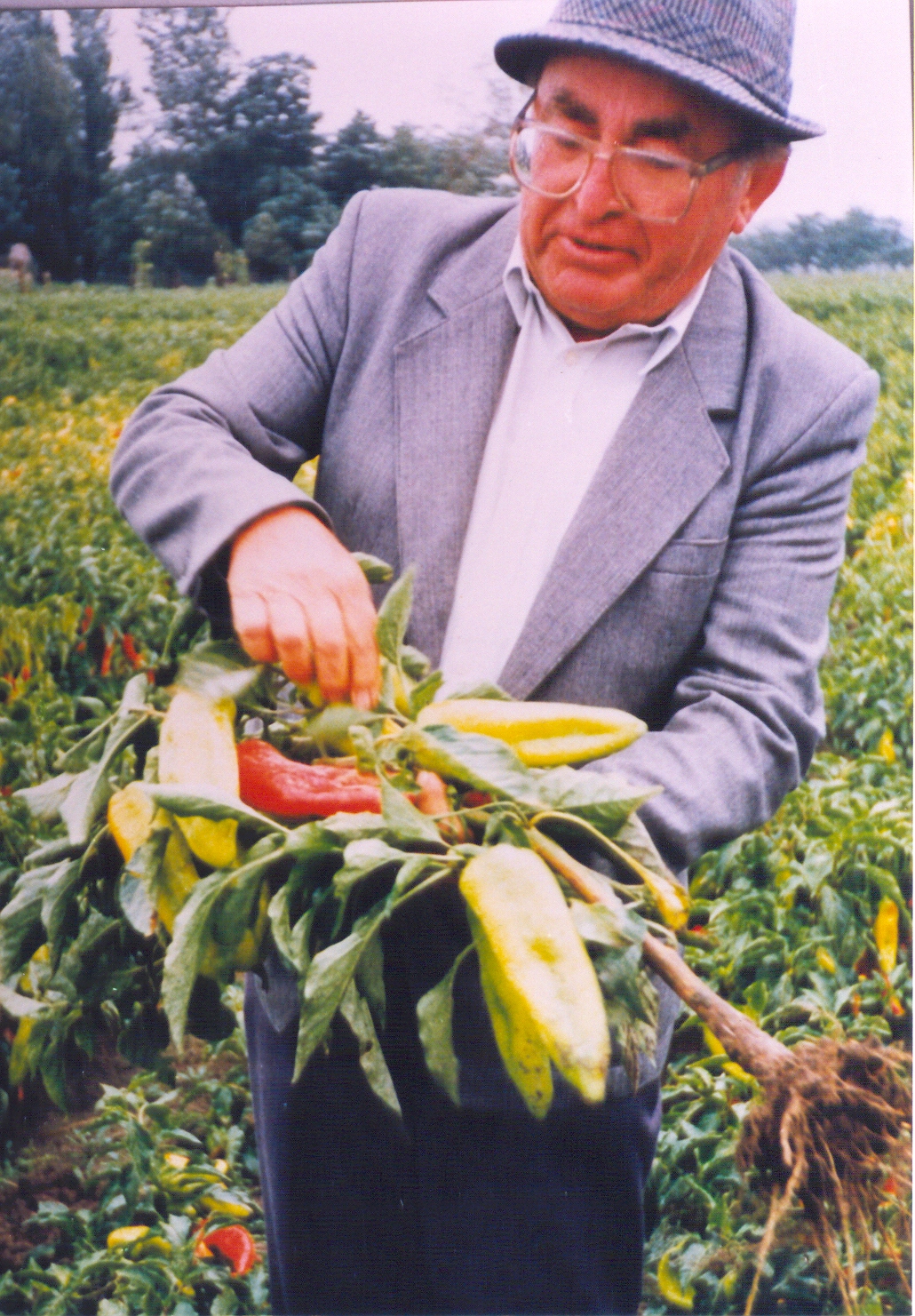
On 10 July 1999, in his 66th year, Dr István Túri, the best-known master and teacher of protected vegetable cultivation, passed away.
He was born on 7 December 1933 in Cegléd. He completed both primary and secondary school in Cegléd, taking his school-leaving examination at the Kossuth Lajos Grammar School in 1952. He graduated from the College of Horticulture and Viticulture in 1957. From 1958, at the College of Horticulture and Viticulture, then at the University of Horticulture, he climbed the mandatory career ladder from research assistant to associate professor. Of his own free will, he requested retirement in 1993, at the age of 60.
From its foundation in 1990, he was research director of PRODUKT Kutató, Fejlesztő, Termelő Kft., and until his death he provided the intellectual leadership of breeding pepper varieties and producing seed of the bred hybrids.
He began his scientific work under the guidance of Professor András Somos. He received his university doctoral degree on the basis of his 1962 dissertation on the survey and analysis of the Nagykőrös vegetable-growing district.
His first research task was to investigate the possibility of vegetable production on poor sandy soils without organic manure. Among the technical questions, his name is linked to the horticultural use of plastics, the development of framework structures for various facilities, the elaboration of heating systems, the creation of various types of ventilation and irrigation methods, the development of several versions of double covering, the design of heated and unheated production units and, last but not least, the curtain-of-water system.
Together with his colleagues he developed the mobile and stationary use of unheated facilities, and the single- and two-phase use of heated facilities; they researched the possibilities of autumn and winter forcing. He also left a lasting mark by introducing new varieties and variety types into production and by implementing new cultivation techniques.
Taking the financial resources available into account, he was certainly the most successful Hungarian pepper breeder to date. Beyond the number (21) of his registered and applied-for varieties and hybrids, their practical value is proof of this. Hungary’s still most popular white pepper for forcing (HRF F1) also testifies to his extraordinary sense for planning individual crosses and selecting parent lines. In addition, among others, the varieties Hó F1, Pritavit F1, Kaméleon F1, Velence F1, Titán F1, as well as the candidate varieties Bajnok F1 and Kápia F1, were bred under his leadership. The breeding base material collected together with his colleagues is also significant and may be the guarantee of the continuation of his life’s work. Under his direction, they developed a specific method of hybrid seed production, also protected by patent, which became the basis of the functioning of the hybrid seed production sector.
It was above all his research on plant habit biology that highlighted Dr István Túri’s versatility. He introduced the concepts of slow, medium and fast growth types, defined the conditions of their development and the possibilities of changing them. At a very early stage he recognised changes occurring in the development of plants. The technological modifications he recommended in such cases were in the vast majority of instances confirmed by subsequent results. As a university lecturer Mr Túri taught students as well as practising horticulturists; his lectures were for the most part highly illustrative, sprinkled with humour and truly fascinating.
The organisation of synchronous advisory services is also linked to his name; already in the late 1960s and early 1970s he held training courses in Soroksár. He organised several exhibitions at the University of Horticulture. The most notable were those combined with conferences on pepper, melon and cucumber production. Since 1981, the seed exchange he envisioned has been held every year to the complete satisfaction of vegetable growers and seed trading companies.
His professional writing activity was characterised by a striving for clarity, and by the description and teaching of practical techniques. He published more than a hundred popular articles, mostly in the journal Kertészet és Szőlészet. His books on plastic-covered production are also popular. Kertészet fólia alatt (co-author: Béla Fodor) was the first agricultural technical book of which more than one hundred thousand copies were sold. He received a quality award for it. He was always proud of this and of the Order of Merit of Labour awarded for his life’s work.
In the last 10–15 years his writings also took on a philosophical tone. This is exemplified by his books Növényalkat (Opportunity and Limit to Increasing Yield) and Az élet korlátai (which summarises the human aspects of habit biology). He also began writing a book venturing into the world of the spirit, the world of the gods. He spoke a great deal about it and would very much have liked to finish it, but was no longer able to do so. When asked about his scientific work and publications, he most often replied: “I do not underestimate the number of books, new varieties, patents, honours and academic degrees, but I do not consider them the most important, so I do not concern myself with such figures. In our profession, among the above and beyond them as well, I consider only that activity important which advances the cause of horticulture.”
In his organisational work he needed perseverance, and at times stubborn tenacity; without it he could not have created the experimental field of the Department of Vegetable Growing. At the Soroksár Experimental Farm, many buildings, structures and plastic-covered facilities still bear witness to his tireless organising work, his constant search for new solutions and his wealth of ideas.
He devoted much attention to his once large number of subordinates. For high-quality work, he regarded several requirements as important: explain, have it written down, ask back, do it, check it. He disliked negligence, indifference and laziness, but acknowledged the will to fight and purposeful, value-creating work. He also appreciated and respected those colleagues and co-workers who recognised something new and supported it even when they had not been the first to notice it.
He often said that if he were to gain possession of an all-powerful magic wand, he would do at least three things: abolish plastic-covered growing facilities for one week, thereby showing the important role they play in the everyday use of vegetables and salads, fruit salads and ornamentals; demonstrate the possibilities in connection with enclosed spaces that we have not yet exploited; and, as he put it, “I would not suspend for a week but forever the disease of saying nothing with artfully crafted ‘clever’ words and sentences”.
Like everyone, he too had his faults and made mistakes. At such times he used to say: “None of us is an angel.” He also overlooked these smaller and greater lapses and errors in his colleagues if he detected no ill will or deliberate intent behind them.
When he retired he held no banquets or celebrations; with a few words he took his leave, and perhaps his last sentence was: “I would still like to serve the cause of horticulture for a long time to come!”
Sadly, this wish of his could not be completely fulfilled. From now on he lives on only in his varieties, his writings and his spirit.
János Gyúrós