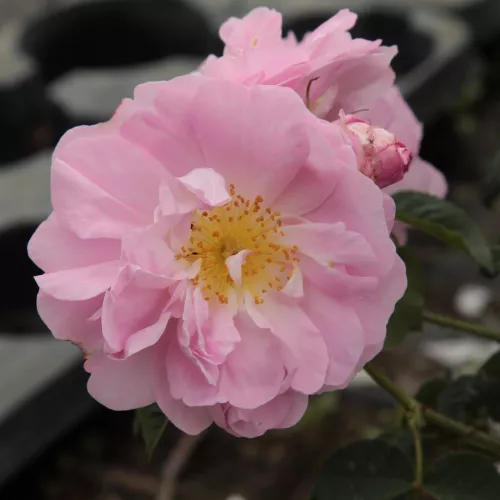
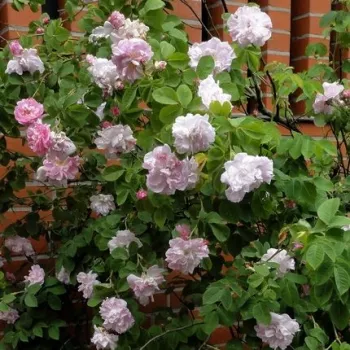
CELSIANA – pink historic Damask rose
Bring a touch of coastal romance to your garden with the historic Celsiana Damask rose – an easy-going shrub that shrugs off wind and copes well with exposed, breezy plots while still rewarding you with generous, early-summer blossom. Its semi-double blooms open wide to welcome bees, then gently self-clean, keeping the plant looking orderly with minimal deadheading. Own-root growth makes this rose reassuringly durable, regenerating from the base if stems are knocked by weather or seaside play, so it suits relaxed, family-friendly borders. In a large 40–50 litre container on a veranda, its graceful, upright habit feels gentle yet substantial, giving light screening and privacy without dominating the space. The very strong, sweet-spicy Damask scent is intensely romantic, evoking tea in a sheltered nook after collecting shells on a Cornish beach, as petals fade from mid-pink to soft, pearlescent pastel tones in the sun. Over time it anchors itself reliably, managing light, well-drained coastal soils and offering a long-lived focal point that becomes quietly timeless as roots establish in year one, shoots strengthen in year two and full ornamental character settles in by the third season.
Usage options
| Target area | Reasoning |
|---|
| Small coastal front garden |
Celsiana’s upright shrub shape and moderate spread give you a graceful focal rose that will not swamp a modest front garden, yet still offers presence and privacy beside a path or driveway for the beginner. |
| Wind-kissed shingle or gravel bed |
Well-suited to exposed, maritime-style planting, this rose tolerates breezy, open situations and copes reliably with blustery weather, providing colour and structure where other shrubs may struggle for the coastal-lover. |
| Large veranda pot (40–50 litres) |
Planted in a substantial container, its upright habit and mid-height stature bring soft screening and scent to a veranda seating area without demanding complex pruning or specialist care for the busy-homeowner. |
| Relaxed, low-maintenance mixed border |
Semi-double, self-cleaning flowers help the shrub maintain a tidy look between light trims, so you enjoy a natural, cottage-style feel with fewer spent blooms to remove for the time-poor. |
| Long-lived family garden feature |
As an own-root historic rose, Celsiana renews from its base rather than from a graft, giving a stable, long-term presence that slowly matures into a characterful garden anchor plant for the family-gardener. |
| Bee- and pollinator-friendly corner |
The open, semi-double blossoms expose pollen-rich stamens that are easy for bees and other pollinators to reach, adding wildlife interest alongside their soft, old-fashioned charm for the nature-lover. |
| Fragrant seating or tea area |
Its very strong, sweet-spicy Damask perfume can be enjoyed from several metres away, ideal beside a bench, tea table or sheltered nook where scent and relaxation matter most for the scent-seeker. |
| Historic-style hedge or boundary line |
Planted at hedge spacing, the upright, moderately thorny framework knits into a romantic, informal barrier that marks boundaries gently while giving seasonal privacy and nostalgia for the traditionalist. |
Styling ideas
- Shellwalk – weave Celsiana through a shingle bed with sea kale and Festuca for a soft, windswept coastal look – perfect for seaside veranda owners.
- Tea-corner – place one rose in a 50 litre pot by a bistro set where its scent drifts over morning coffee – ideal for balcony and veranda users.
- Harbour-hedge – run a loose hedge along a boundary, underplanting with Mexican daisy to spill between stones – suited to cottage-style coastal gardens.
- Pastel-drift – mix with evergreen candytuft and compact sage for year-round structure and pink summer clouds – appealing to low-maintenance border planners.
- Story-garden – use as a specimen framed by weathered timber and gravel to echo historic harbour towns – for lovers of old roses and period charm.
Technical cultivar profile
| Parameter | Data |
|---|
| Name and registration |
Celsiana, a historical Damask rose from the Historic rose collection, known in exhibitions as a Dowager Queen old shrub rose; current trade and ARS exhibition name: Celsiana. |
| Origin and breeding |
Traditional Rosa × damascena selection, origin attributed to Jacques-Martin Cels, introduced circa 1732 in the Netherlands; exact breeder and breeding year remain uncertain or undocumented. |
| Awards and recognition |
Recognised by the American Rose Society with Dowager Queen awards on nine occasions between 2000 and 2001, confirming its exhibition quality among historic shrub roses. |
| Growth and structural characteristics |
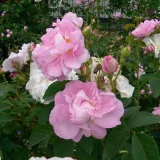
Upright shrub reaching about 135–225 cm in height and 105–175 cm in spread, with moderately dense grey-green, matt foliage and moderate prickliness, forming an informal yet substantial garden presence. |
| Flower morphology |
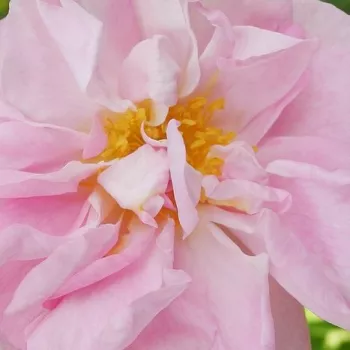
Semi-double, cupped blooms, typically 13–25 petals, medium-sized in clusters; non-remontant, providing one generous main flush of flowers that then self-clean gradually as petals fall away. |
| Colour data and phenology |
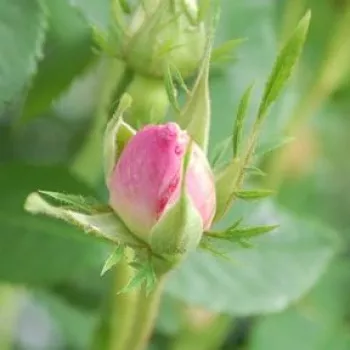
Warm mid-pink flowers with coral hints, ARS MP, RHS 65C outer and 65B inner; buds soft mauve-pink, fading through pastel tones to nearly white in strong sun across the flowering period. |
| Fragrance and aroma |
Very strong, sweet-spicy Damask fragrance, readily noticeable from a distance around seating areas, combining classic rose notes with a rich, perfumed character appreciated in historic gardens. |
| Hip characteristics |
If spent blooms are left, it produces small, spherical, bright red hips, roughly 11–19 mm across, ripening by autumn and adding a modest decorative and seasonal element to the shrub. |
| Resistance and winter hardiness |
Hardy to approximately -32 to -29 °C (RHS H7, USDA 4b, Swedish zone 5); disease resistance is moderate, with similar, manageable susceptibility to black spot, mildew and rust under typical UK conditions. |
| Horticultural recommendations |
Performs best in full sun with well-drained soil; recommended spacings: 140 cm for mass planting, 130 cm for hedging, 220 cm as specimen; watering needed in prolonged drought; maintenance requirement is medium. |
CELSIANA – pink historic Damask rose offers a strongly fragrant, pollinator-friendly shrub that matures into a long-lived feature, and as an own-root plant it regenerates reliably, making it a thoughtful choice for relaxed, enduring gardens.