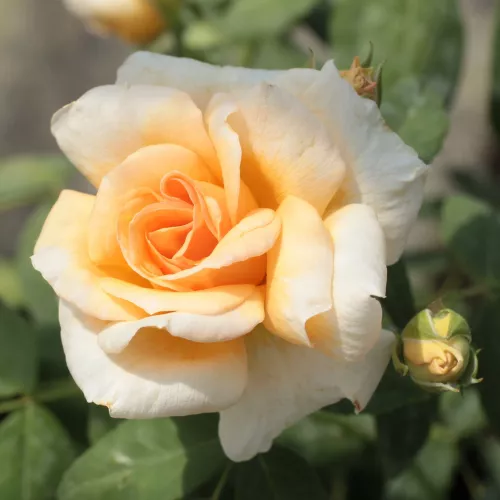
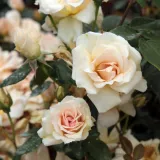
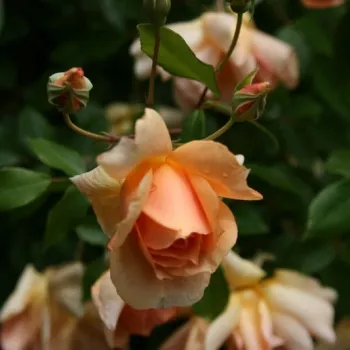
CRÉPUSCULE – apricot historic Noisette rose – Dubreuil
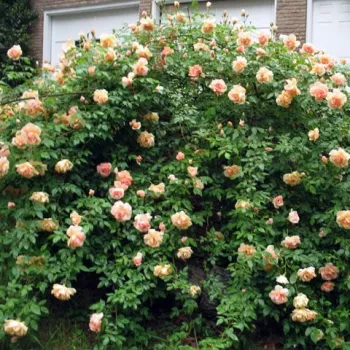
Imagine stepping onto your veranda after a blustery beach walk: the air still salty, the light soft, and the warm, sunset tones of CRÉPUSCULE greeting you in flower along a wall or pergola. This historic Noisette climbs with relaxed grace, covering arches and arbours in medium-sized, semi-double clusters that repeat generously through the season. Its strong, sweet, tea-fruity fragrance carries beautifully on a breeze, while its dark green, slightly glossy foliage adds year-round structure. Bred in France in 1904, it combines romantic character with modern resilience, tolerating exposed coastal air and managing wind and rain where drainage is sensible. As an own-root rose, it develops steadily from roots in year one, shoots in year two and full ornamental value by year three, creating long-lived stability and easy care for busy coastal-style gardeners.
Usage options
| Target area | Reasoning |
|---|
| Coastal veranda in Cornwall or Devon |
CRÉPUSCULE’s climbing habit and flexible canes make it ideal for training along veranda rails or posts, where its warm peach flowers echo sandy coves and evening light. Good tolerance of exposed sea air and wet, windy spells suits coastal homeowners and beginners. |
| Small family garden pergola |
Its moderate vigour and self-cleaning flowers help keep a family pergola neat without constant deadheading, while repeat flushes ensure colour from early summer into autumn. Own-root growth builds a long-lived frame that rewards patient hobby gardeners. |
| Arbour by a seating nook |
The strong, sweet tea-fruity scent is perfect beside a bench where you pause with an afternoon tea after beach walks, as clustered blooms create a softly shaded canopy. The remontant nature means a scented welcome all season for relaxed home owners. |
| Sunny house wall or warm fence |
Its heat tolerance and preference for a warm aspect make south or west-facing walls ideal, where the foliage thickens into a leafy curtain and blossoms glow like a sunset backdrop. Reliable disease resistance keeps maintenance low for time-pressed urban gardeners. |
| Lightly shaded coastal corner |
Partial shade suitability allows planting where buildings cast light shade for part of the day, still giving a generous flowering display. Good disease resistance under cooler, damp conditions reduces spraying worries for environmentally aware coastal gardeners. |
| Large container on sheltered terrace |
Planted in a 40–60 litre container with free-draining compost, CRÉPUSCULE can be trained up a trellis to create a vertical accent, with own-root resilience supporting recovery from any winter dieback. This suits balcony and patio-focused lifestyle owners. |
| Romantic historic-rose border |
Its warm peach tones and semi-double, cup-shaped blooms bring a vintage touch to mixed borders, pairing beautifully with sea kale, Festuca, or lavender for a coastal feel. Long-term structural reliability from own-root growth appeals to heritage-rose enthusiasts. |
| Garden arch or entrance feature |
The climbing habit and medium spread work well over arches marking transitions between garden rooms, where repeat clusters frame paths in soft colour. Its ability to handle blustery British weather is reassuring for family-focused garden owners. |
Styling ideas
- Sunset-arch – Train CRÉPUSCULE over a slim metal arch, underplant with Festuca and sea kale to echo dunes and beaches – ideal for coastal-style lovers seeking a soft, romantic entrance.
- Veranda-screen – Use along a veranda rail with lavender in tubs to create a fragrant, wind-filtering screen – perfect for seaside homeowners wanting privacy without heaviness.
- Tea-corner – Frame a bistro set with an arbour of CRÉPUSCULE and pale gypsophila for a light, “girly” tea spot – suited to beginners wanting easy charm around seating.
- Historic-wall – On a sunny brick wall, combine with Hypericum ‘Hidcote’ and Echinacea for all-season interest – good for hobby gardeners who like low-fuss structure and colour.
- Container-climber – Grow in a 50-litre pot with a slim obelisk, allowing flexible placement on terraces – attractive for urban balcony owners needing movable, easy-care impact.
Technical cultivar profile
| Parameter | Data |
|---|
| Name and registration |
CRÉPUSCULE historic Noisette rose, commercial group Historical rose; unregistered cultivar with American Rose Society exhibition name ‘Crépuscule’, sometimes sold as Dubreuil in specialist collections. |
| Origin and breeding |
Bred by Francis Dubreuil, France, introduced 1904 by the Francis Dubreuil Nursery in Lyon; parentage unknown but classed within the Noisette / Tea Noisette group of old garden roses. |
| Growth and structural characteristics |
Climbing rose with 250–450 cm height and 200–320 cm spread, moderately thorny, relaxed, trainable canes, and moderately dense, slightly glossy dark green foliage suited to arches and walls. |
| Flower morphology |
Semi-double, cup-shaped clusters, typically 13–25 petals, medium flower size about 1.5–2.75 inches, remontant with an abundant second flush, and generally good self-cleaning of spent blooms. |
| Colour data and phenology |
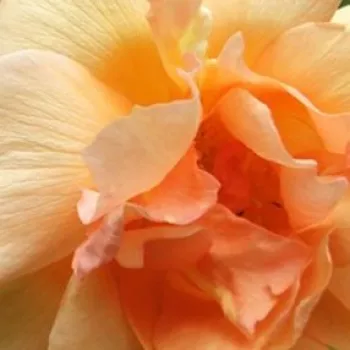
Warm peach blooms with golden undertones; buds deep peachy-copper, opening light peach-yellow with copper veil, then soft peach before lightening in heat or deepening slightly in cooler conditions. |
| Fragrance and aroma |
Strong, well-scented rose with a sweet tea-fruity character; fragrance carries well in still or lightly breezy conditions, particularly effective near seating or paths in sheltered garden corners. |
| Hip characteristics |
Hip set is generally poor; when present, hips are small, spherical, orange-red, around 12–18 mm diameter, adding modest autumn interest but not usually a dominant ornamental feature. |
| Resistance and winter hardiness |
Good overall disease resistance to powdery mildew, black spot and rust; tolerates heat and moderate drought, hardy to approximately −21 to −18 °C (RHS H7, USDA 6b, Swedish zone 3) with normal care. |
| Horticultural recommendations |
Best on warm, well-drained sites for arches, arbours, walls or verandas; suitable for partial shade, low maintenance with occasional pruning, planted about 240–380 cm apart depending on intended use. |
CRÉPUSCULE offers repeat sunset-toned blooms, strong fragrance and reliable disease resistance on an own-root framework that matures steadily over time; consider it if you favour easy, atmospheric structure in a family garden.