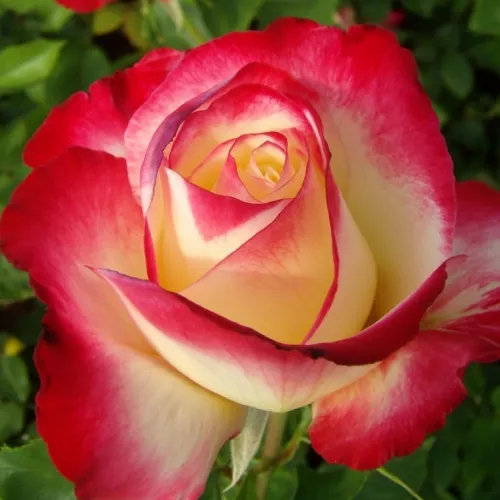
DOUBLE DELIGHT – red-and-white hybrid tea rose
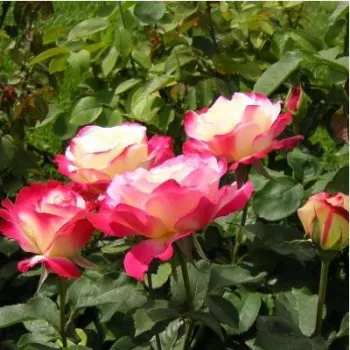
Imagine sitting with afternoon tea on a sunny Cornish veranda, sheltered by the glossy foliage and creamy red blooms of Double Delight, while the breeze carries its fragrance from several metres away. This award-winning hybrid tea gives you classic, high-centred flowers for cutting, yet stays compact and bushy enough for a family garden or spacious container. Bred for strong disease resistance, it keeps its bicoloured petals clean and bright even in damp, coastal weather and steady winds, helping roots to anchor confidently in well-drained soil. As an own-root rose it offers reassuring longevity and the ability to regenerate if cut back hard, so you can plan for a long-lived feature. Plant once in a 40–50 litre pot or open ground, then enjoy a long season of repeat flowering from early summer well into autumn with only light deadheading. Over its first three years it quietly builds roots in year one, stronger shoots in year two and the full ornamental effect by year three, so its visual impact increases naturally as it settles into your coastal-style space.
Usage options
| Target area |
Reasoning |
| Feature rose for a small coastal front garden |
Its compact, bushy habit and strong disease resistance make Double Delight a reliable focal plant near the front door, even where salt‑tinged winds and rain are regular visitors for coastal-style lovers. |
| Statement rose in a large container on a veranda |
Planted in a 40–50 litre container with good drainage, it forms a stable, long-lasting specimen whose own-root growth recovers well from any winter dieback, ideal for time-poor veranda gardeners. |
| Cutting rose for home-arranged bouquets |
The high‑centred, exhibition-style blooms with long stems and slowly fading bicolour make excellent vase flowers and allow regular cutting without weakening the plant for home flower enthusiasts. |
| Perfumed seating corner in a family garden |
Very strong, sweet‑spicy fragrance means just a few plants can perfume a seating nook or tea corner, bringing a sense of indulgence without demanding complex care for fragrance-seeking beginners. |
| Long-season accent in a mixed border |
Reliable repeat flowering keeps colour coming back from early summer to autumn, so gaps between other perennials are filled by fresh blooms through the season for busy family gardeners. |
| Low-intervention rose bed for busy homeowners |
Good resistance to black spot and powdery mildew reduces spraying and fuss, so care is mainly watering in dry spells and simple deadheading after flushes for low-maintenance-focused homeowners. |
| Resilient planting in exposed, rainy sites |
Its robust foliage and strong framework cope well with blustery, wet conditions, helping the plant remain attractive and upright where lesser roses would struggle for weather-conscious coastal owners. |
| Long-term “heirloom” rose in a family plot |
Own-root construction supports a long lifespan and easier regeneration after hard pruning, so the shrub can mature gracefully over many seasons as a lasting feature for sentimental garden planners. |
Styling ideas
- Veranda-bistro – Place Double Delight in a 50 litre clay pot with sea kale and blue fescue at its base for a salty, café-like corner – ideal for coastal veranda owners.
- Cornish-border – Underplant in a mixed bed with Verbena hastata ‘Pink Spires’ and airy grasses to echo cliff-top meadows – perfect for romantic cottage-garden fans.
- Sunset-duo – Pair its red-and-cream blooms with Crocosmia ‘Lucifer’ and pale lavender for fiery yet balanced summer colour – suited to bold-colour enthusiasts.
- Tea-terrace – Flank a small patio bench with two specimen plants in matching tubs to create a fragrant “tea after the beach” setting – good for small-garden relaxers.
- Ribbon-hedge – Plant a loose line at recommended spacing along a path, letting the bicolour flowers guide the way through the garden – appealing to informal-design lovers.
Technical cultivar profile
| Parameter |
Data |
| Name and registration |
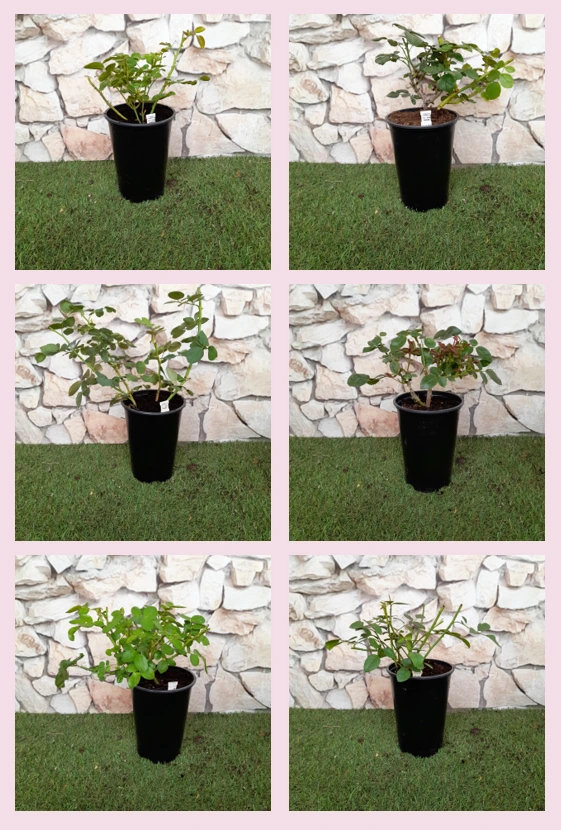
Hybrid tea rose, registered as ANDeli, marketed as Double Delight. Belongs to the hybrid tea group, approved exhibition name Double Delight, supplied as vivianaROSE ORIGINAL 2-litre own-root plant. |
| Origin and breeding |
Bred in the United States in 1976 by Herbert C. Swim with A. E. and A. W. Ellis. Parentage is ‘Granada’ × ‘Garden Party’. Introduced and first distributed by Armstrong Nurseries in 1977. |
| Awards and recognition |
Highly decorated classic rose: Baden-Baden Gold Medal, Rome Gold Medal and Geneva Most Fragrant Rose Award in 1976, AARS winner 1977, and elected World’s Favourite Rose in the Rose Hall of Fame in 1985. |
| Growth and structural characteristics |
Bushy shrub reaching about 110–150 cm high with a 75–105 cm spread. Moderately dense, glossy medium-green foliage and moderate prickliness. Spent blooms tend to persist and benefit from regular deadheading. |
| Flower morphology |
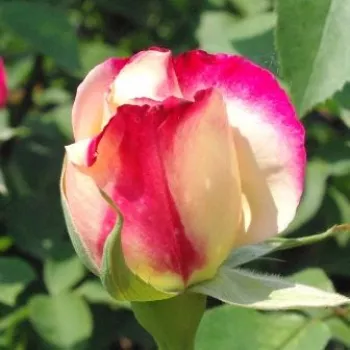
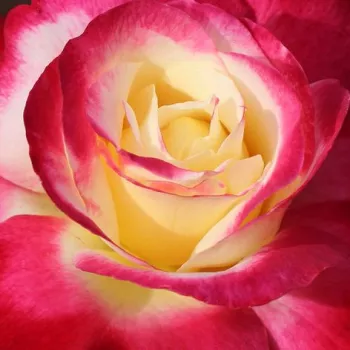
Large, double, high-centred flowers with 26–39 petals, produced mainly singly on stems. Classic pointed buds open to full exhibition-style blooms, repeating well with abundant later flushes in suitable conditions. |
| Colour data and phenology |
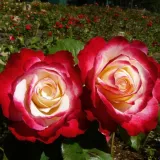
Distinctive cream-white petals edged carmine red, the red band deepening in strong sun. Colours fade only slightly, often to salmon-pink with a gentle warm tint, giving prolonged ornamental value on the plant. |
| Fragrance and aroma |
Rich, very strong sweet-spicy scent, often noticeable at several metres distance. Primarily an ornamental rose with double flowers, so it provides pleasure through perfume rather than pollinator attraction. |
| Hip characteristics |
Hip set is generally low because of the double blooms. Where formed, hips are small, spherical and red, around 10–14 mm in diameter, adding occasional discreet autumn interest without seeding everywhere. |
| Resistance and winter hardiness |
Hardy to around −26 to −23 °C (RHS H7, USDA 5b, Swedish Zone 4). Good resistance to powdery mildew and black spot, moderate rust sensitivity. Needs watering in prolonged drought, otherwise robust in UK gardens. |
| Horticultural recommendations |
Best in fertile, well-drained soil with sun or light shade. Space at 55–100 cm depending on use. Water during dry spells and deadhead to encourage repeats. Own-root plants respond well to rejuvenation pruning when needed. |
DOUBLE DELIGHT – red-and-white hybrid tea rose ANDeli offers award-winning perfume, repeat flowering and reliable disease resistance on a long-lived own-root plant; an excellent choice if you would like one special rose.