EDITH PIAF® GPT – dark red climbing rose – Meilland
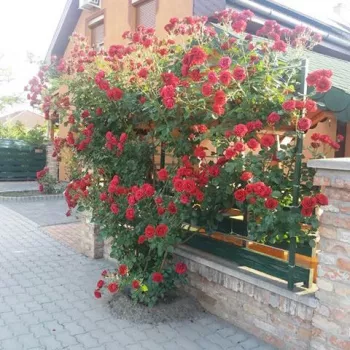
Gathering seashells, rinsing sand from your hands, then sitting down with tea behind a gentle windbreak – this is the atmosphere EDITH PIAF® GPT brings to a coastal veranda or small family garden. Its velvety, dark red, high-centred blooms offer a classic romance, while the strong fragrance with notes of grapefruit and red berries creates a quietly luxurious mood in everyday spaces. As an own-root climber, it is bred for lasting stability, able to regenerate from the base and keep its ornamental value over many years. Once established, its structure gives good anchoring in breezier gardens, and with simple tying-in it will cover arches, railings or a sunny house wall. Plant it where drainage is reliable and routine watering is straightforward, and in most UK family gardens you can expect roots in year one, strong shoots in year two, and full ornamental impact by year three – an easy-care route to long-lived elegance, salty-air refreshment and relaxed coastal-style living.
Usage options
| Target area |
Reasoning |
| Sunny coastal veranda in a large container |
Ideal for a 40–50 litre container on a sheltered veranda, where its strong scent and compact footprint give maximum effect in a small space; tie to a trellis or railing to create a fragrant seating nook for the coastal-style beginner. |
| House wall or sheltered courtyard |
Trained against a warm house wall or courtyard fence, its repeat-flowering habit and long season provide reliable colour where you pass daily, with own-root resilience giving peace of mind for the time-poor homeowner. |
| Family garden pergola or arch |
On a pergola or arch, the strongly scented, very double blooms hang at nose height for everyday enjoyment; the vigorous but manageable growth makes covering a structure straightforward for the casual gardener. |
| Narrow boundary fence in an average-sized garden |
Where ground space is tight, its tall, trained growth habit lifts colour and perfume vertically, keeping the planting strip slim while enhancing privacy for the small-plot family. |
| Low-maintenance feature near a seating area |
Planted near a bench or patio, the strong, fruity perfume and dramatic dark red flowers create a focal point that looks refined with only periodic deadheading, suiting the busy urban resident. |
| Coastal, breezy garden with reliable drainage |
In a shingle or free-draining border, its vigorous framework ties securely to supports, offering a floral screen that copes well once established in wind-exposed spots typical of many coastal plots. |
| Mixed border with Mediterranean companions |
Combined with sea kale, blue fescues or lavender, its velvety red flowers and glossy foliage bring drama and structure, while own-root longevity means the combination matures gracefully for the style-conscious planner. |
| Cut-flower corner for informal bouquets |
Grown where stems can be reached easily, its high-centred, exhibition-type blooms provide richly coloured, scented cuts over a long season, rewarding even light pruning by the hobby florist. |
Styling ideas
- Veranda Screen – Train along a slim trellis in a 50+ litre pot, pairing with sea kale in tubs below to echo a shingle shore – for coastal veranda owners seeking easy privacy and perfume.
- Romantic Arch – Clothe a metal arch with this climber and underplant with lavender and blue Festuca to contrast the dark red blooms – for couples wanting a simple, romantic garden route.
- Cornish Courtyard – Against a suntrap wall, mix with dwarf box and pots of grasses for a tidy, low-fuss look – for busy homeowners who like structure without complex upkeep.
- Family Boundary – Use along a fence with repeating groups of sea kale and coneflowers to soften edges and lift colour vertically – for families turning a narrow side return into a character feature.
- Cutting Nook – Dedicate a sunny corner with sturdy supports, letting long stems develop for vases and evening scent – for hobby gardeners who enjoy bringing their own flowers indoors.
Technical cultivar profile
| Parameter |
Data |
| Name and registration |
Climbing large-flowered rose, registered as MEIramboysar; marketed as Edith Piaf® Gpt PERFUMELLA® MEIramboysar, exhibition name Edith Piaf, Cl., in the climbing rose commercial group. |
| Origin and breeding |
Natural sport of the Hybrid Tea ‘Edith Piaf®’ (MEIramboys), bred by Alain Meilland for Meilland International; introduced by Meilland Richardier in 2016 after selection and trials. |
| Growth and structural characteristics |
Vigorous climbing habit to 200–320 cm high and 150–250 cm spread, with dense, glossy dark green foliage and moderate thorns; flowers borne mainly singly on long, tieable shoots. |
| Flower morphology |
Very double, high-centred, exhibition-type blooms with 40+ petals and XL size; solitary flowers display classic pointed buds opening to full, sculpted cups, with a good second flush. |
| Colour data and phenology |
Deep dark red to velvety ruby, ARS code DR, RHS 187A outer and 186B inner; buds near-black, opening intense ruby, holding rich dark red before fading to dark cherry with slight matt finish. |
| Fragrance and aroma |
Powerful, far-reaching perfume with a full, fruity character; grapefruit zest and red berry notes dominate, creating a classic old-rose style scent suitable for close seating and cutting. |
| Hip characteristics |
Hip set is usually sparse due to very double flowers; occasionally small spherical hips 10–14 mm across develop, bright red (RHS 44A), adding discreet late-season interest when present. |
| Resistance and winter hardiness |
Hardy to approximately −21 to −18 °C (RHS H7, USDA 6b, Swedish zone 3); shows moderate susceptibility to black spot, mildew and rust, benefiting from good air circulation and routine care. |
| Horticultural recommendations |
Best on sunny walls, fences, arches or pergolas; plant 190–350 cm apart depending on use, at about 0.3 plants/m² in schemes; needs tying-in, deadheading and occasional plant protection as required. |
EDITH PIAF® GPT MEIramboysar offers powerful fragrance, romantic dark red blooms and durable own-root growth for long-term structure; consider it if you would like a refined, easy-going climbing feature.