EMERAUDE D'OR – golden-yellow hybrid tea rose - Delbard-Chabert
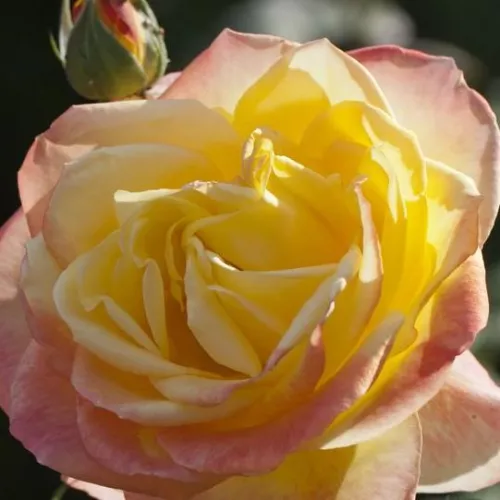
Imagine stepping onto a sunlit coastal veranda after a walk on the beach, sheltered by a living screen of Emeraude d’Or whose upright, very bushy habit forms a natural backdrop against winds and weather while still sitting comfortably in an average family garden. Large, classically shaped blooms in a refined golden-yellow open one by one on sturdy stems that lend themselves both to garden display and cutting for the vase, giving you weeks of colour with a dependable, remontant flowering rhythm. As an own-root rose, it establishes steadily for a long, reliable life, supporting easy care: roots settle in the first season, shoots strengthen and fill out in the second, and by the third year you enjoy its full ornamental value with stable shape and repeat performance. In coastal gardens where good drainage helps the plant anchor and cope with wet, windy spells, this medium-maintenance hybrid tea rewards simple, regular deadheading with clean, tidy borders and an elegant, almost formal presence that still feels relaxed enough for a “girly” shingle garden beside the sea.
Usage options
| Target area |
Reasoning |
| Feature rose in a small coastal front garden |
The upright, very bushy habit gives good vertical presence without overwhelming a typical small Cornish or Devon front plot. Repeated large blooms create a clear focal point against shingle or gravel, especially where good drainage helps anchoring and weather resilience for beginners. |
| Sunny veranda in a large 40–50 litre container |
Its hybrid tea form with long, sturdy stems suits container growing, provided you use at least a 40–50 litre pot for root space and stability. In a sheltered veranda corner it offers elegant, manageable height and easy access for the occasional deadheading needed by busy owners. |
| Mixed coastal-style flowerbed with grasses and perennials |
Golden-yellow, pink-washed blooms mix beautifully with blue thistles and fine grasses, giving a soft, seaside palette. Recurrent flowering means gaps are quickly refilled, while own-root resilience underpins a long-lived structure appreciated by relaxed gardeners. |
| Loose, informal hedge line along a path |
Planted at about 90 cm intervals, the upright, bushy structure forms a semi-formal hedge that still feels light and feminine. Medium maintenance simply means periodic pruning and deadheading, manageable even for those with limited time yet wanting dependable colour. |
| Specimen planting in a lawn or gravel circle |
With a recommended 180 cm spacing as a specimen, it has room to show off its changing colours from golden-yellow to pinkish-red. The moderate height works well as a stand-alone focal point that keeps its shape for years, reassuring more cautious homeowners. |
| Cutting corner for home bouquets |
The solitary, large, cup-shaped blooms on upright stems are ideal for cutting, giving classic hybrid tea flowers for the house. Regular picking doubles as deadheading, supporting repeat flowering while keeping beds neat for aesthetically minded families. |
| Clay-based garden borders with improved drainage |
In many UK family gardens with heavier soils, planting into improved, well-drained pockets allows this variety to root deeply and stabilise. Over time the own-root habit supports recovery from weather or pruning mishaps, suiting long-term planning owners. |
| Sunny, sheltered seating area windbreak |
The rose’s height and dense framework create a light screen around a terrace or tea corner, softening breezes without forming a solid wall. Regular flowering adds changing colour through the season, contributing to a calm retreat valued by coastal-style lovers. |
Styling ideas
- Shingle elegance – Plant three in a loose triangle in gravel with blue globe thistle and fine fescues for a sunlit, coastal feel – ideal for relaxed coastal-style gardeners.
- Veranda trio – Group three large 50 litre containers by a south-facing wall, underplanted with trailing sea kale for movement around the stable rose framework – perfect for busy veranda owners.
- Golden avenue – Line a straight path with evenly spaced plants to form a soft hedge, combining with low lavender to echo the rose’s warm tones – suited to structured yet low-effort family gardens.
- Cutting patch – Dedicate a sunny corner bed with this rose in rows, backed by Japanese euonymus for evergreen structure – good for home florists wanting reliable stems.
- Lawn focal-ring – Place a single plant in a circular gravel mulch in the lawn, with a low collar of dwarf grasses to frame the changing flower colours – appealing to homeowners seeking a simple statement.
Technical cultivar profile
| Parameter |
Data |
| Name and registration |
Hybrid tea rose, registered as DELrop and marketed as Emeraude d'Or; a classic exhibition-type hybrid tea with large blooms suitable for garden display and cutting. |
| Origin and breeding |
Bred by André Delbard-Chabert in France from ‘Sultane’ × ‘Queen Elizabeth’; introduced and registered in 1965 by Pépinières et Roseraies Georges Delbard and partners. |
| Growth and structural characteristics |
Strong, upright and very bushy shrub reaching around 140–180 cm high and 100–140 cm wide, with moderately dense, slightly glossy dark green foliage carrying a subtle bronze tinge. |
| Flower morphology |
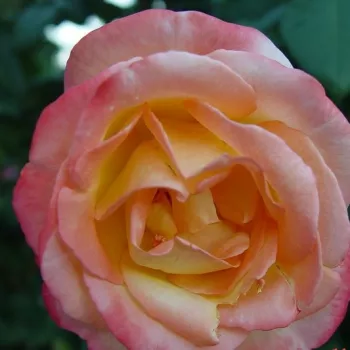
Large, double, cup-shaped hybrid tea flowers with 26–39 petals, borne mostly singly on stems; remontant habit provides generous second and subsequent flushes in suitable conditions. |
| Colour data and phenology |
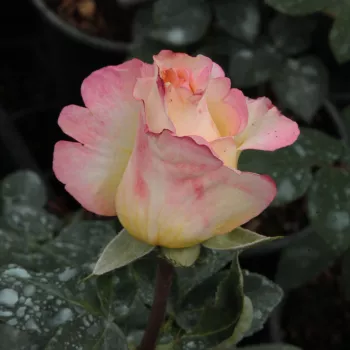
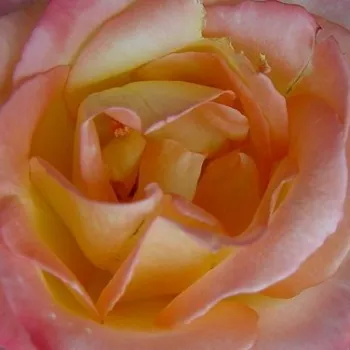
Golden-yellow base with soft pink edging (RHS 14A outer, 45B inner), intensifying to apricot and carmine pink, sometimes crimson, before ageing to lighter, beige-edged tones. |
| Fragrance and aroma |
Very weak, delicate rose-like scent that is barely noticeable in most conditions; chosen primarily for its visual effect and floral form rather than for perfume intensity. |
| Hip characteristics |
Sparse rose-hip production; where pollination succeeds, small spherical hips 14–22 mm form, generally orange-red and unobtrusive, so they rarely dominate the plant’s late-season aspect. |
| Resistance and winter hardiness |
Hardy to around −21 to −18 °C (RHS H7, Swedish zone 3, USDA 6b); disease resistance medium to powdery mildew, black spot and rust, benefiting from basic preventive care. |
| Horticultural recommendations |
Best in a sunny, well-drained site with regular deadheading, especially as spent blooms persist; spacing from 90–180 cm depending on use, with occasional pest and disease checks. |
EMERAUDE D'OR offers tall, bushy structure, repeat flowering and versatile container or border use, while its own-root form supports long-term resilience and recovery; consider it if you want an enduring, elegant hybrid tea presence.