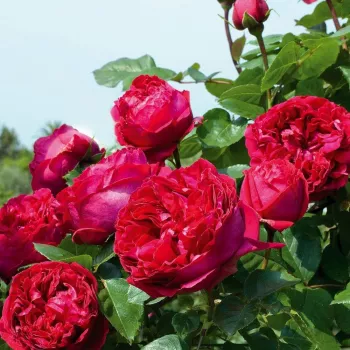
ERIC TABARLY® – dark red climbing rose – Meilland
Wrap your veranda or garden seating in a sense of harbour calm with ERIC TABARLY®, a dark red climbing rose that brings a quietly dramatic backdrop to coastal and inland family gardens alike. Its strong, damask fragrance and deeply velvet petals evoke tea after a windswept walk, while the stable, own-root form builds up steadily for a long garden life. Planted with sound drainage on heavier soils, it copes well with brisk breezes and showery weather typical of British coasts, helping create a sheltered corner where you can unwind. Year by year, you see roots in the first season, more confident shoots in the second, and full ornamental presence by the third, turning a simple pergola or fence into a richly coloured, romantic screen. Large, very full rosettes repeat through summer, rewarding even modest care, while the dense foliage offers welcome privacy and a reassuring sense of permanence for busy gardeners who still want something special.
Usage options
| Target area | Reasoning |
|---|
| Small coastal veranda windbreak |
Trained along a railing or slim trellis, this climber forms a surprisingly effective living screen in compact spaces, combining dense foliage with repeat flowers to soften salt-tolerant, shingle-style layouts; ideal for the coastal-style beginner gardener |
| Pergola over seating area |
Its tall, climbing habit and strong fragrance make it perfect for framing an outdoor seating nook, where repeated flushes of dark red rosettes create a calm, enveloping mood over several seasons; suited to relaxed tea-and-book terrace users homeowners |
| Family garden boundary fence |
Planted at recommended spacing along a fence, it gradually forms a thick, long-lived screen, with own-root resilience supporting decades of structural presence and colour with moderate routine pruning; best for those seeking low-fuss structure planners |
| Feature column by front door |
Trained up an obelisk or column in a 50-litre or larger container, it makes a welcoming focal point near an entrance, combining classic damask scent and velvety blooms with the practical stability of an own-root plant; attractive to style-conscious visitors |
| Romantic “girly” corner with shingle mulch |
Dark red, very full flowers emerge beautifully against pale gravel and sea-themed accessories, while a gradual build-up over three seasons lets you shape a soft, feminine corner without constant replanting; designed for time-pressed garden beginners |
| Clay-soil family garden bed |
With improved drainage and mulching on heavier clay, its strong root system anchors well and supports the tall framework, giving reliable flowering and structure despite British downpours and breezy spells; a sound choice for practical plot-owning families |
| Cutting patch near the house |
Large, cluster-borne blooms with strong fragrance lend themselves to home arrangements, and the remontant habit offers stems across the summer without the need for specialist care; ideal for informal bouquet-making enthusiasts |
| Cottage-style façade planting |
Trained flat against a house wall or garage, it provides a long-lived, vertical curtain of colour and scent, combining medium maintenance needs with reliable hardiness through typical UK winters; well suited to relaxed, traditional façade-loving owners |
Styling ideas
- Harbour-Veranda Screen – run ERIC TABARLY® along a slim trellis on a coastal veranda with shingle mulch and a few pots of sea kale for a breezy, sheltered corner – for coastal balcony and veranda users
- Tea-Arbour Retreat – clothe a wooden pergola with this climber, underplanting with Festuca and pale pink Lavandula to contrast its dark blooms – for those wanting a scented reading or tea nook
- Romantic Façade – train it beside windows with white woodwork, pairing with climbing hydrangea for contrasting texture and season-long structure – for lovers of classic cottage-style fronts
- Column of Velvet – plant into a 50–70 litre container with good drainage and spiral it around an obelisk to create a vertical accent on patios – for small-garden owners seeking height without hard landscaping
- Shingle Rose Corner – set against pale gravel, with low mounds of silvery foliage and a vintage bench beneath, to express a “girly” yet grown-up seaside look – for design-conscious but busy hobby gardeners
Technical cultivar profile
| Parameter | Data |
|---|
| Name and registration |
ERIC TABARLY® Romantica® climber, registered as MEIdrason; large-flowered climbing rose with ARS exhibition name Eric Tabarly, in the Romantica® collection for garden and show use. |
| Origin and breeding |
Bred by Alain Meilland (Meilland International SA), France, from ‘Cappa Magna’ × ‘Ulmer Münster’; bred 2002, European protection 2002, US plant patent 2004, introduced commercially after 2004. |
| Awards and recognition |
Los Angeles Rose Society Show Climber Award (2005), recognising exhibition-quality blooms and performance as a large-flowered climbing rose suitable for show benches and enthusiast collections. |
| Growth and structural characteristics |
Vigorous climbing habit, around 300–500 cm high and 200–300 cm spread; dense mid-green, slightly glossy foliage on well-armed canes, forming a substantial, long-term vertical framework when supported. |
| Flower morphology |
Very full, rosette-shaped blooms with 40+ petals, XL size from about 3.5 inches; cluster-flowering with good remontancy, giving a plentiful second flush and suitable stems for cutting and exhibition. |
| Colour data and phenology |
Deep, velvety dark red flowers (RHS 53A–53B) with crimson tones; buds burgundy with sheen, darkening to muted deep burgundy, outer petals slightly blackened, with only slight fading in strong sun. |
| Fragrance and aroma |
Strong, long-lasting classic damask fragrance, most noticeable around seating height when trained on pergolas or along fences; very double form encloses stamens, making it mainly an ornamental rather than pollinator rose. |
| Hip characteristics |
Occasional spherical hips, roughly 12–18 mm diameter, red (RHS N45A), produced sporadically after flowering; primarily ornamental interest, with hip set varying by season and deadheading practice. |
| Resistance and winter hardiness |
Medium disease resistance to powdery mildew, black spot and rust, benefitting from good airflow; hardy to about –23 to –21 °C (RHS H7, USDA 6a), tolerating UK winters and heat with regular watering in dry spells. |
| Horticultural recommendations |
Best on supports such as pergolas, fences or façades, in sun or light partial shade; space 145–270 cm depending on use, improve drainage on clay, use 50+ litre containers, and deadhead to maintain appearance. |
ERIC TABARLY® offers velvety dark red, strongly scented blooms on a tall, structural climber whose own-root vigour supports long-term reliability and easy shaping, making it a thoughtful choice if you want lasting romance with manageable care.