ERNYE – pink bedding floribunda rose - Márk
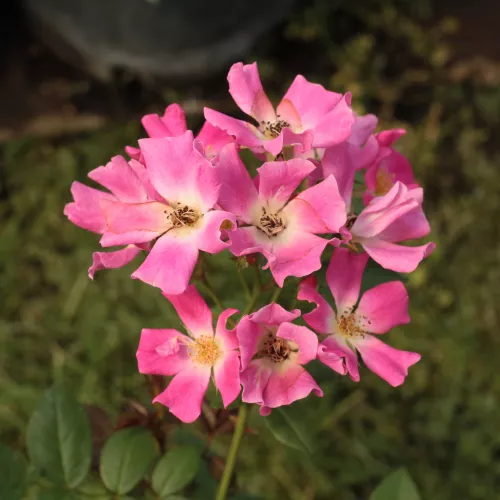
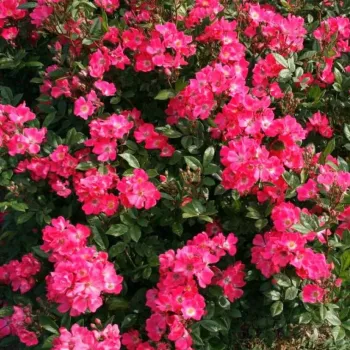
Imagine a sunny coastal afternoon, sea breeze on your face and a sheltered corner of your garden glowing with uncomplicated pink blooms: ERNYE is bred for exactly this kind of easy, relaxed enjoyment. Its low, spreading habit suits shingle beds, small borders and larger containers, where its remontant flowering keeps colour returning throughout the season. Own-root growth offers reassuring longevity, giving a stable plant that rides out winters and can regenerate after tougher years with little fuss. In typical British family gardens, especially in breezier regions, ERNYE copes confidently, its roots anchoring well and helping it stay put in blustery coastal weather. Once planted in reasonably drained soil and a sunny, lightly sheltered spot, there is very little you must do apart from occasional pruning and basic plant protection. Year by year, expect a steady development from strong roots in the first season, more generous shoots in the second, and by the third year a settled, full display that becomes part of the permanent garden structure. Its compact size works beautifully near seating areas or verandas, where the fine-textured cluster blooms give a feeling of lightness and freshness rather than heaviness, echoing the relaxed mood of tea after collecting seashells and bringing a quietly uplifting, girly accent to your outdoor space.
Usage options
| Target area | Reasoning |
|---|
| Coastal veranda containers (40–50 litre+ planters) |
ERNYE’s compact, spreading habit and good heat tolerance make it ideal for larger coastal containers that do not dry out too quickly. A single plant in a 40–50 litre pot anchors the display without overwhelming the space, giving long-season colour for relaxed seaside-style seating areas, especially appreciated by the beginner. |
| Small family front gardens and drive edges |
Its modest height and tidy spread fit effortlessly into narrow beds along drives or in compact front gardens, providing cheerful pink clusters that are easy to keep in scale with paths and windows. The own-root form settles gradually into the soil, supporting a dependable structure that improves with age for the time-pressed homeowner. |
| Informal “girly” shingle or gravel beds |
The clear pink, single blooms sit lightly above gravel or shingle, softening the hard surface with a playful, feminine accent without looking fussy. Combine with coastal-tolerant grasses and silvery foliage for a breezy, seaside feel that remains simple to look after, even for the busy. |
| Mixed borders with perennials |
ERNYE repeats well through the season, threading its pink colour between flowering waves of perennials such as Rudbeckia or lamb’s ear, while its medium foliage density leaves room for companions. This continuity of flower helps a border feel “alive” for longer, rewarding the patient gardener. |
| Low bedding and massed planting schemes |
Planted in groups at the recommended spacing, ERNYE forms a unified low carpet of colour that reads clearly from a distance yet remains easy to maintain. The own-root habit supports a durable, long-lived planting, well suited to family gardens that need reliable structure for the practical planner. |
| Pollinator-friendly family play areas |
The open, single flowers offer exposed stamens and readily accessible pollen, inviting bees while remaining thorny enough to discourage trampling through beds. This makes ERNYE a good choice near lawns or play areas where wildlife interest is welcome but maintenance must stay simple for the nature-loving family. |
| Sunny seating nooks and tea corners |
Place ERNYE close to a bench or small patio to enjoy its bright, unscented flowers at eye level without overwhelming confined spaces. With own-root resilience and a predictable growth pattern, it quietly matures into a friendly, long-term companion for everyday outdoor moments, suiting the reflective observer. |
| Wind-exposed but reasonably drained coastal beds |
In open, breezy gardens, ERNYE’s spreading habit and good root anchorage let it handle gusty days as long as the soil is not waterlogged and drains reliably after heavy rain, echoing a naturally robust coastal planting feel for the practically minded coastal-gardener. |
Styling ideas
- Shingle-Chic – Set ERNYE in a gravel bed with sea kale and blue Festuca to echo a Cornish beach palette – for coastal-style lovers wanting relaxed, low-fuss charm.
- VerandaGlow – Plant one rose per 45–60 litre pot, underplanted with trailing thyme, to frame a sheltered veranda seating area – for homeowners making the most of small outdoor spaces.
- PinkRibbon – Line a front path with evenly spaced ERNYE for a soft “girly” pink border that stays neat without clipping – for beginners seeking an easy, welcoming entrance.
- PrairieEdge – Mix ERNYE with Rudbeckia and airy grasses for a long-season, naturalistic edge that blends cottage and coastal moods – for hobby gardeners who like informal structure.
- PollinatorPatch – Group ERNYE with lamb’s ear and a small clematis obelisk to create a bee-friendly focal point visible from the kitchen – for families encouraging children to watch garden wildlife.
Technical cultivar profile
| Parameter | Data |
|---|
| Name and registration |
ERNYE is a bedding floribunda shrub rose from the Bed rose commercial group; current trade name “Ernye Bedding rose Márk”, with a male forename as its cultivar name meaning. |
| Origin and breeding |
Bred in Hungary in 1988 by Márk Gergely, from the cross ‘Zsófi’ × ‘Minililla’; introduced to the market by PharmaRosa® Ltd., with detailed registration year data not available. |
| Growth and structural characteristics |
Low, spreading habit, typically 40–50 cm high and 50–70 cm wide, with moderately dense, medium-green, slightly glossy foliage and a moderately thorny framework suitable for bedding and small borders. |
| Flower morphology |
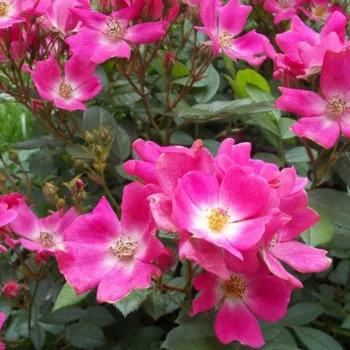
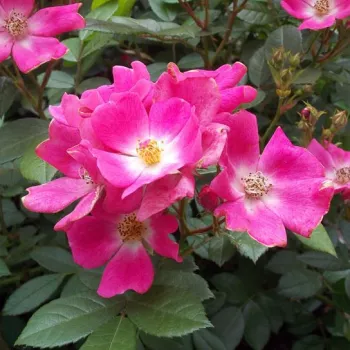
Single, cup-shaped to flat-opening flowers, 0.5–1.5 inches in size, borne in large clusters, with approximately 5–12 petals and a remontant habit providing a notably abundant second flush. |
| Colour data and phenology |
Pure, warm pink blooms (RHS 68B–68C) that gradually fade to pastel from the centre outwards; colour retention is moderate, with a bright base tone softening gently as the flowers age. |
| Fragrance and aroma |
The variety is considered unscented, with no noticeable fragrance reported, but its open single blooms offer easily accessible pollen and are generally regarded as attractive to bees and other pollinating insects. |
| Hip characteristics |
Produces moderate numbers of small, spherical orange-red hips, typically around 5–8 mm in diameter, adding a subtle seasonal interest in late season without dominating the plant’s overall appearance. |
| Resistance and winter hardiness |
Hardy to around −21 to −18 °C (RHS H7, Swedish Zone 3, USDA 6b), with good tolerance of heat and drier spells; disease resistance is moderate to powdery mildew, black spot and rust. |
| Horticultural recommendations |
Best in sunny sites with reasonably drained soil; suitable for beds, borders, containers and specimens, spaced 35–65 cm apart; maintenance is medium, with occasional plant protection and routine pruning recommended. |
ERNYE offers compact coastal-suited growth, season-long pink colour and own-root longevity for an enduring, low-fuss presence in family gardens, making it a thoughtful choice when planning your next planting.