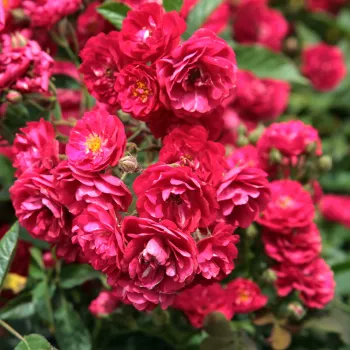
FAIRY DANCE – red groundcover rose - Harkness
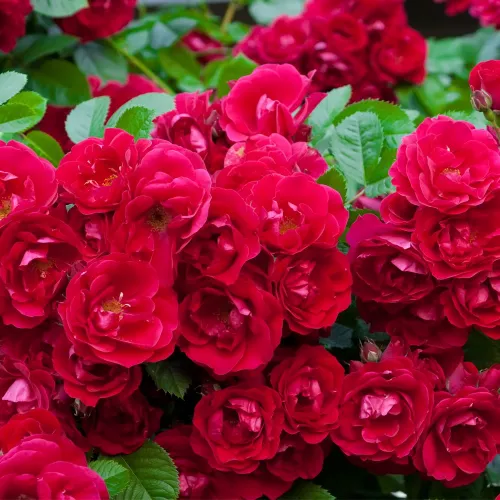
Imagine stepping onto your coastal veranda to a low wave of colour, a neat red foam of blooms that shrugs off wind and showers, creating a cheerful foil to shingle, pebbles and sea-kissed paving. FAIRY DANCE spreads modestly, giving reliable cover without smothering the rest of your planting, and its semi‑double clusters keep returning through the season with minimal effort. As an own‑root plant it builds a long‑lived, stable framework that quietly regenerates, so you can plan for years of dependable structure rather than short‑term bedding. In a deep 40–50 litre container or well‑drained bed it anchors itself securely and makes water management simpler, fitting naturally into small family gardens where space and time are both precious. Over the first three years roots, then shoots, then full ornamental value develop at a gentle, reassuring pace.
Usage options
| Target area | Reasoning |
|---|
| Low-maintenance coastal front garden |
Its spreading habit forms a neat, low red carpet that copes well with breezy, exposed drives and shingle, needing only occasional trimming to keep pathways clear and presentable for beginners. |
| Family garden groundcover bed |
Compact height and good self-cleaning mean spent flowers drop away without deadheading, so borders stay bright and tidy around play areas and lawns with minimal intervention for busy homeowners. |
| Large container on veranda or balcony |
In a 40–50 litre pot it creates a dense, flowering mound that anchors well in the wind, avoiding top‑heavy tipping and providing long-season colour close to seating for coastal veranda owners. |
| Small urban front garden or town house |
The modest spread suits narrow beds along paths or under windows, offering a structured, all‑season presence without overgrowing neighbouring plants or needing complex pruning for urban gardeners. |
| Mixed coastal border with grasses and perennials |
Its long flowering season and muted raspberry-red tones pair beautifully with sea kale, Festuca and lavender, giving an easy, seaside feel that softens hard landscaping for coastal-style lovers. |
| Clay soil beds with improved drainage |
Once established it knits the soil surface into a stable, shallow shrub layer that helps manage splash, runoff and exposure in typical UK clay, especially where regular rain and wind meet shingle for practical gardeners. |
| Low flowering hedge or edging strip |
Planted at hedge spacing it forms a continuous low ribbon of red, clearly defining boundaries and paths while remaining easy to clip lightly once or twice a year for easy-care seekers. |
| Long-term planting schemes and park-style corners |
The own-root habit supports slow, steady development into a durable, replace-from-within clump that copes with routine trimming and occasional hard renovation, suiting plans over many years for long-term planners. |
Styling ideas
- Shingle-ribbon – Thread FAIRY DANCE along a gravel path with sea kale and low Festuca, echoing Cornish beaches – ideal for coastal-style lovers seeking a relaxed, seaside feel.
- Veranda-breeze – One or two large containers flanking a bench, underplanted with trailing thyme for scent – perfect for balcony and veranda owners wanting impact in small spaces.
- Playful-edge – Use as a soft, low edging around a family lawn, mixing with catmint to attract bees without thorny height – suited to families prioritising child-friendly planting.
- Clay-tamer – In improved heavy soil, run a band of FAIRY DANCE across a slope above a patio, underplanted with spring bulbs – good for gardeners tackling awkward, wet corners.
- Town-front – Combine with dwarf deutzia and compact lavender in a tight front garden bed, giving structure and colour from street to doorstep – made for busy urban homeowners.
Technical cultivar profile
| Parameter | Data |
|---|
| Name and registration |
Polyantha groundcover rose, registered as HARward, marketed as FAIRY DANCE – red groundcover rose - Harkness; exhibition category shrub rose within the Groundcover collection. |
| Origin and breeding |
Bred by Jack E. Harkness in the United Kingdom in 1979, with unknown parentage; introduced by R. Harkness & Co. Ltd. from 1981 as a reliable, spreading groundcover type. |
| Growth and structural characteristics |
Low, spreading shrub 35–50 cm high and 40–60 cm wide, moderately thorny, with mid‑green, glossy foliage of medium density and a naturally carpeting, ground-hugging habit. |
| Flower morphology |
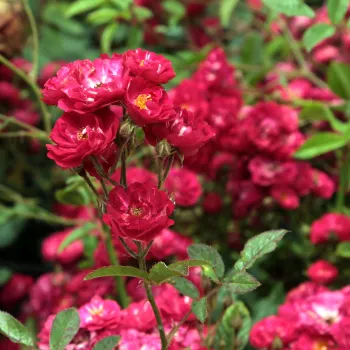
Small S-sized, cup-shaped clusters of semi-double blooms with 13–25 petals, flowering in generous trusses and remontant with a notably abundant second flush in suitable conditions. |
| Colour data and phenology |
Pure, mid-red flowers, ruby in bud, ageing to a softer pinkish tone in strong sun; outer petals slightly paler, giving a lively, textured effect over a long flowering season. |
| Fragrance and aroma |
Very lightly scented with a delicately fruity character; fragrance is barely noticeable in the garden but contributes a gentle, unobtrusive note at close quarters. |
| Hip characteristics |
Produces small, globular hips 5–7 mm across, red RHS 46A, generally in modest quantities due to good self-cleaning, so ornamental impact remains focused on the flowers. |
| Resistance and winter hardiness |
Hardy to about −32 to −29 °C (RHS H7, Swedish zone 5, USDA 4b); medium resistance to black spot, powdery mildew and rust, benefits from occasional monitoring and basic care. |
| Horticultural recommendations |
Suited to beds, edging, containers and mass groundcover; plant 35–70 cm apart, 6.3–7.2 plants/m² for carpets; prefers regular watering in dry spells and partial shade tolerance aids siting. |
FAIRY DANCE offers compact, wind-tolerant groundcover, long seasonal colour and a durable own-root habit, making it a thoughtful choice for relaxed coastal and family gardens you wish to enjoy for many years.