FIREBIRD ® – yellow-red bedding floribunda rose - Kordes
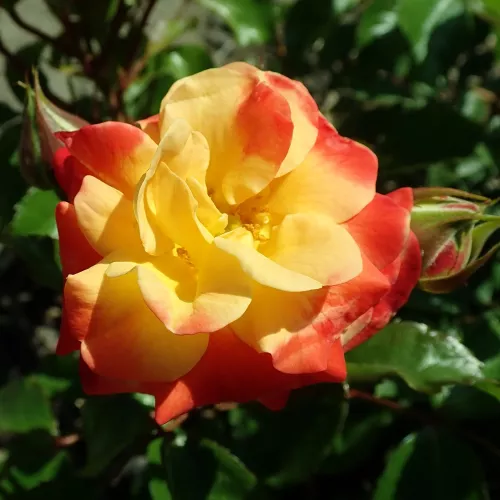
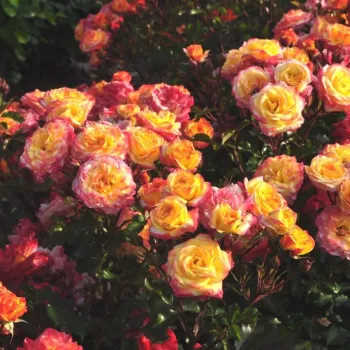
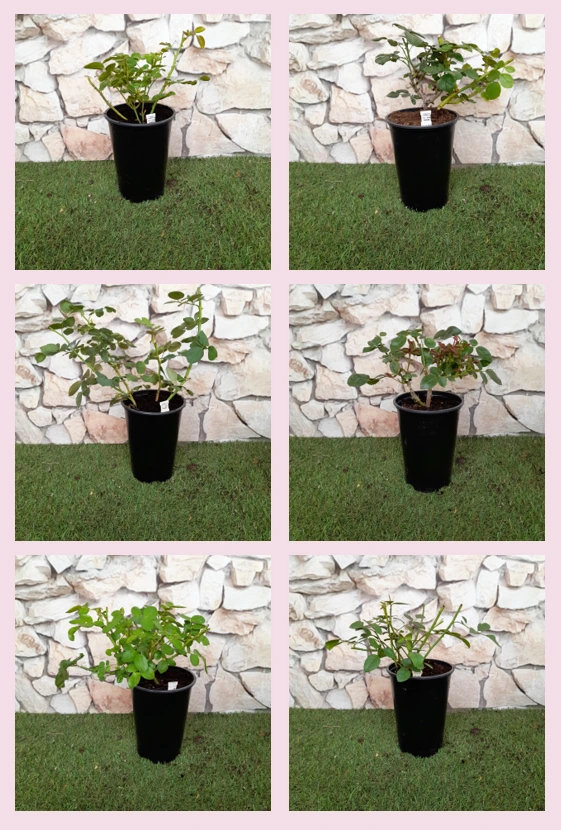
Imagine stepping onto your veranda after a windy walk along the shore, sheltered from sea breezes by a low rose hedge whose blooms glow like embers in the late sun. FIREBIRD brings that feeling home with its compact, upright habit that suits small family gardens and coastal patios where anchoring roots matter on exposed sites. Its floribunda clusters evolve from golden-yellow and scarlet into deep crimson, a lively, flame-like display that keeps borders interesting from early summer well into autumn. As an own-root plant, FIREBIRD develops quietly and steadily, giving you reassuring longevity instead of short-lived show: in the first year it concentrates on roots, in the second on stronger shoots, and by the third it reaches full ornamental impact. This structure makes it easier to maintain over decades, recovering well from pruning and coastal weather. Medium overall care with robust disease resistance means basic watering and feeding are usually enough, especially if you improve drainage in heavy clay and avoid waterlogging. Its moderate height fits seamlessly into mixed flowerbeds or larger containers of 40–50 litres on a sheltered balcony, providing reliable, low-upkeep colour. In mass plantings, the dense, glossy foliage knits together to form bright, informal edging along paths or shingle drives, while the relatively low fragrance keeps the effect fresh and never overwhelming. Choose FIREBIRD if you value steady, uncomplicated performance and a garden that feels sunny, salty and relaxed without demanding constant attention.
Usage options
| Target area |
Reasoning |
| Coastal shingle or salt-tolerant front garden bed |
The compact, upright growth and strong root system help FIREBIRD stand firm in breezy, exposed spots, making it well suited to small coastal front gardens that still need structure in blustery weather; ideal for coastal-style lovers. |
| Low, colourful flowering hedge along a path or driveway |
Planted at 35–40 cm spacing, the dense foliage and branching habit knit into an informal hedge that gives a long ribbon of colour from early summer onwards with only routine trimming; an easy win for busy homeowners. |
| Mixed family flowerbed in heavy clay soil |
FIREBIRD’s moderate height and fibrous own-root system settle well where drainage has been improved, creating a stable, long-term feature that copes with typical UK clay when you avoid waterlogging; reassuring for beginner gardeners. |
| Large patio container (40–50 litres) on a sheltered veranda |
Its manageable size, repeat flowering and upright habit make it ideal for a single large pot, bringing vivid colour to a sheltered terrace or balcony with simple watering and feeding routines; a strong option for urban balcony owners. |
| Season-long colour accent near seating areas |
The remontant flowering provides repeated flushes, so once established you enjoy reliable waves of bright blooms through the main season with minimal deadheading, keeping seating areas cheerful with little effort for time-pressed families. |
| Long-term planting in small to medium family gardens |
As an own-root rose, FIREBIRD builds strength year after year, regenerating well after pruning and offering stable ornamental value over the long term rather than quickly declining, which particularly supports long-view planners. |
| Formal or semi-formal bedding schemes |
The even height, upright form and regular clusters of medium-sized flowers suit repeated, geometric layouts that stay tidy with straightforward annual pruning, giving classic structure without complex care for design-conscious owners. |
| Warm-toned combinations with grasses and low perennials |
The fiery yellow-red blooms pair beautifully with ornamental grasses and compact groundcovers, creating a modern, textural effect that looks considered yet is easy to maintain once established, especially appealing to weekend gardeners. |
Styling ideas
- Seaside-border – combine FIREBIRD with sea kale and blue Festuca in a free-draining shingle strip to echo coastal colours while benefiting from the rose’s compact, anchoring habit – ideal for coastal-style lovers.
- Patio-focus – plant a single FIREBIRD in a 50-litre terracotta pot with low Saxifraga spilling at the base for a neat, upright focal point that flowers repeatedly – perfect for balcony and veranda owners.
- Family-ribbon – run a low line of FIREBIRD along a front path, underplanting with dwarf fountain grass for movement and texture, creating an easy-care, colourful welcome – suited to busy family households.
- Sunset-bed – mix FIREBIRD with warm-toned perennials and evergreen honeysuckle groundcover, using its steady repeat bloom to tie the palette together – good for small-garden enthusiasts wanting impact.
- Formal-patch – set FIREBIRD in a simple grid within a rectangular bed, letting its uniform height and foliage build a structured look with seasonal colour shifts – appealing to design-conscious beginners.
Technical cultivar profile
| Trait |
Data |
| Name and registration |
Floribunda bedding rose from the Fantasia collection, registered as KORtragoso and marketed as FIREBIRD, with Firebird accepted for exhibition; premium bronze quality, authenticity verified for vivianarose.co.uk. |
| Origin and breeding |
Bred in Germany by Tim-Hermann Kordes from unnamed Rosa hybrida lines; introduced 2015 by W. Kordes’ Söhne and later by Star Roses & Plants in the USA, protected under EU CPVO and US plant patent. |
| Awards and recognition |
Audience Prize at Le Roeulx, Belgium, in 2014, together with further awards in international rose competitions, indicating strong public appeal and solid garden performance across varied European conditions. |
| Growth and structural characteristics |
Compact, upright bush 60–80 cm tall and 45–65 cm wide, with dense, glossy dark green foliage and moderate prickles; forms a neat, rounded shrub ideal for bedding, edging and low hedging in smaller gardens. |
| Flower morphology |
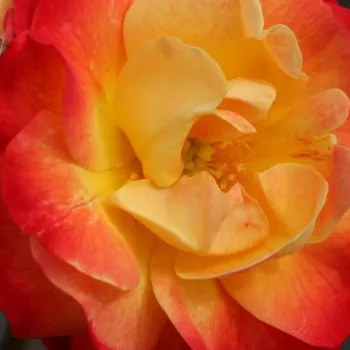
Double, cupped floribunda clusters bearing medium-sized blooms with 26–39 petals; remontant habit gives a generous second flush, with several flowers per stem for strong colour presence in beds and containers. |
| Colour data and phenology |
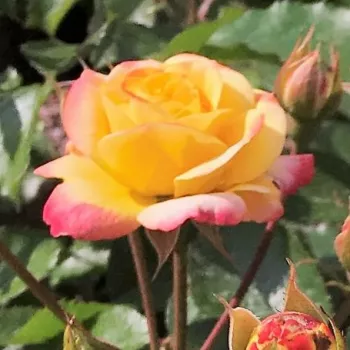
Yellow-red bicolour with golden-yellow bases and scarlet outer zones (RHS 43B, 13C); buds scarlet with yellow flush, maturing through orange-red to crimson, showing colour shift rather than fade in strong sun. |
| Fragrance and aroma |
Very weak, barely perceptible scent with a light fruity tone; primarily grown for visual impact rather than perfume, making it suitable where strong fragrance is not desired or may conflict with nearby seating. |
| Hip characteristics |
Rosehip production is generally low due to the double flowers; occasional small spherical hips, about 6–10 mm wide, may form in orange-red tones (RHS 34A), adding discreet seasonal interest in late season. |
| Resistance and winter hardiness |
Hardy in USDA zone 5b, RHS H7 and Swedish zone 4, tolerating approximately −26 to −23 °C; shows good resistance to powdery mildew and black spot, with medium susceptibility noted for rust in some seasons. |
| Horticultural recommendations |
Best in full sun and fertile, well-drained soil; plant 35–40 cm apart for hedges or beds, at 6.3–7.2 plants per m² for massing; medium maintenance with occasional plant protection and regular feeding advised. |
FIREBIRD ® offers compact, upright growth, vivid season-long colour and reliable disease resistance in a long-lived own-root form that rewards patient gardeners with steadily increasing impact, making it a thoughtful choice for relaxed coastal or family gardens.