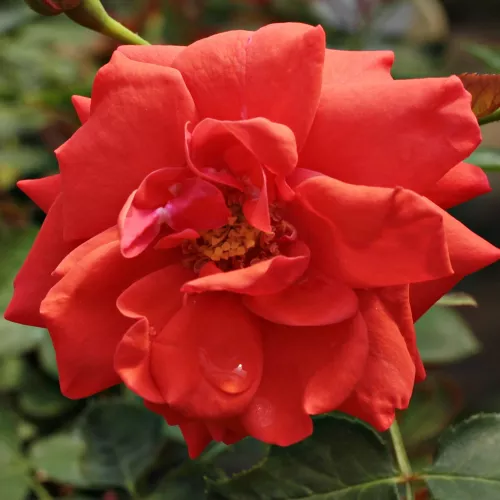
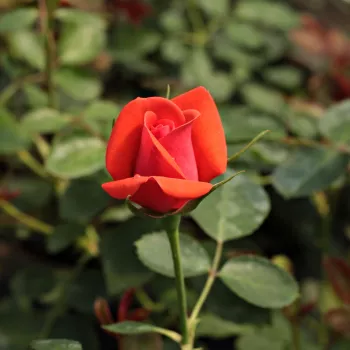
FLIRTING™ – red bedding shrub rose
Imagine a sunlit veranda above a pebbly Cornish cove, where a low cushion of FLIRTING™ roses spills over pots and borders in easy, carefree colour. This compact floribunda brings refreshment to small family gardens, thriving in breezy, open sites with roots that anchor firmly and manage moisture well even after coastal weather. Its cushion habit stays neat beside paths and patios, while the cluster blooms shift from coral-red to soft peach, giving a playful flirting effect for months on end. Own-root plants offer reassuring longevity, quietly rebuilding from the base if stems are damaged, so you can enjoy steady colour with only modest care. Ideal where space is limited yet you still want a reliable, season-long display, this rose settles in step by step – first strengthening its roots, then building shoot growth, and by the third year revealing its full ornamental potential along your coastal-style terrace.
Usage options
| Target area | Reasoning |
|---|
| Small coastal front gardens |
The naturally low, spreading habit forms a compact cushion that sits neatly behind shingle or low edging, giving structure without blocking windows or sea views; ideal for those wanting tidy form with playful colour, especially beginners. |
| Wind-exposed beds near the house |
The broad, well-rooted framework stays stable in blustery conditions, coping well where other shrubs rock in the wind, so beds by driveways or corners of the house keep their shape and flower cover, reassuring for busy homeowners. |
| Long-season colour in small borders |
Repeat-flowering clusters keep sending up waves of blooms from early summer into autumn, so even a short border feels lively for months with minimal intervention between flushes, attractive to time-poor gardeners. |
| Coastal-style verandas in large containers |
Its compact root system adapts well to generous pots of 40–50 litres or more, making it easy to enjoy on verandas and terraces where space is tight yet you still want a reliable flowering focal point, perfect for balcony owners. |
| Informal mixed beds with perennials |
The warm coral-red to peach tones blend smoothly with ornamental grasses and coastal perennials, allowing you to create relaxed seaside combinations that look considered but not fussy, inspiring for design-conscious gardeners. |
| Family play gardens with paths and seating |
The modest height lets you line paths or frame a seating nook without thorny stems reaching face level, keeping movement safe and views open while still giving a vivid flower presence, appreciated by families with children. |
| Low-maintenance shrub beds |
Once established, own-root plants build a durable base that reshoots reliably after pruning or weather damage, helping beds stay full and attractive over many years with straightforward seasonal care, valued by casual gardeners. |
| Clay-based coastal plots needing structure |
Given a well-drained planting pocket, the plant roots in steadily, providing a firm, low anchor that copes with wet winters and breezy summers where soils are heavier, reassuring for coastal garden owners. |
Styling ideas
- Shingle-terrace ribbon – Run a low line of FLIRTING™ along a gravelled seating area, where its cushion habit defines the edge without blocking chairs – ideal for coastal-style patio owners.
- Seaside-mix border – Combine its long-season clusters with airy Festuca grasses and sea kale to echo dunes and drift, keeping interest from early summer to autumn – suited to relaxed, naturalistic gardeners.
- Container-veranda duo – Plant two generous 50-litre pots either side of French doors so the coral-red flowers frame your view and stay compact and manageable – perfect for veranda and balcony users.
- Family-path edging – Use short rows along a main garden path where children run past; the low growth and steady flowering give colour while staying below eye level – good for young-family households.
- Peach-sunset bed – Pair with lavender and soft yellow perennials to pick up the flower’s peach fade, creating a gentle sunset palette that repeats through the season – appealing to colour-focused home gardeners.
Technical cultivar profile
| Parameter | Data |
|---|
| Name and registration |
Floribunda bed rose from the Palace® collection; registered as POUlac011, marketed as Flirting™ Palace® POUlac011, with ARS exhibition name Flirting for floribunda show classes. |
| Origin and breeding |
Bred by L. Pernille and Mogens Nyegaard Olesen (Poulsen Roser A/S, Denmark); bred 1992, parentage unknown, introduced 2003 via Poulsen Roser for garden and bedding use. |
| Growth and structural characteristics |
Low, spreading shrub 40–50 cm high and 55–65 cm wide, forming a cushion-like outline with dense, glossy dark green foliage and moderate prickles on well-branched shoots. |
| Flower morphology |
Medium, double, cup-shaped blooms with 26–39 petals, borne in large clusters; reliably repeat-flowering with a notably abundant second flush that maintains a colourful display. |
| Colour data and phenology |
Initially bright orange-red with coral tones, maturing through orange-pink to soft peach, while a yellowish centre remains; full bloom appears broad, saucer-shaped and evenly orange-pink. |
| Fragrance and aroma |
Lightly scented floribunda with a subtle, delicately spicy, piquant fragrance; perfume is noticeable at close range but not overpowering, suiting seating areas and smaller urban gardens. |
| Hip characteristics |
Occasional small spherical hips, about 10–14 mm, coloured orange-red (RHS 40A), forming after successful pollination and adding a modest seasonal accent in late season plantings. |
| Resistance and winter hardiness |
Hardy to approximately −26 to −23 °C (RHS H7, Swedish Zone 4, USDA 5b); disease resistance moderate to black spot, powdery mildew and rust, with protection helpful in very humid sites. |
| Horticultural recommendations |
Best in full sun with well-drained soil; allow 40 cm for beds and 35 cm for low hedging, using roughly 5.6–6.5 plants/m² depending on layout for an even, unified flowering carpet. |
FLIRTING™ combines compact cushion growth, long-season repeat flowering and resilient own-root longevity, making it a dependable, space-efficient choice for relaxed coastal-style gardens and verandas you may wish to enjoy for many years.