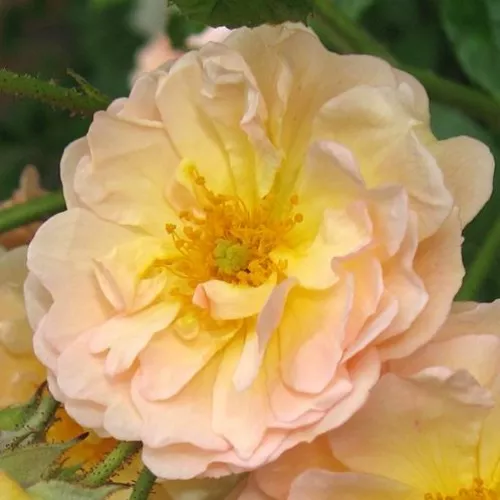
Ghislaine de Féligonde – yellow historic rambler rose
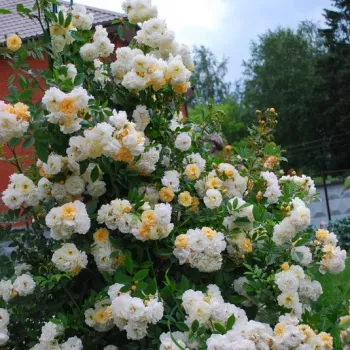
Imagine a sheltered coastal corner where you return from the beach, brush the sand from your shoes and sit down with a pot of tea, framed by the soft pastel clusters of Ghislaine de Féligonde. This historic rambler is naturally adaptable, coping well with blustery days and helping your garden stay steady even when strong seas breezes test less robust plants, all while fitting beautifully into compact family plots. Its romantic small blooms open in peachy-yellow and fade to cream, giving a long, gentle display over summer. Own-root vitality makes this rose exceptionally reliable over the years, reshooting well after pruning or weather damage and keeping its decorative value without fuss. With medium maintenance needs and an RHS Award of Garden Merit, it offers confidence for less experienced gardeners. Barely any thorns mean it feels welcome around children’s play spaces and narrow side paths, and the light green foliage stays attractively fresh as it clothes pergolas, fences and verandas. In its first year it concentrates on roots, in the second on stronger shoots, and by the third year you enjoy its full ornamental impact with minimal extra effort.
Usage options
| Target area | Reasoning |
|---|
| Coastal veranda windbreak |
Dense, light green foliage and flexible climbing growth help create a gentle living screen that softens wind on exposed Cornish or Devon verandas while still feeling airy and light for seaside relaxation for the beginner. |
| Small family pergola |
Its medium maintenance needs, self-cleaning clusters and modest flower size make it easy to keep a pergola neat and usable for everyday family life, without constant deadheading or specialist pruning for the busy homeowner. |
| Compact front-garden fence |
With a height around 2.4–4.2 m but relatively narrow spread, it clothes boundary fences in a soft pastel curtain that does not overpower smaller plots, giving kerb appeal that stays in scale for the urban gardener. |
| Part-shaded side passage |
Good tolerance of partial shade allows planting in side gardens that miss the midday sun; it still flowers reliably, brightening awkward, narrow runs between houses that many roses would resent for the practical planner. |
| Low-thorn family seating area |
Its barely thorny shoots are kinder to passing arms and children’s hands, making it suitable to arch over benches or frame low walls where people brush past frequently, reducing snagged clothes for the cautious family. |
| Long-season feature on an arch |
Remontant flowering with a lighter second flush keeps colour returning through summer; the shifting peach-to-cream tones give evolving interest rather than a single brief peak, rewarding patient establishment over several years for the enthusiast. |
| Low-spray traditional rose corner |
Medium disease resistance and robust own-root growth offer a good compromise between beauty and effort, so you can maintain a classic rose look with only occasional plant protection and routine pruning, reassuring the time-pressed beginner. |
| Anchoring a coastal-style planting mix |
Strong, well-branched climber roots itself firmly over time, helping stabilise a planting scheme that faces frequent rain and wind on exposed plots, while still working elegantly with shingle, grasses and sea-themed perennials for the coastal-style lover. |
Styling ideas
- Seaside-pergola – Train over a timber pergola with sea kale and blue Festuca beneath for a breezy coastal feel – ideal for coastal veranda owners wanting shelter without heaviness.
- Soft-boundary – Cover a low garden fence, underplanting with lavender and silver foliage to keep the boundary light yet private – suited to small front gardens seeking gentle screening.
- Tea-corner – Let it frame a bench or bistro set in a sheltered nook, pairing with potted herbs for scent – perfect for beginners creating a calm afternoon tea spot.
- Historic-arch – Grow up a metal arch and combine with foxgloves for a nostalgic, cottage look – for heritage-rose admirers wanting long-lived, characterful structure.
- Family-walkway – Guide its low-thorn canes along supports beside a path, with soft grasses at ground level – great for families needing beauty that is easy to live with.
Technical cultivar profile
| Parameter | Data |
|---|
| Name and registration |
Ghislaine de Féligonde, heritage rambler and climbing rose, historic multiflora–musk hybrid; unregistered cultivar used under long-established trade and exhibition names worldwide. |
| Origin and breeding |
Bred by Eugène Turbat & Compagnie, Orléans, France, from ‘Goldfinch’ × unknown seedling; introduced in 1916 and now regarded as a classic early twentieth-century garden rambler. |
| Awards and recognition |
Holder of the RHS Award of Garden Merit and a Certificate of Merit from the Bagatelle International New Rose Competition (Paris, 1916), confirming dependable performance in diverse gardens. |
| Growth and structural characteristics |
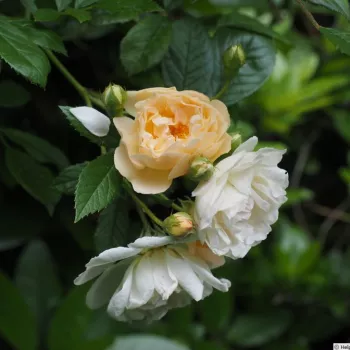
Climbing rambler with dense, slightly glossy light green foliage; typically 2.4–4.2 m high with 1.6–3 m spread, moderately self-cleaning clusters and very few thorns along flexible canes. |
| Flower morphology |
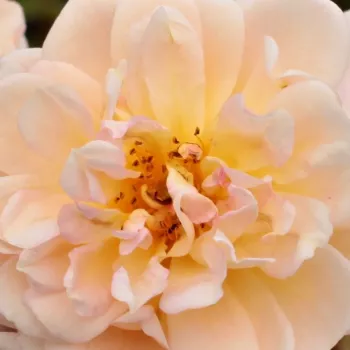
Semi-double, cup-shaped blooms, usually 13–25 petals, produced in airy clusters of small flowers about 1–3 cm across; remontant with a lighter but noticeable second flowering later in the season. |
| Colour data and phenology |
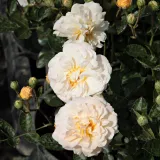
Buds warm golden-yellow with peach tones, opening peachy-yellow then soft cream with rosy outer veils; ARS yellow blend, RHS 12C outer and 11B inner, fading faster to white in hot weather. |
| Fragrance and aroma |
Medium-strength, sweet nectar-like fragrance noticeable at close range, particularly around seating areas; semi-double form gradually reveals stamens, offering moderate appeal to pollinating insects. |
| Hip characteristics |
Occasional small spherical hips, roughly 5–9 mm, ripening to bright red (RHS 46A); mainly ornamental, they appear sparsely and add a modest late-season accent amongst the light foliage. |
| Resistance and winter hardiness |
Hardy to about −26 to −23 °C (RHS H7, USDA 5b, Swedish Zone 4); medium resistance to black spot, mildew and rust, benefiting from reasonable spacing, airflow and sensible watering routines. |
| Horticultural recommendations |
Suitable for pergolas, arches, fences and walls; plant 1.3–2.2 m apart, in well-drained but moisture-retentive soil, or in containers from 40–50 litres upwards with regular watering and seasonal feeding. |
Ghislaine de Féligonde offers gentle pastel bloom, discreet thorns and long-lived own-root strength for pergolas and verandas, making it a thoughtful choice if you favour graceful structure with modest upkeep.