GIPSY – red-yellow flowerbed floribunda rose - Suzuki
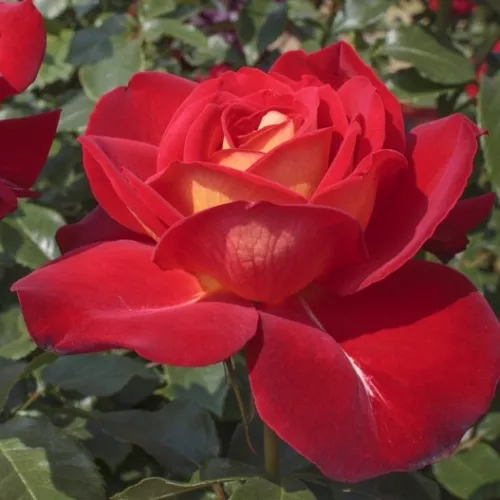
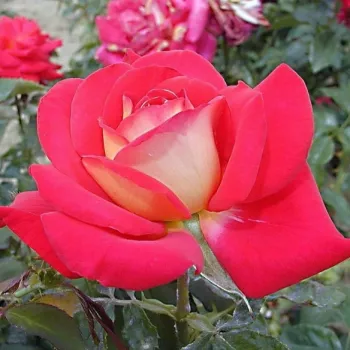
Imagine returning from a breezy walk on the beach to enjoy tea on a sheltered veranda, with the vivid blooms of GIPSY lifting the mood in your coastal garden. This compact floribunda is bred for reliable colour, producing generous clusters of XL, very full, cupped flowers whose scarlet and golden-yellow tones soften gently as they age. Its dense, glossy foliage forms a neat, low hedge or bedding patch that sits well in shingle or well-drained clay. Own-root vitality gives a long-lived, regenerating framework that copes well once established, so you can enjoy a stable display with fewer worries. In a 40–50 litre container it anchors itself securely, helping it stand firm against brisk coastal breezes and salt-tinged air, while the moderate fragrance remains fresh and unobtrusive around seating areas. Over time, its exhibition-quality blooms and award-winning pedigree settle into the garden rhythm: the first year quietly building roots, the second year filling out with shoots, and by the third year offering its full ornamental impact from early summer onwards.
Usage options
| Target area | Reasoning |
|---|
| Front of coastal flower bed |
The compact, bushy habit makes GIPSY ideal for the front of a mixed border where space is tight but you still want a strong, warm red-and-gold focal point through summer and autumn; this suits beginners and busy urban garden owners. |
| Low informal hedge along a path |
Planted at 25–30 cm centres, its dense foliage and rounded shape knit into a low hedge that guides paths or edges terraces without blocking light, creating structure that remains attractive even between flushes of flowers for family garden owners. |
| Large coastal veranda container (40–50 L) |
In a generous 40–50 litre pot with good drainage, the compact roots and own-root stamina give a stable, wind-resilient plant that colours a veranda or balcony and echoes seaside sunsets for owners of coastal verandas. |
| Mass planting in shingle-style beds |
At higher densities the rich red-yellow flowers read as a single glowing carpet, excellent for shingle or gravel designs where low-maintenance, long-season colour is wanted more than intricate plant combinations for coastal-style lovers. |
| Mixed border with perennials and grasses |
GIPSY’s bold blooms contrast beautifully with sea kale, Festuca or lavender while its moderate height keeps views open; the steady repeat-flowering adds rhythm without demanding constant attention from hobby gardeners. |
| Exposed yet sheltered family seating nook |
Once established, the own-root structure combines reliable flowering with a secure anchor that copes well in blustery weather, giving a colourful wind-filter near your seating where you can relax after collecting shells for homeowners by the sea. |
| Statement specimen near entrance or gate |
Used singly at 45 cm spacing from other shrubs, its exhibition floribunda blooms and medal-winning heritage create a welcoming focal point that remains tidy and manageable in a small front garden for style-conscious beginners. |
| Long-term, low-fuss rose for busy lifestyles |
With an own-root plant you gain a long-lived, regenerating framework that maintains ornamental value with simple pruning and moderate care, rewarding you year after year with waves of colour despite occasional salt-laden winds for time-poor garden owners. |
Styling ideas
- Sunset Edge – Drift GIPSY along a shingle path, backed with blue Festuca and sea kale to echo beach colours – ideal for coastal-style lovers wanting a relaxed, seaside feel.
- Veranda Glow – Plant a single shrub in a 50 litre terracotta pot with pale gravel mulch, pairing with low lavender for scent – perfect for beginners creating an easy, wind-tolerant seating corner.
- Ruby Ribbon – Use a narrow row of plants along a front path, underplanted with silver-grey groundcovers to highlight the red-yellow flowers – suited to homeowners who like neat, welcoming entrances.
- Cornish Patchwork – Combine small groups of GIPSY with Crocosmia and ornamental grasses for a vibrant, textural summer border – great for hobby gardeners who enjoy bold, informal colour.
- Family Focus – Place a compact cluster near a favourite bench so children and adults can enjoy the changing flower shades up close – ideal for families wanting impact from a manageable rose.
Technical cultivar profile
| Trait | Data |
|---|
| Name and registration |
Floribunda bed rose registered as ‘Kiboh’, marketed as GIPSY – red-yellow flowerbed floribunda rose - Suzuki; ARS exhibition name ‘Kiboh’, in the bedding rose collection for garden use. |
| Origin and breeding |
Bred by Seizo Suzuki at Keisei Rose Nursery, Japan, from ‘Liberty Bell’ × ‘Kagayaki’; introduced in Europe by Meilland International in 1986 after registration in 1985. |
| Awards and recognition |
Highly regarded exhibition floribunda with notable show success: Gold Medals at The Hague and Monza in 1985, Silver Medals at Courtrai (Kortrijk) and Saverne the same year. |
| Growth and structural characteristics |
Compact, upright floribunda 70–100 cm high and 35–55 cm wide, with dense, dark green glossy foliage and moderate prickles; forms a bushy, well-branched structure suitable for beds and low hedges. |
| Flower morphology |
Very full, cupped XL blooms with more than 40 petals, produced mostly in clusters of one to five per stem; strongly remontant habit ensures a generous second flush following the main early summer flowering. |
| Colour data and phenology |
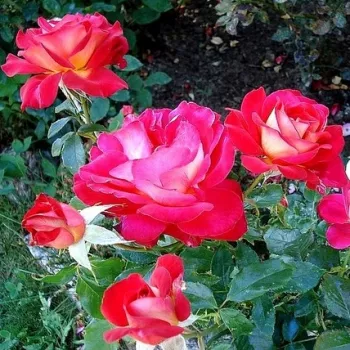
Upper petals vibrant red with golden-yellow reverse (ARS RB; RHS 46A outer, 13B inner); colours soften from scarlet and golden to carmine and cream as blooms age, giving a gentler late-stage display. |
| Fragrance and aroma |
Fragrance is mild and unobtrusive, with a fresh, lively character that does not overwhelm nearby seating areas; ideally placed where colour impact is desired without a heavy or dominating rose scent. |
| Hip characteristics |
Hip set is generally low due to the many-petalled, double flowers; when present, hips are small spherical orange-red fruits about 6–10 mm in diameter, adding occasional late-season interest. |
| Resistance and winter hardiness |
Rated to approximately −15 to −12 °C (RHS H6, Swedish Zone 2, USDA 7b); disease resistance is moderate to powdery mildew, black spot and rust, so occasional preventive care may be beneficial. |
| Horticultural recommendations |
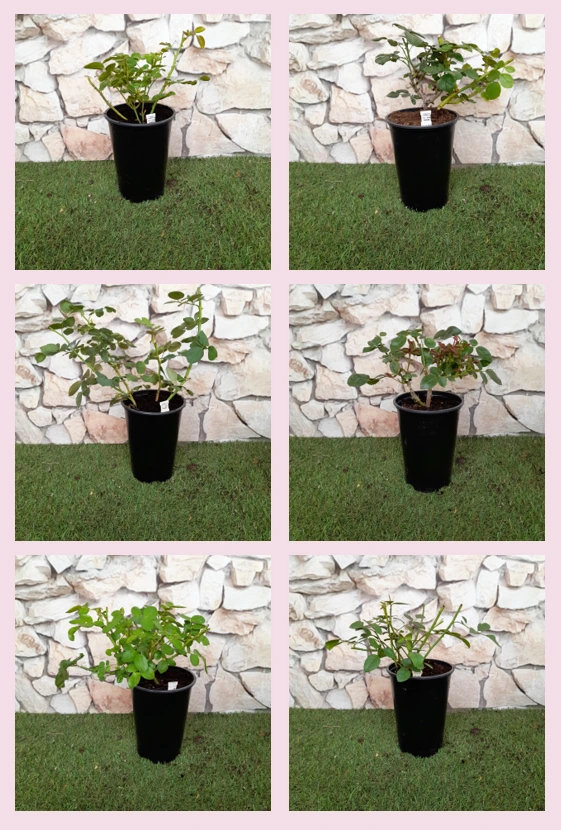
Best in well-drained soil, including improved heavy clay; space 30 cm for bedding, 25 cm for low hedges, 45 cm as specimen; suit own-root 2-litre planting for easy establishment and long-term performance. |
GIPSY – red-yellow flowerbed floribunda rose - Suzuki offers compact, long-season colour, dense foliage structure and the durable, regenerating advantages of an own-root plant, making it a thoughtful choice for low-effort coastal and family gardens.