DELSTROR – salmon-pink bedding floribunda rose
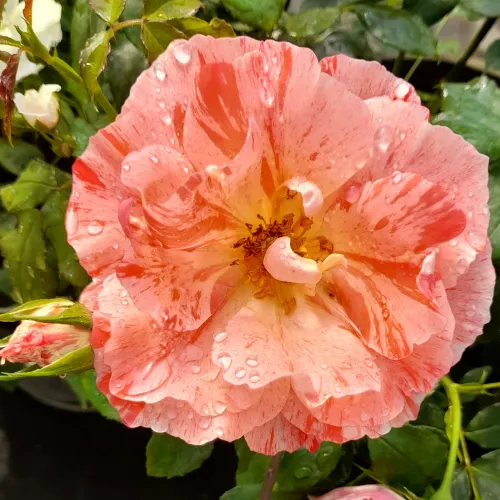
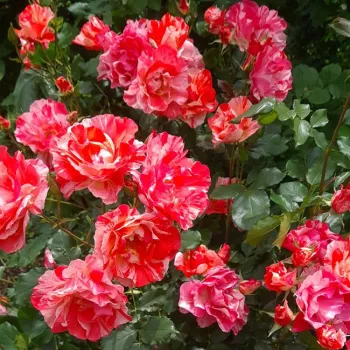
Imagine returning from a breezy walk along the shore to sit with tea, sheltered by a low hedge of salmon-pink roses: DELSTROR settles calmly into coastal family gardens where blustery weather is common yet shelter from strong winds creates a reassuring frame around your space. Its semi-double blooms open in clustered, painterly shades of salmon streaked with cream and soft pink, giving a gently changing floral display from spring to autumn. In the first year it concentrates on roots, the second on fuller shoots, and by the third you enjoy its complete ornamental presence with minimal fuss. Compact and bushy, it fits easily into flower beds, shingle borders or generous pots, while own-root resilience supports a long-lived, quietly reliable structure. Soft colour, relaxed hedge, painterly blooms, coastal veranda, enduring structure, gentle fragrance, adaptable container, and practical longevity make it a refreshing choice.
Usage options
| Target area |
Reasoning |
| Coastal shingle or salt-tolerant front garden |
Compact stature and bushy growth help create a low, protective frame around sitting areas, echoing seaside planting without overwhelming tight plots, ideal for coastal-style lovers seeking informal charm in small family spaces for beginners. |
| Low informal hedge along a path or drive |
Regular, bushy structure and repeat flowering allow you to line a path or drive with a soft, salmon-pink border that reads clearly from a distance, guiding the eye while remaining easy to clip and shape for busy homeowners. |
| Feature rose in a 40–50 litre terrace container |
Its manageable height and medium spread work well in a large, well-drained pot of at least 40–50 litres, where the own-root form settles securely and can be refreshed with simple top-dressing instead of regular replacement for urban gardeners. |
| Mixed bed with sea kale and ornamental grasses |
The painterly salmon and cream blooms sit beautifully among silvery sea kale and fine Festuca or similar grasses, giving a relaxed, coastal palette that moves in the wind and provides long-season colour contrast for design enthusiasts. |
| Family seating nook as a low windbreak |
The bushy, medium-height habit lets you plant a loose arc behind benches or loungers, softening gusts while keeping sight lines open, well suited to UK gardens where managing breezy corners matters for family gardeners. |
| Season-long colour focus near the veranda |
Remontant flowering with a generous second flush means reliable waves of salmon-pink clusters near doors and patios, keeping the veranda lively through the season with little more than occasional deadheading for time-poor owners. |
| Long-lived structural planting in small borders |
As an own-root rose it matures steadily into a durable framework that regenerates well after pruning, so even narrow borders gain a stable, long-lived backbone of flowering wood without the unpredictability of graft unions for future-focused buyers. |
| Lightly scented accent by paths and entrances |
The mild, fruity-rosy scent adds a discreet note as you pass, complementing its distinctive bicolour petals without dominating nearby planting, ideal where you want a refined fragrance rather than an overpowering perfume for sensitive visitors. |
Styling ideas
- Seaside-porch border – Combine DELSTROR with sea kale and blue Festuca in a narrow strip beside decking, echoing Cornish shingle and giving gentle movement – for coastal-style veranda owners.
- Painterly-parterre – Use low box or thyme edging with repeating groups of DELSTROR for colour blocks that read like brushstrokes – for design-conscious hobby gardeners.
- Family-windbreak – Plant a loose hedge behind a bench with interspersed Geranium macrorrhizum for soft groundcover and a relaxed barrier to breezes – for family gardeners wanting calm corners.
- Terrace-centrepiece – Grow a single plant in a 50 litre clay pot with trailing Sedum spurium at the rim to spill over in contrasting texture – for urban balcony and patio owners.
- Soft-hedge mix – Alternate DELSTROR with clumps of Liriope muscari for late-season foliage and flower spikes, creating a low, varied edging – for gardeners seeking gentle structure.
Technical cultivar profile
| Parameter |
Data |
| Name and registration |
Floribunda bed rose registered as DELstror, marketed as Delstror Les Roses de peintres DELstror, also shown under the exhibition name Grimaldi in floribunda bush classes. |
| Origin and breeding |
Bred in France around 1990 by Georges and Guy Delbard, later introduced by Pépinières et Roseraies Georges Delbard in 2001 in France and 2002 in the United Kingdom. |
| Awards and recognition |
Recognised in Monza rose trials with the People’s Choice award in 1998 and silver medals in 1998 and 1999, reflecting strong public appeal for its distinctive flower colour. |
| Growth and structural characteristics |
Bushy, medium-height plant reaching about 90–115 cm with a 95–125 cm spread, medium foliage density, dark green leaves and moderate thorniness, forming a rounded, well-filled bed rose. |
| Flower morphology |
Semi-double, cupped blooms with around 13–25 petals, carried in clusters of medium-sized flowers, remontant with a generous second flush that extends seasonal colour displays. |
| Colour data and phenology |
Salmon-pink base richly variegated with white and pale pink streaks; newly opened blooms show irregular mottling that lightens in strong sun, softening to gentler tones as the flowers age. |
| Fragrance and aroma |
Mild, fresh fragrance with a fruity-rosy character, present but restrained so it supports rather than dominates nearby plantings, suitable where subtle scent is preferred near seating or entrances. |
| Hip characteristics |
May form small hips, typically 0–8 mm in diameter, though they are irregular and not a dependable ornamental feature, so planting is usually focused on flowers rather than fruit display. |
| Resistance and winter hardiness |
Hardy to approximately −21 to −18 °C (RHS H7, USDA 6b, Swedish zone 3); moderate heat tolerance but needs watering in dry spells, with disease sensitivity requiring attentive, preventative care. |
| Horticultural recommendations |
Best in well-drained soil with regular monitoring for rust and leaf diseases; suitable for beds, groups, hedges and larger containers, with partial shade tolerance and spacing around 60–110 cm. |
DELSTROR offers compact coastal-friendly structure, painterly salmon-pink flowers and steady own-root longevity for relaxed, long-term planting; consider it where you want colour, form and durability without complexity.