HORJASPER – red climbing rose - Horner
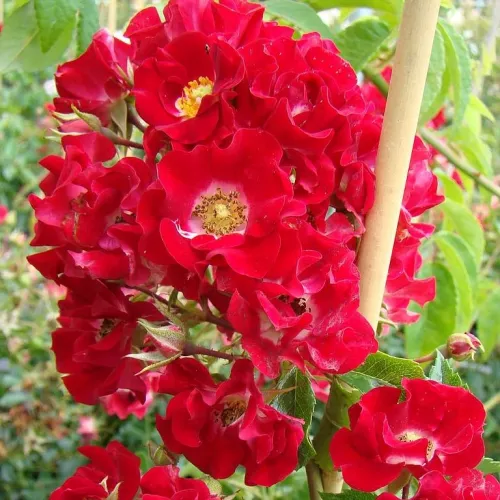
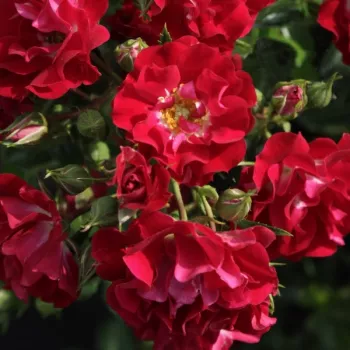
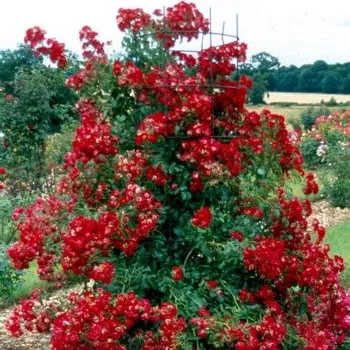
Along a breezy Cornish fence or Devon veranda, HORJASPER creates a vivid, salty seaside mood with its scarlet-red clusters and clean white eye, while its vigorous climbing habit quickly dresses walls, arches and pergolas for a sheltered cup of tea after collecting seashells. This repeat-flowering rambler gives generous flushes from early summer onwards, yet remains surprisingly manageable thanks to good self-cleaning, so most spent petals simply drop away before you notice them. In a well-prepared planting pit that copes gracefully with storm-driven rain and wind, the robust own-root system anchors securely and supports an impressively long lifespan. Over the first three seasons it naturally shifts from building roots, to extending shoots, to delivering its full ornamental impact with dense, glossy dark foliage as a richly coloured backdrop. Well-suited to partial shade on coastal plots, it copes with summer heat and modest dry spells, filling smaller family gardens where space is tight but you still want a standout feature that rewards steady, basic care.
Usage options
| Target area | Reasoning |
|---|
| Coastal veranda windbreak |
Trained on balustrades or trellis, HORJASPER quickly forms a vertical screen that filters sea breezes without overwhelming a small seating area, ideal where a compact but effective windbreak is needed for coastal-style lovers and beginners. |
| House wall or sunny fence |
Its climbing habit and 3–5 m height let you green up bare walls or fences with abundant red clusters, while good self-cleaning reduces ladder work deadheading for busy homeowners and beginners. |
| Rose arch or pergola accent |
The long, flexible canes are easy to fan over arches and pergolas, creating a tunnel of colour that repeats through the season and frames family paths attractively for hobby gardeners and homeowners. |
| Compact family garden focal point |
With a spread of around 1–2.2 m, it offers strong visual impact without dominating the whole plot, giving smaller gardens a striking vertical feature that feels proportionate for busy urban garden owners and beginners. |
| Large container on sheltered terrace |
In a 40–50 litre planter with reliable drainage, HORJASPER can be grown near doors or seating areas so you enjoy flowers at eye level, while the own-root form helps it recover if exposed canes suffer weather damage for coastal veranda owners and homeowners. |
| Long-term garden investment |
As an own-root climber, it can regenerate from the base if canes are pruned hard or damaged, maintaining shape and colour over many years and rewarding consistent, basic care for dedicated owners and hobby gardeners. |
| Part-shade side passage |
HORJASPER tolerates partial shade, so it can brighten side alleys and less-sunny boundaries that many roses resent, giving reliable colour in tricky aspects for busy urban garden owners and coastal-style lovers. |
| Exposed but well-drained coastal border |
Once established in properly prepared soil that channels heavy coastal rain away from the roots, its heat tolerance and climber’s framework handle breezy conditions confidently for coastal gardeners and family-garden owners. |
Styling ideas
- Seaside-arch – Train HORJASPER over a simple metal arch, underplant with Festuca and sea kale for a dune-like feel – ideal for coastal-style lovers wanting a breezy entrance.
- Veranda-screen – Grow it in a 50 litre container against trellis to create a living privacy panel beside outdoor seating – suited to beginners with small terraces.
- Cottage-fence – Let it scramble along a sunny picket fence with Geranium macrorrhizum at the base for soft groundcover – perfect for family gardens needing charm without fuss.
- Pergola-walk – Combine HORJASPER on posts with lavender edging so red clusters hover over a fragrant path – appealing to hobby gardeners planning a long-lived feature.
- Shady-corner – Use it on a north-east wall, pairing with Hedera and soft grasses to brighten awkward spaces – good for homeowners making use of part-shade areas.
Technical cultivar profile
| Trait | Data |
|---|
| Name and registration |
Repeat-flowering rambler and climbing rose; registered as HORjasper, marketed as Horjasper Climbing rose HORjasper, with Rambling Rosie approved for exhibition classes. |
| Origin and breeding |
Bred by Colin P. Horner in the United Kingdom in 2001 from Super Excelsa × (Baby Love × Golden Future); introduced and first distributed in 2005 by Warner’s Roses. |
| Awards and recognition |
Gold Standard Award 2007, RHS Award of Garden Merit 2012, Glasgow Golden Prize 2010 and Hague Rose Trials Bronze Certificate 2010 confirm strong ornamental performance and appeal. |
| Growth and structural characteristics |
Vigorous climber reaching 3–5 m high with a 1–2.2 m spread, dense dark green glossy foliage, flexible canes and notably thorny stems, self-cleaning flowers and a neatly clothed framework. |
| Flower morphology |
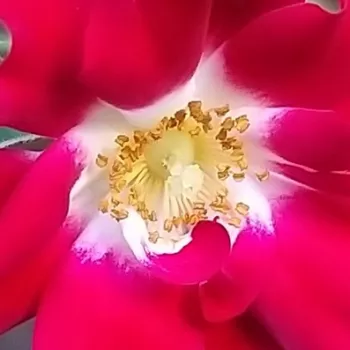
Semi-double clusters of small, flat blooms 1.3–3.8 cm across with around 13–25 petals, producing abundant first and second flushes and carrying occasional visible stamens within the white eye. |
| Colour data and phenology |
Intense scarlet-red flowers with a clean white centre; buds deep scarlet with crimson hints, fading through carmine tones while the eye lightens, ARS MR, RHS 46A outer, 46B inner petals. |
| Fragrance and aroma |
Very light rose scent, mostly noticeable at close range in warm, still weather; semi-double flowers offer moderate, occasional interest to pollinators due to partially accessible central stamens. |
| Hip characteristics |
Forms small spherical orange-red hips, approximately 6–10 mm across, produced in moderate numbers after flowering, and adding a discreet seasonal accent in late summer and early autumn. |
| Resistance and winter hardiness |
Hardy to about −21 to −18 °C, RHS H7, USDA 6b, Swedish Zone 3; tolerates heat and some drought but is moderately susceptible to mildew and black spot and highly prone to rust. |
| Horticultural recommendations |
Best on well-drained, fertile soil with sturdy supports; regular feeding, watering and preventative disease care needed, especially in damp summers, with pruning to renew older flowering wood. |
HORJASPER offers vivid repeat-flowering colour, a space-saving climbing habit and a long-lived own-root framework that can regenerate from the base, making it a thoughtful choice for coastal and family gardens alike.