IMPÉRATRICE FARAH™ – white-red hybrid tea rose – Delbard
Imagine a sheltered coastal veranda where glossy foliage frames your view and long-stemmed, exhibition-quality blooms repeat from summer to autumn, quietly creating a sense of elegance without demanding constant attention. IMPÉRATRICE FARAH™ is a premium own-root hybrid tea rose that rewards simple, consistent care with reliable flowering and strong structure, gradually anchoring itself even in breezier gardens where drainage and wind exposure need a little thought. Its tall, upright habit and radiant white petals edged in vivid red bring a subtly “girly” coastal charm to shingle beds and veranda planters, while own-root resilience gives you dependable longevity and recovery after harsher seasons. In a large 40–50 litre container or a sunny border, this cultivar offers generous cut flowers with formal, high-centred blooms, clean foliage with notable black spot resistance, and a steady presence that suits beginners who prefer clear, simple tasks. Plant once, water well, and let it follow its natural rhythm of strengthening roots in year one, extending shoots in year two and reaching its full ornamental impact by year three.
Usage options
| Target area | Reasoning |
|---|
| Coastal veranda in large container |
A tall, upright hybrid tea that performs well in a 40–50 litre container, giving you long-stemmed blooms at comfortable eye level and coping well with breezy, exposed seating areas by the sea, ideal for relaxed moments after work for beginners. |
| Statement rose beside front door |
The formal high-centred flowers and bicolour petals create a welcoming focal point by an entrance, while own-root vigour and moderate care needs mean you mainly deadhead and water, suiting busy home-focused owners. |
| Cutting patch for home arrangements |
Large, long-stemmed hybrid tea blooms appear singly, making it easy to cut perfect exhibition-style flowers through the season with regular deadheading, appealing to creative flower-loving gardeners. |
| Small feature bed in family garden |
Its upright height and moderately dense, dark green foliage give structure without taking up much ground space, ideal for a compact front or back garden where you want impact from just a few plants, ideal for space-conscious households. |
| Coastal-style shingle and gravel border |
Suited to a sunny, free-draining bed where thoughtful watering and mulching help it manage exposed, drying winds, echoing a laid-back Cornish or Devon coastal mood for design-aware coastlovers. |
| Feature rose in mixed container grouping |
Placed in a generous pot and underplanted with low companions, its upright shape and repeated flushes of bicolour blooms provide vertical emphasis and colour focus with relatively straightforward pruning needs for practical-minded starters. |
| Accent plant in formal border |
The award-winning, high-quality blooms and reliable second flush offer a classic hybrid tea look that slots neatly into more traditional layouts, rewarding simple seasonal feeding and winter preparation for style-conscious newcomers. |
| Ridge of roses screening a seating area |
Planted at recommended spacing, the tall, straight growth habit helps define and lightly screen a terrace or seating nook while maintaining airflow and easy access for basic care, reassuring for low-maintenance-seeking families. |
Styling ideas
- Veranda focus – Grow IMPÉRATRICE FARAH™ in a 50 litre container as the main vertical element by a bistro table, with sea kale and blue fescues at ground level – ideal for coastal veranda owners seeking a calm retreat.
- Girly shingle – Set two or three plants in a pale gravel bed with low pink cranesbills and driftwood accents – for those wanting a feminine, seaside-inspired front garden without complex planting schemes.
- Cut-flower corner – Dedicate a sunny border section to rows of this rose with soft grasses behind – perfect for home florists who like straightforward, repeat cutting without specialist techniques.
- Formal entrance – Flank a path or doorway with matching containers, underplanted with lavender to echo the white-red blooms – suited to homeowners who want a tidy, stately look from simple seasonal care.
- Mixed coastal border – Combine with St John’s wort and blue-grey grasses for a textural, salt-evoking scheme – appropriate for garden improvers wanting structure and colour without constant replanting.
Technical cultivar profile
| Parameter | Data |
|---|
| Name and registration |
Hybrid tea rose; registered as DELivour, marketed as IMPÉRATRICE FARAH™ hybrid tea rose; ARS exhibition name Impératrice Farah; female given-name reference underlines the refined, personal character. |
| Origin and breeding |
Bred by Georges Delbard in France, 1986; introduced commercially in 1992 by Delbard and Georges Delbard SA; hybrid tea type selected for flower form and garden performance rather than known parentage. |
| Awards and recognition |
Gold medal at Rome in 1992 and a total of eight international competition medals, indicating consistent exhibition-standard flower quality and reliable garden performance under varied judging conditions. |
| Growth and structural characteristics |
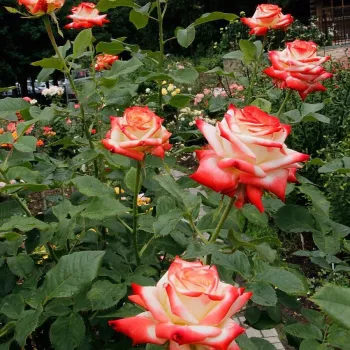
Upright, strongly vertical habit reaching 130–170 cm high and 70–95 cm wide; moderately dense, dark green glossy foliage; densely thorned stems; best spaced 50–100 cm depending on use and desired density. |
| Flower morphology |
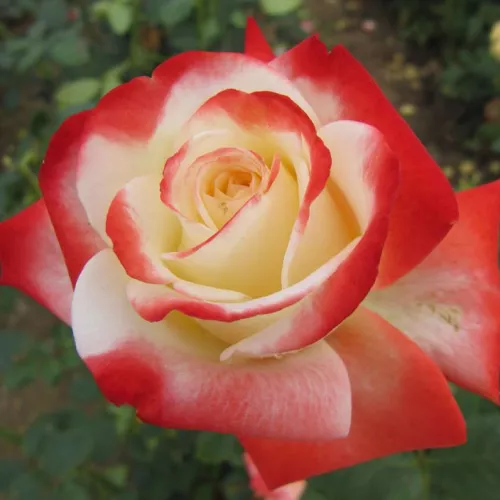
Large, double, high-centred hybrid tea flowers with 26–39 petals, typically borne singly on long stems; classic exhibition shape with pointed buds; remontant with a strong second flush given regular deadheading. |
| Colour data and phenology |
Snow-white petals edged vivid carmine-red, ARS Wbl, RHS 53A margin, 155D ground; red edging fades to pale pink and white base to creamy tones, retaining a bright, clear overall effect in full bloom before ageing. |
| Fragrance and aroma |
Fragrance is very weak and only lightly rosy, making it unobtrusive near seating or windows; chosen primarily for its striking colour contrast and flower form rather than scent-driven planting schemes. |
| Hip characteristics |
Due to very double blooms, hips form only occasionally; where present they are small, egg-shaped, about 10–14 mm in diameter, orange-red in colour and of limited ornamental significance in most garden situations. |
| Resistance and winter hardiness |
Hardy to approximately –21 to –18 °C (USDA 6b, RHS H7); good black spot resistance with moderate tolerance of powdery mildew and rust; copes with heat but needs regular watering in prolonged dry spells. |
| Horticultural recommendations |
Best in sunny sites with well-drained, nourished soil; plant 60 cm apart in beds, 50 cm for hedging; maintain by seasonal pruning, feeding, watering in dry periods and occasional spraying where disease pressure is high. |
IMPÉRATRICE FARAH™ DELivour offers tall, upright structure, repeat large bicolour blooms and space-efficient planting, with own-root durability for long-term coastal or urban gardens; consider it when you want lasting elegance from manageable care.