KIFTSGATE – white rambler climbing rose - Murrell
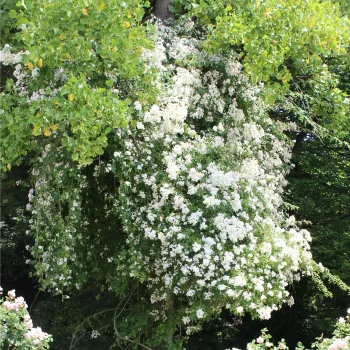
Imagine leaning back with afternoon tea on a sheltered coastal veranda while snow-white sprays of KIFTSGATE sway above you, casting a dappled shade and humming with visiting bees. This vigorous rambler quickly builds a living screen over walls, pergolas or old trees, anchoring itself securely even where wind funnels through the garden and you must consider careful drainage and water management for reliable anchoring in exposed ground. Its once-a-year summer flowering is a breathtaking cascade of small, honey-scented blooms, followed in autumn by glowing orange-red hips that extend the season’s interest. Own-root plants settle steadily, with roots establishing in year one, strong new framework in year two and full ornamental effect by year three, giving long-term reassurance in a family garden. In large containers of at least 50 litres, or in open soil, it rewards minimal intervention with abundant wildlife and an enduring coastal garden character.
Usage options
| Target area |
Reasoning |
| Coastal windbreak and boundary screen |
KIFTSGATE’s very tall, vigorous growth and dense framework make it ideal for training along fences or boundary wires to create a green windbreak that filters strong coastal gusts. Once established, it forms a resilient living screen needing only occasional pruning, suiting those who value long-term structure with modest upkeep, especially beginners. |
| Pergolas, arches and veranda structures |
This rambler quickly clothes pergolas and veranda frames, producing a spectacular midsummer curtain of white blooms above seating areas. Its graceful, hanging clusters create shade and a sense of enclosure without demanding fussing over repeat flowering. Year by year the own-root framework thickens, ensuring a durable overhead canopy appreciated by homeowners. |
| Climbing into mature trees or tall supports |
With potential heights well over 9 m, KIFTSGATE excels when allowed to scramble into established trees or over tall poles, echoing its origins at Kiftsgate Court Gardens. The small single flowers sit beautifully against foliage high above, then hips sparkle in autumn, rewarding patient, low-input gardeners such as hobby-gardeners. |
| Pollinator-friendly family garden feature |
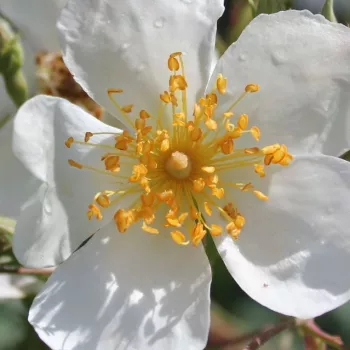
The simple, open flowers with golden stamens are highly attractive to bees and other pollinators, turning its flowering period into a lively wildlife spectacle. This makes it a natural choice for family gardens where children can watch insects at close range while adults enjoy the scented summer display, delighting many families. |
| High-impact summer display with ornamental hips |
Although it flowers once, the sheer volume of clusters creates an unforgettable early-summer show, followed by abundant orange-red hips with strong ornamental value. The hips keep structures interesting into winter and can complement festive decorations, appealing to gardeners who like long visual interest with little effort, including busy-owners. |
| Own-root, long-lived landscape planting |
As an own-root rambler, KIFTSGATE develops a robust base that can regenerate from below even after hard pruning or weather damage, supporting a long lifespan in UK climates. This underlying resilience suits informal landscape corners, bank plantings and less-frequented areas, offering security and continuity for cautious planners. |
| Shingle and clay-based coastal gardens |
KIFTSGATE adapts well to typical coastal plots where improved but heavy soils and shingle mulches dominate, provided you ensure good drainage at planting. Over time its extensive root system helps stabilise the planting area, and its size provides structure against sea breezes and salt-tinged air, reassuring practical coastal gardeners. |
| Large containers on robust verandas |
Planted in a minimum 50–70 litre container with sturdy support, this rambler can be trained up posts or wires to make a dramatic yet relatively low-maintenance feature beside seating areas, where watering is easy to manage and wind is filtered by nearby structures, fitting the lifestyle of space-conscious balcony-owners. |
Styling ideas
- Coastal-arch – Train KIFTSGATE over a timber arch with blue-grey Festuca and sea kale at the base for a breezy Cornish feel – ideal for coastal-style enthusiasts.
- Veranda-curtain – Let long canes form a green curtain on a veranda frame, underplanted with lavender in large troughs – suited to busy homeowners wanting shade and scent.
- Wildlife-haven – Allow it to climb an old apple or hawthorn, combining blossom, hips and bees in one vertical habitat – perfect for families interested in pollinators.
- Shingle-border – Use as a backdrop to shingle with sea kale and ornamental grasses, its white flowers glowing against pebbles – attractive for owners of informal seaside gardens.
- Grand-pergola – Cover a sturdy pergola, pairing with chives and dwarf marigolds in the foreground for long-season colour – appealing to hobby gardeners planning a focal walkway.
Technical cultivar profile
| Parameter |
Data |
| Name and registration |
Rambler rose Kiftsgate, registered cultivar name and ARS exhibition name Kiftsgate; commercial form Kiftsgate Climbing rose Kiftsgate, unregistered but long-established garden variety. |
| Origin and breeding |
Naturally occurring Rosa filipes variant discovered and selected in the UK; attributed to breeder E. Murrell, introduced circa 1954 by Edwin Murrell Ltd, Shrewsbury. |
| Awards and recognition |
Holds the Royal Horticultural Society Award of Garden Merit (1993), confirming dependable garden performance and ornamental value under a range of typical British conditions. |
| Growth and structural characteristics |
Exceptionally vigorous climbing rambler, typically 9–15 m high with 2.5–4.5 m spread; moderately dense, mid-green foliage, densely thorned shoots and good self-cleaning habit after flowering. |
| Flower morphology |
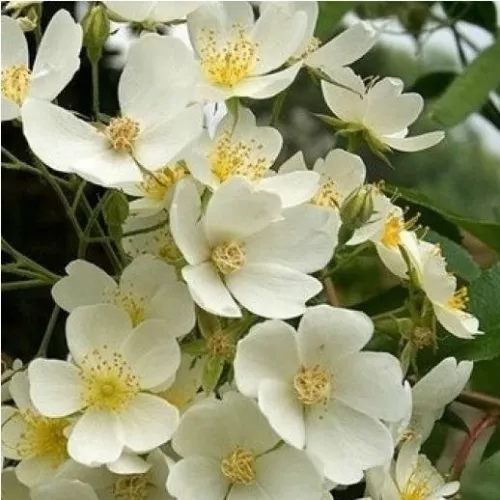
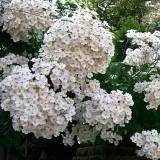
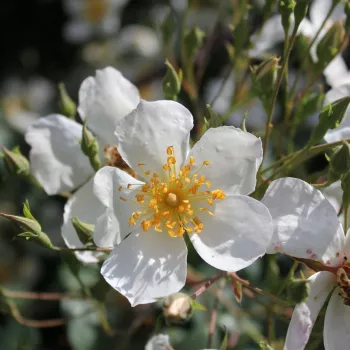
Single to semi-single blooms with 5–12 petals, flat, small (about 1–3.5 cm) and carried in very large, many-flowered clusters; once-blooming in early summer, non-remontant thereafter. |
| Colour data and phenology |
Pure white to creamy white blooms (RHS 155D outer, 155C inner); buds cream-white, opening dazzling white with golden stamens, then softening to creamy yellowish-white as petals dull slightly before drop. |
| Fragrance and aroma |
Medium-strength, noticeable sweet honeyed scent, particularly effective when many clusters open together; fragrance carries well around arches, pergolas and seating areas in still or lightly breezy weather. |
| Hip characteristics |
Produces many decorative orange-red hips (RHS 33A); ovoid, about 15–22 mm diameter, setting freely after flowering and contributing strong late-season and winter interest on established plants. |
| Resistance and winter hardiness |
Hardy to approximately −26 to −23 °C (RHS H7; USDA 5b, Swedish zone 4); moderate disease resistance, with some susceptibility to mildew, black spot and rust, generally acceptable in open, airy sites. |
| Horticultural recommendations |
Best on strong supports, walls, pergolas or into trees; plant with generous spacing. Prefers well-drained soil and regular watering in drought; prune after flowering to manage size and encourage new framework. |
Kiftsgate offers a spectacular summer cascade of white flowers, reliable hips and long-lived, regenerating own-root strength; consider it where you want a big-impact, low-fuss rambler for years to come.