KNIRPS® – deep pink groundcover rose – KORverlandus
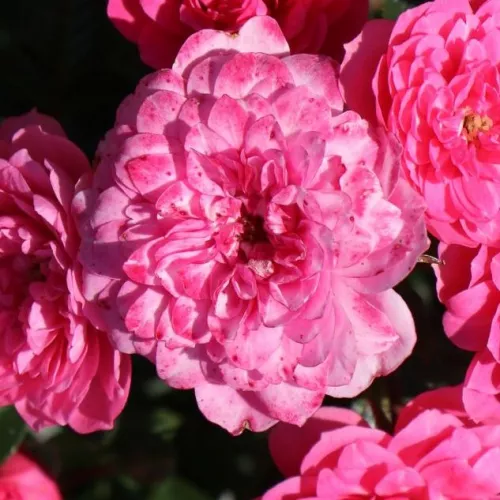
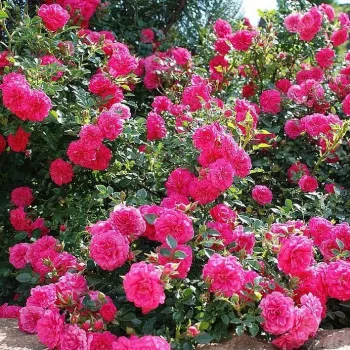
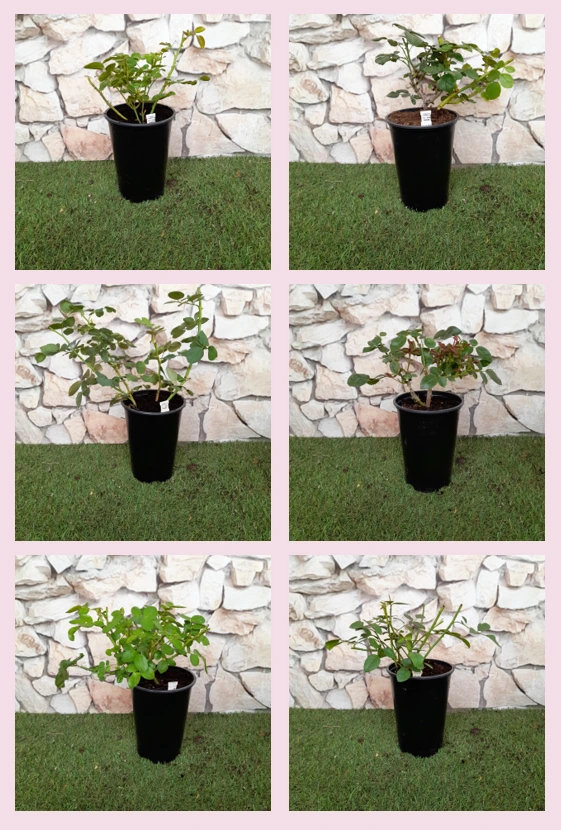
Imagine returning from the shore, a mug of tea in hand, to a low, deep-pink carpet of KNIRPS® roses quietly taming your shingle or small family lawn edge. This compact groundcover rose forms a dense, glossy canopy that naturally suppresses weeds and anchors light, coastal soils, coping reliably with brisk winds and weather blowing in from the sea. Its very double, clustered blossoms repeat all summer, giving months of colour with almost no deadheading, as most spent flowers fall away by themselves. Planted as a low border or in generous 40–50 litre containers, it settles in steadily: first building roots, then strong shoots, and by the third year reaching full ornamental impact with minimal intervention. As an own-root rose it offers reassuring longevity, regenerating well after hard pruning and suiting beginners who prefer reliable structure to demanding showpieces.
Usage options
| Target area | Reasoning |
|---|
| Coastal shingle or gravel strip near the house |
Its low, spreading habit and dense mid-green foliage create a stable, weed-suppressing groundcover that copes well with blustery, changeable seaside weather and offers long-lasting colour with little intervention – ideal for the beginner. |
| Small family front garden bed |
The compact 25–45 cm height and 40–70 cm spread make it easy to keep paths and driveways tidy while still providing a neat, deep-pink cushion of flowers that children can enjoy close-up without towering thorns – reassuring for the homeowner. |
| Low-maintenance edging along a terrace or veranda |
Good disease resistance and self-cleaning blooms mean less time spent spraying or deadheading, so you can sit out with tea while it quietly refreshes the hard edges of paving and decking – perfect for the busy-gardener. |
| Large container on a sheltered coastal veranda |
In a 40–50 litre pot, its shallow, spreading roots knit well into the compost, forming a dense flowering dome that tolerates reflected heat from walls, provided it is watered during prolonged dry spells – well suited to the balcony-owner. |
| Informal groundcover under taller shrubs |
The glossy foliage and continuous clusters of small, very double blooms fill bare soil at the base of shrubs like Philadelphus, creating a layered look that remains attractive even between flushes – appealing for the stylish-gardener. |
| Clay-based, improved family lawn edge |
Once planted into loosened, well-drained soil, its spreading habit and relatively shallow rooting help hold the structure together while providing a soft, flowered margin that is easy to mow alongside – useful for the practical-owner. |
| Urban front garden or street-side bed |
Originally bred for robustness and earning ADR recognition, it tolerates heat, moderate drought and pollution, offering cheerfully deep-pink flowers in exposed spots where more delicate roses may fail – reassuring for the city-gardener. |
| Family seating corner with a coastal feel |
Planted with sea kale, Festuca and lavender, its low, deep-pink mounds echo seaside planting while creating a calm, unified backdrop that looks settled by the third season with little more than annual pruning – ideal for the relaxed-gardener. |
Styling ideas
- Coastal-cup – Plant KNIRPS® in a 50 litre clay pot with blue Festuca and a small driftwood feature to suggest a Cornish shore – for coastal-style lovers seeking easy upkeep.
- Pink-carpet – Use as a continuous ribbon along a front path, spaced at 40 cm, to form a low, flowering edge that replaces fiddly bedding – for homeowners wanting neat structure with minimal work.
- Veranda-nest – Combine in containers with lavender and sea kale for a sheltered, salty-breeze seating area that stays attractive from spring to autumn – for tea-on-the-deck families.
- Urban-curve – Soften the base of a curved brick wall with KNIRPS® under a backdrop of mock orange and bluebeard shrubs – for city gardeners designing compact, layered interest.
- Playcorner – Create a low, thorn-aware but child-visible flower zone near a sandpit or shell-collecting area, leaving clear access paths around the mounds – for families wanting colour without tall, snagging stems.
Technical cultivar profile
| Parameter | Data |
|---|
| Name and registration |
Groundcover shrub rose; Registered as KORverlandus, marketed as KNIRPS® Groundcover KORverlandus, approved exhibition name Knirps; part of the Groundcover collection for low, spreading use. |
| Origin and breeding |
Bred by Wilhelm, Tim-Hermann and Margarita Kordes, W. Kordes’ Söhne, Germany; bred 1987, introduced and registered 1997, initially distributed by W. Kordes’ Söhne for robust landscape planting. |
| Awards and recognition |
Holds ADR status since 2004, with major trial successes including a Gold Medal at Baden-Baden, Silver Medal at Adelaide National Rose Trials (1999) and a Certificate of Merit at Orléans (2001). |
| Growth and structural characteristics |
Very low, spreading habit, typically 25–45 cm tall and 40–70 cm across, with dense, mid-green glossy foliage and moderate prickles; forms a compact, carpet-like shrub suitable for edging and groundcover. |
| Flower morphology |
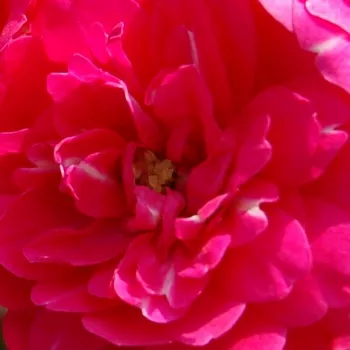
Bears many small, flat, very double blooms (over 40 petals) in clusters, size 0.5–1.5 inches; strongly remontant, producing an abundant second flush and further repeating in suitable conditions. |
| Colour data and phenology |
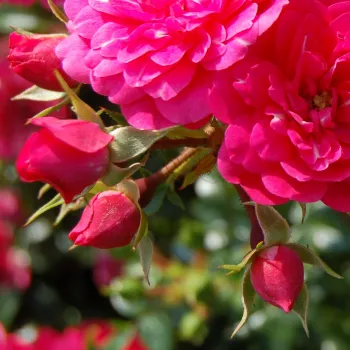
Deep pink flowers, buds velvety dark pink; opens bright with lighter centre, then rich deep pink before fading to soft pastel; colour fades faster in strong sun, holding better in cooler, overcast spells. |
| Fragrance and aroma |
Fragrance is very weak, with a discreet, neutral character; primarily chosen for colour, form and garden performance rather than scent, ideal where visual effect and easy care are higher priorities. |
| Hip characteristics |
Hip set is limited by the very double flowers; when present, hips are small, 6–10 mm, spherical and orange-red, adding modest late-season interest without significant self-seeding issues. |
| Resistance and winter hardiness |
Rated hardy to around −29 to −26 °C (RHS H7, USDA 5a, Swedish zone 4); good heat and moderate drought tolerance, with strong resistance to black spot, powdery mildew and rust in typical garden settings. |
| Horticultural recommendations |
Suited to sunny positions; low maintenance with good self-cleaning; plant 30–70 cm apart depending on use, at 6.3–7.2 plants/m² for massing; ideal for groundcover, edging, beds, containers and urban landscapes. |
KNIRPS® Groundcover KORverlandus offers compact, colourful groundcover with award-winning disease resistance and reliable repeat flowering on a durable own-root framework, making it a thoughtful choice for long-term, low-effort coastal-style planting.