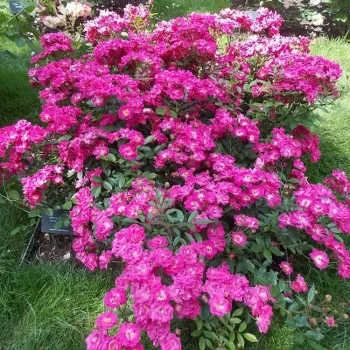
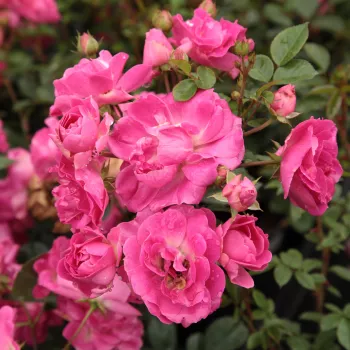
LIPPAY JÁNOS – dark pink bedding polyantha rose - Márk
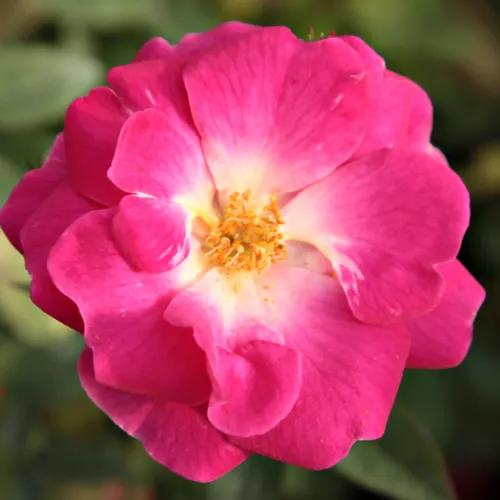
Imagine returning from a breezy walk on a Cornish beach to sit with tea behind a living windscreen of colour: LIPPAY JÁNOS is a compact polyantha rose that thrives where air is salty and wild yet space is limited. Its neat, upright habit fits easily into small family gardens and coastal verandas, creating a low, flower-packed hedge or edging that looks orderly but feels relaxed. Vibrant dark-pink clusters keep coming in generous waves from early summer onwards, holding their colour well in sun and wind. As an own-root plant, it builds a long-lived, reliable framework that regenerates from the base for a stable display over the years. In a typical UK setting with wind-prone, heavier ground, it appreciates simple, thoughtful drainage so roots stay anchored and healthy. Allow it time: roughly a year to focus on roots, a second to push stronger shoots, and by the third year you enjoy its full ornamental presence with minimal fuss. In a 40–50 litre container or snug shingle bed, it offers an easy-care, low, colourful border that makes everyday coastal living feel quietly refreshed.
Usage options
| Target area | Reasoning |
|---|
| Low bedding in small coastal front gardens |
The compact, upright growth suits shallow shingle beds and narrow strips by the front wall, where it forms a low, tidy but lively carpet of dark-pink clusters. Good heat and drought tolerance helps it cope with reflected sun and occasional dry spells typical of coastal streets, ideal for time-poor homeowners. |
| Informal edging for family paths and play lawns |
Its modest height and rounded spread create a soft edging that visually frames lawns and paths without becoming a prickly barrier for children. Semi-double flowers add colour and movement through repeated flushes, while own-root resilience means it recovers well from the odd knock or ball, reassuring busy families. |
| Containers on sheltered verandas and balconies |
Planted in a 40–50 litre pot with free-draining compost, it makes a stable, low-maintenance feature beside outdoor seating. Consistent repeat flowering and good colour retention in sun provide long seasonal interest, with only light pruning and feeding needed, convenient for new or time-pressed gardeners. |
| Coastal wind-filter hedge around seating areas |
Closely spaced, it forms a dense, knee-high line of stems and foliage that breaks up breezes without blocking the view, echoing the feel of dune vegetation. Its structure copes well where air is often moist, bright and moving, supporting a relaxed, seaside atmosphere appreciated by coastal-style enthusiasts. |
| Colour accent in mixed perennials with grasses |
The vivid, stable dark-pink flowers hold their tone above glossy foliage, giving a strong contrast to silvery Lavandula, blue Festuca or sea kale in a coastal-themed border. Repeating clusters extend the colour season beyond many perennials, supporting layered planting plans valued by design-conscious owners. |
| Urban front gardens and small courtyards |
Its naturally neat outline and moderate prickliness make it easier to live with along pavements or near parking spaces. Own-root growth provides a long-lived base framework, so even if stems are pruned hard for access or reshaping, the plant reshoots reliably, suiting practical-minded city-dwellers. |
| Low-maintenance mass planting in public-style spaces |
When planted at the recommended density, it delivers a continuous pink sheet of clustered blooms that reads clearly from a distance. Repeat flowering and compact structure reduce the need for intricate pruning; basic seasonal care and simple watering management keep displays attractive for community-focused residents. |
| Resilient accent in heavier coastal soils |
Once established with simple preparatory work to improve drainage, its good drought and heat tolerance combine with a sturdy root system, helping it stay stable and attractive where winds funnel through and rain can quickly saturate compacted ground, reassuring cautious coastal beginners. |
Styling ideas
- Seaside-border – combine LIPPAY JÁNOS with sea kale, Festuca and pale gravel to echo Cornish shingle banks – for lovers of relaxed, naturalistic coastal planting.
- Veranda-ribbon – line a balcony edge with large matching containers for a low pink fringe – for urban terrace owners wanting colour without complex care.
- Playfriendly-hedge – plant as a soft, low divider between patio and play lawn, keeping views open – for families seeking gentle structure around children’s spaces.
- Pink-parterre – use geometric blocks of this single variety in front gardens for a modern, easy-to-read pattern – for house-proud owners favouring simple but striking layouts.
- Pollinator-pocket – weave a few plants among yarrow and dwarf deutzia to create semi-wild nectar spots – for gardeners keen to support insects in small gardens.
Technical cultivar profile
| Parameter | Data |
|---|
| Name and registration |
LIPPAY JÁNOS is a polyantha bedding rose from the Bedding rose collection, traded internationally since 2005; it is marketed as a compact exhibition polyantha suitable for garden and landscape use. |
| Origin and breeding |
Bred in Hungary in 2002 by Márk Gergely from ‘Minililla’ × ‘Titanilla’, with PharmaRosa® Ltd. as initial distributor; developed as a bedding and edging rose with strong colour impact in mass planting. |
| Awards and recognition |
Bronze Medal at the Rome International New Rose Competition in 2005 and Bronze Medal at the Bundesgartenschau (BUGA) Gera-Ronneburg in 2007 highlight its ornamental and garden performance. |
| Growth and structural characteristics |
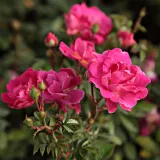
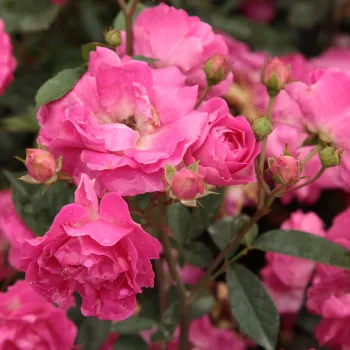
Compact, upright shrub reaching about 45–65 cm in height and 40–55 cm in spread, with moderately dense, glossy dark-green foliage and moderate prickliness, forming an even, low bedding structure. |
| Flower morphology |
Semi-double, cup-shaped blooms with 13–25 petals, produced in clusters on short stems. Small flowers (around 0.5–1.5 inches) appear in generous flushes, with a notably abundant second flowering wave. |
| Colour data and phenology |
Dark-pink flowers with a paler, almost whitish centre and contrasting yellow stamens; inner petals near RHS 60A, outer around 53A, with very good colour retention and only slight softening toward pastel mauve-pink. |
| Fragrance and aroma |
No noticeable fragrance is recorded; value lies in visual effect rather than scent. Semi-double flowers offer partial accessibility to pollen and nectar, giving moderate appeal to visiting pollinating insects. |
| Hip characteristics |
Produces small, bright-red hips about 6–9 mm across, generally globular and moderately numerous, adding a fine-textured autumn accent which is subtle but visible at close range in mixed planting schemes. |
| Resistance and winter hardiness |
Hardy to approximately −21 to −18 °C (RHS H7, USDA 6b, Swedish Zon 3). Drought and heat tolerance are good, but disease resistance is moderate to low, with particular sensitivity to rust in humid periods. |
| Horticultural recommendations |
Best in sunny, well-drained beds or large containers, with regular feeding and timely plant protection where disease pressure is high. Recommended spacing 25–50 cm depending on use, at around 10–11.6 plants per square metre. |
LIPPAY JÁNOS offers compact structure, vivid repeat flowering and reliable heat tolerance in a long-lived own-root form, making it a thoughtful choice for easy, colourful coastal and urban gardens.