LUCCY® – yellow dwarf-mini rose – Barni
Imagine a low, sparkling hedge of sunlight along a Cornish path: LUCCY® brings compact, shimmering colour to shingle beds, balcony boxes and patio pots while coping steadily with brisk coastal breezes and carefully managed wet, heavy soils. Its tidy, miniature habit stays neat beside deckchairs and children’s sand toys, and the bright, firefly-yellow blooms keep returning from early summer well into autumn with reassuring ease. As an own-root plant it offers dependable longevity and the ability to recover from weather stress, giving you a quietly reliable, low, flowering structure that anchors small spaces. With a modest ultimate size, LUCCY® is simple to position in front-of-border edges or on a breezy veranda, where its glowing clusters lend a feeling of seaside refreshment through the seasons.
Usage options
| Target area |
Reasoning |
| Coastal veranda containers |
Its compact, 30–40 cm growth habit suits tubs and balcony boxes where space is tight and wind exposure is higher; in a sheltered corner it forms a bright, low mound of yellow that is easy to water and tend from the doorstep, ideal for the busy beginner. |
| Small front-garden borders |
LUCCY® works well as a neat edging rose along a path or drive, giving structured lines and repeated mid-yellow colour without overwhelming a modest plot; spacing at about 35 cm helps create a soft but defined boundary perfect for a typical family garden. |
| Low coastal hedge or path edging |
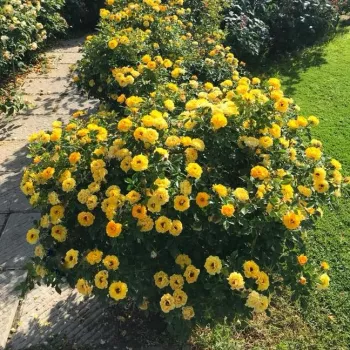
Planted at around 30 cm in a row, it forms a low, continuous ribbon of bloom that visually anchors shingle or gravel, particularly useful where you want order near parking spaces or play areas yet need plants that handle blustery conditions, suiting the practical homeowner. |
| Rock gardens and raised beds |
Its dwarf size and dense foliage sit naturally among rocks and gravel, and occasional deadheading is usually all that is required; in a raised bed the flowers can be enjoyed close-up from a chair, a bonus for the relaxed coastal-style gardener. |
| Balcony and roof-terrace pots (40–50 L) |
In a 40–50 litre container LUCCY® develops a stable root system that supports repeat flowering through summer; the modest height keeps views open while own-root vigour encourages long-term pot culture, a reassuring choice for the urban balcony owner. |
| Mixed perennial planting with grasses |
The vivid yellow clusters contrast attractively with compact grasses such as Festuca and low lavender, giving a seaside feel with minimal effort; good disease resistance means foliage remains glossy and dark, enhancing nearby textures for the design-conscious beginner. |
| Family play areas and seating corners |
Its small stature and moderately thorny stems make it easier to place near seating or along the edge of lawns where children play, while remontant flowering keeps the area cheerful over the holidays, suiting the comfort-focused family. |
| Low-maintenance own-root collection bed |
Planted with other compact roses, LUCCY® contributes reliable, long-season bloom on a durable own-root framework that can regenerate after pruning or weather damage, appealing to those who want a long-lived, steadily improving collection. |
Styling ideas
- Shingle-border sparkle – Line a shingle path with LUCCY® and a drift of blue Festuca for a bright, low ribbon of colour – ideal for coastal-style homeowners wanting easy structure.
- Teacup terrace – Plant LUCCY® in a 40–50 L pot beside a bistro set, underplant with sea thrift for a seaside feel – perfect for veranda tea drinkers with limited space.
- Miniature rock cove – Tuck LUCCY® between boulders with Campanula and small sedums to echo a rocky bay – suited to hobby gardeners creating a playful corner.
- Sunny balcony trio – Group three matching containers of LUCCY® along a rail, underplanted with trailing thyme – a tidy solution for busy urban balcony owners.
- Family-friendly edging – Use LUCCY® as a low hedge along a lawn, backed by lavender for scent and soft movement – attractive for families wanting gentle definition near play areas.
Technical cultivar profile
| Parameter |
Data |
| Name and registration |
Miniature dwarf rose from the Lillipuziane collection; registered as BARluccio, marketed as Luccy® and Luccy® Lillipuziane; ARS exhibition name Lucciola for show and catalogue listing. |
| Origin and breeding |
Bred by Enrico Barni in Pistoia, Italy, with parentage not disclosed; introduced by Rose Barni in 2011, representing their compact miniature line selected for garden and container use. |
| Awards and recognition |
Miglior Rosa Miniatura 2011 at the International Rose Competition in Madrid, plus a Certificate of Merit 2021 from the National Rose Trial Garden of Australia, confirming consistent ornamental quality. |
| Growth and structural characteristics |
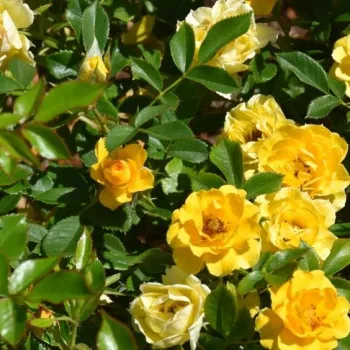
Compact, rounded plants 30–40 cm high and wide with dense, glossy dark green foliage and moderate prickliness; maintains a tidy outline suitable for edging, small borders, and container displays. |
| Flower morphology |
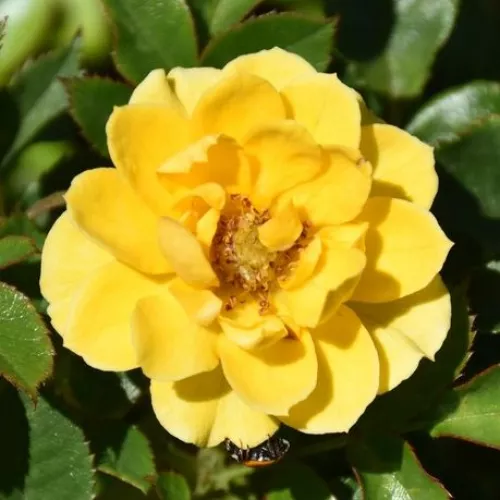
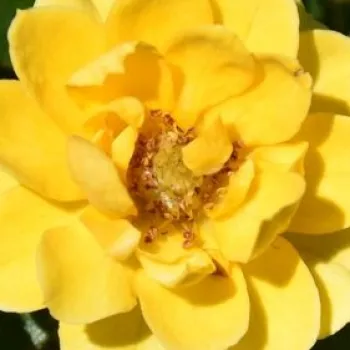
Semi-double blooms with 13–25 petals, small in size at 0.5–1.5 inches across, produced in clusters of 1–3 per stem; remontant flowering with an equally abundant second flush in suitable conditions. |
| Colour data and phenology |
Clear, bright mid-yellow flowers, RHS 14A outer and 13B inner; buds deep golden-yellow with slight orange undertone, colour holding well in sun with only lightening and virtually no browning or muddiness. |
| Fragrance and aroma |
Fragrance is very weak and barely noticeable, making it effectively a colour-focused miniature rose; best chosen for visual impact, structure and repeat flowering rather than for scent-led planting schemes. |
| Hip characteristics |
Rose hip production generally low; when present, forms occasional small spherical red hips around 5–7 mm diameter, offering a discreet seasonal accent without noticeably reducing ornamental flowering impact. |
| Resistance and winter hardiness |
Rated to approximately -21 to -18 °C, RHS H7, USDA zone 6b and Swedish zone 3; good resistance to black spot, mildew and rust, with moderate heat tolerance provided regular watering is maintained. |
| Horticultural recommendations |
Best in sunny positions, in borders, containers, rock gardens or small beds; allow 30–60 cm spacing depending on use, with free-draining but moisture-retentive soil and occasional deadheading to prolong display. |
LUCCY® offers compact coastal-friendly colour, reliable repeat flowering and durable own-root performance in pots or borders, making it a thoughtful long-term choice for brightening smaller garden spaces.