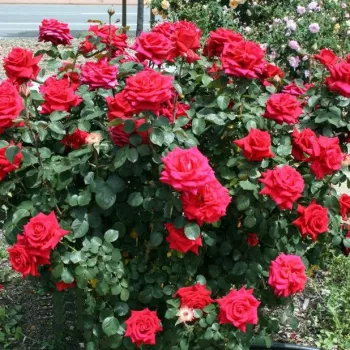
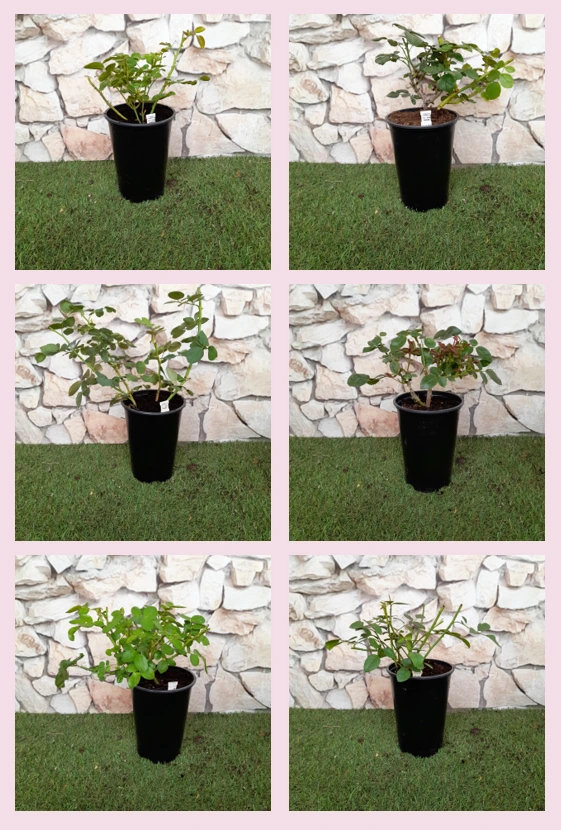
NATIONAL TRUST – scarlet hybrid tea rose – McGredy
Imagine returning from a blustery beach walk to sit with tea in a sheltered corner, framed by the vivid scarlet blooms of National Trust, their velvety petals catching the sun against glossy dark foliage. This compact hybrid tea rose fits easily into a typical family garden, thriving in a bright, sunny spot while coping well where exposed borders need extra rooting strength and reliable anchoring in breezy conditions. Container-grown in a 2‑litre pot, it is straightforward to plant and settles quickly, ideal if you want colour without complicated tasks. With regular deadheading and basic care, it rewards you with abundant, repeat flowering from early summer well into autumn, offering a quietly sophisticated, almost “exhibition” look in everyday spaces. As an own‑root rose it is grown for longevity, able to regenerate from its base and maintain stable ornamental value over many seasons, giving you time to enjoy its structure, balanced height and manageable width without the fuss of specialist rose skills, while its classic flower form provides a dependable source of elegant cut blooms for the home.
Usage options
| Target area |
Reasoning |
| Small coastal veranda containers |
Its bushy, compact habit and moderate height fit neatly into 40–50 litre containers on a sheltered coastal veranda, where its vivid scarlet blooms create a focal point without dominating the space; regular watering and deadheading keep it fresh and manageable for beginners |
| Front garden statement by the door |
The high‑centred, exhibition-style blooms present neatly towards eye level, giving a smart welcome beside a path or porch; in a sunny, wind-sheltered corner it delivers that “heritage house” feel without demanding advanced rose knowledge from busy homeowners |
| Mixed border with grasses and sea kale |
Dark, glossy foliage and rich scarlet flowers offer strong contrast to silver foliage and fine grasses such as Festuca or sea kale, providing a structural anchor that reads clearly from a distance for coastal-style lovers |
| Cutting patch for home bouquets |
Large, very double, high‑centred blooms on straight stems are ideal for vases, so even one or two bushes in a sunny corner can supply repeat stems through summer, giving you florist-style roses at home as an easy reward for hobby florists |
| Formal edging in a family garden |
Planted at recommended spacing, the compact bushes form a low, orderly line that defines lawns or paths without becoming over-tall, while the uniform scarlet colour lends a smart, traditional edge enjoyed by orderly gardeners |
| Feature in heavy, improved clay soil |
Once established, the own‑root plant develops a solid base that helps it sit steadily in improved clay beds in typical UK plots, giving reliable structure and flower production over time for practical gardeners |
| Long-season colour focus near seating |
Remontant flowering brings repeated flushes from early summer to autumn, so a seat or small terrace can look lively for much of the season with only moderate care and tidy deadheading expected of relaxed gardeners |
| Long-lived focal rose in a small garden |
As an own‑root plant it builds up quietly, with roots strengthening in the first year, shoots filling out in the second, and full ornamental presence by about the third, supporting a long service life that suits patient family gardeners |
Styling ideas
- Veranda Classic – One or two 50‑litre tubs flanking French doors, underplanted with low Festuca and coastal pebbles for a clean, seaside feel – ideal for coastal-style lovers
- Heritage Path – A short row along a front path, paired with trimmed Ilex crenata balls for a National Trust-inspired entrance – suited to homeowners wanting formal structure
- Cerise & Mist – Mixed with blue-grey grasses and pale sea kale in a shingle bed, echoing Cornish coves – perfect for relaxed coastal gardeners
- Tea & Roses – A single specimen beside a small seating area with lavender and Anemone ‘Fantasy Belle’ for late-summer softness – for those who enjoy evening garden rooms
- Cottage Cutting – A simple rectangular cutting strip with repeat-flowering rows, interplanted with Eupatorium for airy height – appealing to hobby florists and bouquet makers
Technical cultivar profile
| Parameter |
Data |
| Name and registration |
Hybrid tea rose ‘National Trust’; registered and commercially traded under the same name for garden and exhibition use, recognised by the American Rose Society as National Trust. |
| Origin and breeding |
Bred by Samuel Darragh McGredy IV from ‘Evelyn Fison’ × ‘King of Hearts’; introduced by Samuel McGredy & Son, Nurserymen in Northern Ireland in 1970 for garden and cut-flower cultivation. |
| Awards and recognition |
Recognised with a Belfast Certificate of Merit and RNRS Trial Ground Certificate in 1969, and a Silver Medal at the Courtrai Rose Trials in 1970 for garden and exhibition performance. |
| Growth and structural characteristics |
Bushy, compact shrub reaching around 80–100 cm in height and 60–80 cm spread, with medium-density, glossy dark green foliage and moderate prickles on well-branched, upright stems. |
| Flower morphology |
Large, very double, high‑centred hybrid tea blooms with 40+ petals, usually borne singly on stems; remontant habit with a generous second flush when deadheaded; no significant fragrance recorded. |
| Colour data and phenology |
Intense scarlet red with velvety depth; buds dark scarlet, opening to vivid scarlet, then mellowing only slightly to deep ruby before fading, providing very good colour retention across the flowering period. |
| Fragrance and aroma |
Classified as a scentless rose, with no noticeable fragrance reported in garden use; grown primarily for its colour impact, classic hybrid tea form and cutting qualities rather than perfumed effect. |
| Hip characteristics |
Rose hips are sparse due to the very double flower form; occasionally forms small, ovoid orange-red hips around 10–14 mm in diameter, with limited ornamental impact in most garden situations. |
| Resistance and winter hardiness |
Rated H7 and USDA Zone 6b, tolerating approximately −21 to −18 °C; displays moderate resistance to black spot, powdery mildew and rust, benefiting from standard preventive care in humid seasons. |
| Horticultural recommendations |
Best in sunny sites with well-drained soil; recommend 50–90 cm spacing depending on use, and at least 40–50 litre containers; medium maintenance with routine deadheading and periodic disease monitoring. |
NATIONAL TRUST offers compact structure, long-season scarlet blooms and enduring own-root reliability, making it a thoughtful choice for UK gardens where you prefer lasting beauty with manageable care.