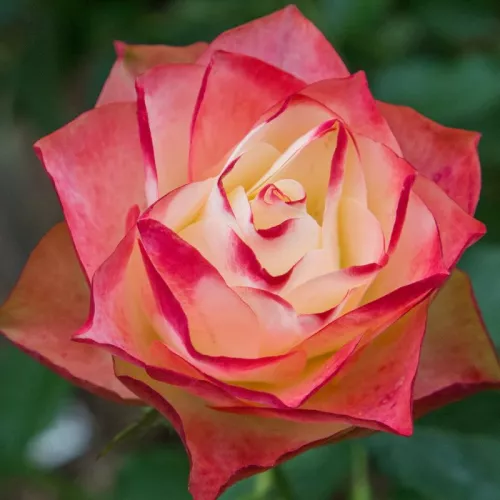
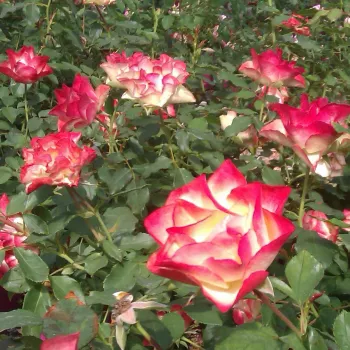
ORIGAMI ® – cream-red bedding floribunda rose – Meilland Richardier
Imagine stepping back from a blustery coastal walk to enjoy tea beside a sheltered shingle bed, where Origami blooms fold and refold like paper against the light. This compact floribunda offers colour-rich clusters of starry flowers that sit comfortably in smaller family gardens and on verandas, thriving in well-drained soil that copes smoothly with winter wet and wind. Its bushy habit makes it easy to tuck into narrow borders or raised beds, while the bicoloured petals add instant drama to containers from spring into autumn. Over time, the own-root form supports reliable renewal, with roots settling in the first year, stronger shoots building in the second, and a fuller ornamental display by the third. In larger pots, a 40–50 litre volume gives the structure and moisture balance this rose appreciates, helping it sit firmly against coastal gusts. Whether you favour a clean-lined modern layout or a softer cottage border, ORIGAMI ® keeps its crisp cream-and-red theme while staying compact enough for relaxed, low-fuss enjoyment.
Usage options
| Target area | Reasoning |
|---|
| Small coastal shingle bed |
The compact, bushy structure makes it easy to anchor in a confined shingle or gravel strip, where the patterned blooms supply strong visual interest without overwhelming the space – ideal for a low-effort, high-impact edge for beginners. |
| Feature container on a veranda |
In a 40–50 litre pot, this floribunda forms a neat mound of repeat-flowering stems that show off the cream-and-red blooms at eye level, perfect for a sheltered Cornish or Devon veranda where you want seasonal colour with straightforward routine care for homeowners. |
| Narrow front-garden border |
The moderate height and dense foliage help define paths and driveways without blocking light, while the angular, star-shaped flowers bring character to everyday family spaces, suiting people who want tidy planting lines with minimal pruning for busy. |
| Mixed bed with ornamental grasses |
Clustered blooms sit nicely against upright grasses such as switchgrass, so the rose provides colour while the grasses lend movement and airiness, creating a modern coastal feel with simple deadheading and feeding for hobby-gardeners. |
| “Girly” pastel seating corner |
The cream base and red edging soften as flowers age, giving a palette that works with soft pinks and whites around a seating area, while the compact habit keeps maintenance modest for those who want a pretty retreat without complex regimes for beginners. |
| Balcony or roof-terrace planter |
Planted in a deep, well-drained trough, the bushy growth and moderate drought tolerance allow reliable flowering where watering can be less regular, especially if combined with drought-tolerant companions, fitting those managing exposed urban spaces for city-dwellers. |
| Decorative low hedge |
At the recommended spacing, plants knit into a low, colourful line that frames lawns or play areas; the own-root form supports long-term structure and gradual regeneration, making it a considered, future-proof choice for families. |
| Clay-based coastal garden replant |
When set into improved, well-drained pockets within heavier soils, the bushy framework and firm root system work well where winter wet and blustery conditions can unsettle weaker roses, offering reliable shaping and flower production for coastal-owners. |
Styling ideas
- Shingle-Strip Focus – line a narrow gravel strip with ORIGAMI ® and low sea kale for a crisp, seaside feel with compact structure – for coastal veranda owners wanting tidy, low-fuss definition.
- Veranda-Tea Trio – plant one rose in a 50-litre tub with blue Festuca and trailing thyme to echo sea and foam – for those who enjoy calm, wind-sheltered seating areas.
- Modern-Grass Drift – weave ORIGAMI ® through clumps of Panicum ‘Sangria’ so bicolour blooms float above fine foliage – for design-conscious gardeners favouring contemporary coastal schemes.
- Romantic-Nook Mix – combine with soft pink Monarda and pale lavender in a small border beside a bench – for beginners seeking a feminine, gently scented reading corner.
- Front-Garden Frame – repeat plant along the front path, underplanting with low silver herbs to keep lines neat and inviting – for busy households who still want welcoming kerb appeal.
Technical cultivar profile
| Parameter | Data |
|---|
| Name and registration |
Floribunda bed rose, registered as MEImozahiq, marketed as ORIGAMI ® Classics MEImozahiq, a cream-red bicoloured variety suitable for exhibition as a bush or floribunda rose. |
| Origin and breeding |
Bred by Michèle Meilland Richardier for Meilland International in France, from unknown parentage, breeding completed in 1999 and introduced commercially in 2015 via Meilland Richardier. |
| Awards and recognition |
Gold Medal and Rose Hills Trophy for best floribunda at the Australian National Rose Trial Garden 2010, plus Silver Medal at the Tokyo International Rose & Gardening Show the same year. |
| Growth and structural characteristics |
Bushy, moderately thorny shrub reaching about 70–90 cm in height and 40–60 cm in spread, with dense, slightly glossy dark green foliage that forms a compact, well-filled outline in planting schemes. |
| Flower morphology |
Densely double, cluster-flowering blooms with over 40 petals, medium-sized at roughly 4–7 cm across, combining cup-shaped and star-like angular forms, produced repeatedly with a generous second flush. |
| Colour data and phenology |
Cream-white base with vivid red margins, ARS rb, RHS 155D and 46A; colour softens in strong sun as the red edge pales and the cream ground fades towards white over the bloom’s lifespan. |
| Fragrance and aroma |
Fragrance data are limited, but the variety is regarded as very weakly scented, with any aroma barely noticeable in normal garden use, making it primarily a visual feature rather than a perfumed rose. |
| Hip characteristics |
Due to the densely double form, hip set is usually sparse; when produced, hips are small, spherical, orange-red and around 8–12 mm in diameter, adding only a light decorative effect in late season. |
| Resistance and winter hardiness |
Very susceptible to powdery mildew, black spot and rust, requiring attentive plant protection; winter hardy to approximately –21 to –18 °C, corresponding to RHS H7 and USDA Zone 6b performance. |
| Horticultural recommendations |
Best placed in well-drained beds or large containers with regular feeding and preventive spraying; suits beds, borders, terraces, balconies and cutting, at relatively close spacings for a continuous display. |
ORIGAMI ® Classics MEImozahiq offers compact structure, striking bicolour blooms and long-term own-root reliability for containers and small coastal-style gardens; consider it if you value patterned flowers and steady seasonal colour.