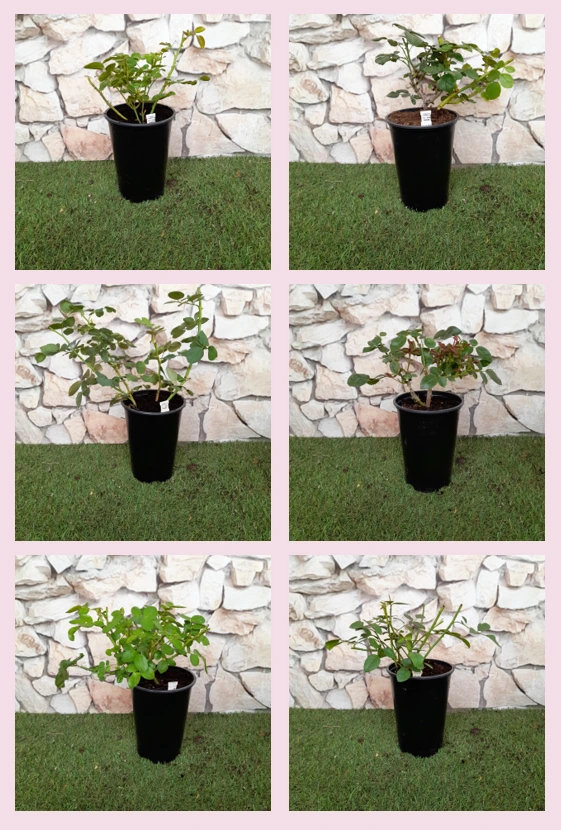
PASCALINE – white dwarf-mini rose - Lens
Created by Belgian breeder Louis Lens, Pascaline is a compact miniature rose that fits effortlessly into small UK gardens and coastal verandas, providing a sheltered, bright corner where its pure white blooms appear in generous clusters. Its rounded, upright habit and dense grey-green foliage help it stay steady in breezier, exposed positions while you enjoy its medium, honeyed fragrance at close quarters. In a 40–50 litre container or a narrow shingle border, its remontant flowering keeps colour going from early summer onwards with very little fuss, gradually strengthening as the roots anchor and the top growth fills out over the first few seasons. As an own-root rose, it offers dependable regeneration and a long ornamental life without complicated pruning, making it a reassuring choice for beginners and time-pressed gardeners who want reliable miniature flowers, compact growth, remontant display, fragrant evenings, durable colour, container versatility, long-lived planting and beginner-friendly care.
Usage options
| Target area |
Reasoning |
| Coastal veranda containers |
Its naturally compact habit makes Pascaline ideal for 40–50 litre tubs where wind could buffet taller roses, allowing you to create a sheltered, bright seating corner with steady white flowering and light honey scent – perfect for the coastal-style lover. |
| Small front gardens and entrances |
The dwarf, upright growth slots neatly beside steps or paths without blocking access, while pure white, cup-shaped blooms lend a neat, welcoming look even in very limited space – a reassuring option for the busy homeowner. |
| Low, formal edging to beds or borders |
Regular planting at 25–30 cm intervals forms a low, structured line of clean foliage and white clusters, giving definition to cottage or contemporary schemes with minimal clipping or training – ideal for the tidy-minded gardener. |
| Season-long display in mixed planting |
Its remontant flowering habit means waves of blooms after the first flush, offering long seasonal interest among perennials such as lavender and sea kale without constant deadheading – attractive for the time-pressed beginner. |
| Long-term planting in family gardens |
Being grown on its own roots, Pascaline builds strength steadily, coping well with routine pruning mishaps and recovering from knocks, so it remains an attractive feature year after year – reassuring for the cautious buyer. |
| Clay-based but well-drained borders |
Once established, its moderate size and dense root system help it sit securely in heavier soils that have been improved for drainage, providing stable ornamental value in typical UK family plots – helpful for the practical gardener. |
| Close-up seating and tea corners |
Medium-strength, honeyed fragrance is best appreciated at arm’s length, making it a natural choice beside benches or bistro sets where you sit at the same height as the blooms – appealing to the relaxed tea-drinker. |
| Exhibition miniature and collectors’ corners |
The refined, snow-white, many-petalled flowers and compact framework suit exhibition miniature standards or a dedicated container group, especially for those who value proven show performance – satisfying for the detail-focused collector. |
Styling ideas
- Shingle-terrace strip – line Pascaline along a sunny, gravelled edge with sea kale and low Festuca for a soft, coastal look – for veranda owners wanting simple, low visual clutter.
- Courtyard trio – group three 40–50 litre pots around a bistro set, underplanting with thyme or low sedums – for small-space gardeners craving a calm white focus.
- Mini hedge – plant a short run beside a path, interspersed with Calamintha nepeta ‘Blue Cloud Strain’ to bring movement and scent – for families seeking gentle structure without tall barriers.
- White-on-white bed – combine with pale ornamental grasses and white echinacea for a restrained, elegant palette – for design-led owners who prefer a cool, modern scheme.
- Collector’s showcase – mix Pascaline with other miniature roses in matching containers to highlight contrasting forms and bloom styles – for enthusiasts building a compact, curated collection.
Technical cultivar profile
| Parameter |
Data |
| Name and registration |
Miniature rose cultivar Pascaline, registered as LENpas; commercial type dwarf miniature, part of the Mini – dwarf rose collection, also exhibited under the American Rose Society name Pascaline. |
| Origin and breeding |
Bred by Louis Lens, Lens Roses N.V., Belgium, from unknown seedling × (‘New Penny’ × ‘Jour de Fête’); introduced and registered in 1984, reflecting classic Lens miniature breeding. |
| Awards and recognition |
Honour Diploma at Rose Salon, Paris, 1984, underlining its ornamental value and stability in exhibition miniature classes soon after introduction to the European rose market. |
| Growth and structural characteristics |
Compact, upright habit reaching 30–40 cm in height and spread, with dense, matt grey-green foliage and sparse prickles; forms a neat, rounded bush suited to edging, small beds and containers. |
| Flower morphology |
Double, cup-shaped blooms of 26–39 petals, small size around 0.5–1.5 inches, produced in clustered inflorescences; remontant with abundant second and subsequent flushes across the growing season. |
| Colour data and phenology |
Pure cool white blooms, ARS W, RHS 155D outer and 155C inner; colour holds very well, barely fading, with a subtle pearlescent sheen and occasional greenish tinge at bud and petal bases. |
| Fragrance and aroma |
Medium-strength, honeyed fragrance best appreciated at close range; primarily ornamental, with very double flowers that partly conceal stamens and therefore offer limited value for pollinator foraging. |
| Hip characteristics |
Occasionally sets small, spherical orange-red hips, about 5–7 mm in diameter; hips are decorative rather than prolific, adding a light seasonal accent if spent blooms are not removed in late summer. |
| Resistance and winter hardiness |
Hardy to approximately −21 to −18 °C (RHS H7; Swedish zone 3; USDA 6b); disease resistance medium overall, with good resistance to black spot and medium tolerance to powdery mildew and rust. |
| Horticultural recommendations |
Best in full sun with improved drainage; plant 25–50 cm apart depending on use; suitable for containers, borders, beds and cutting; maintenance moderate with occasional pest and disease checks. |
PASCALINE – white dwarf-mini rose - Lens offers compact growth, remontant white flowering and a long-lived own-root structure, making it a thoughtful choice for containers or small borders you plan to enjoy for years.