PAULII – white wild rose - Paul
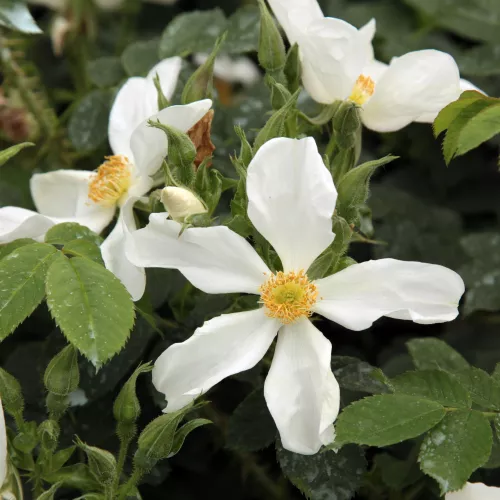
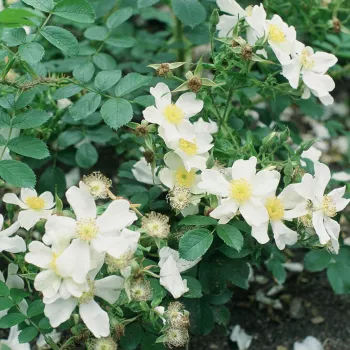
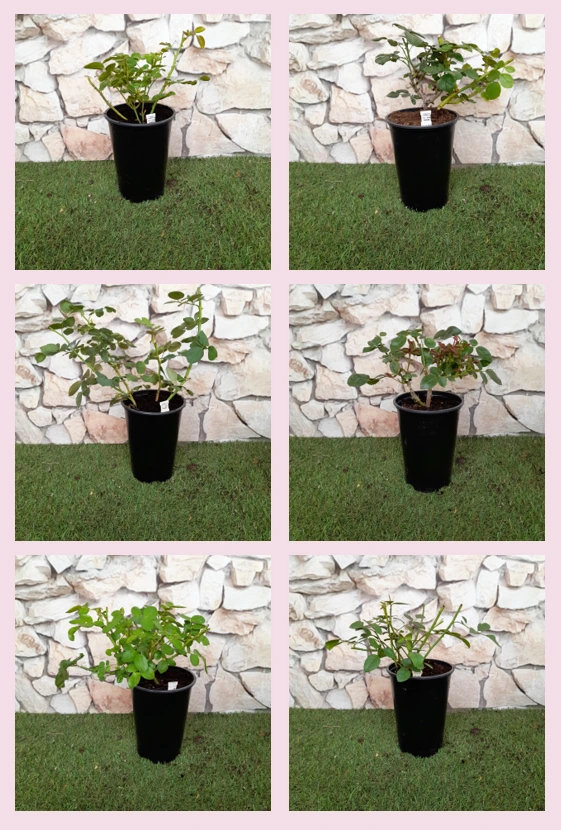
Imagine a low, foam-white sea of flowers edging your garden, giving that breezy Cornish veranda feeling without demanding your weekends. Rosa paulii settles in quickly on well-drained soil and copes calmly with strong winds and salt-tinged air, helping your borders stay neat and anchored in blustery weather. As a spreading, ground-hugging shrub, it covers bare spots efficiently, yet remains manageable in a family garden. Its once-a-year curtain of snow-white blossoms has a gentle, spicy fragrance that suits quiet afternoon tea rather than fuss and formality. Dense, thorny growth creates a discreet living barrier along shingle drives or boundaries, while disease-resistant foliage keeps its fresh, mid-green look with little intervention. In an own-root 2‑litre container, the first year focuses on roots, the second on framework, and by the third year you enjoy its full coastal charm.
Usage options
| Target area | Reasoning |
|---|
| Low coastal hedge along a driveway or boundary |
The naturally spreading, bushy habit and dense prickles form a low, effective barrier that stays tidy without clipping, ideal for subtly guiding movement and marking edges for busy coastal homeowners |
| Shingle or gravel strip in a coastal-style front garden |
Rosa paulii is well suited to exposed positions, coping with brisk breezes and occasional salt spray while its wide spread knits into shingle, helping stabilise loose areas for low-maintenance design lovers |
| Groundcover on banks or the foot of a sunny slope |
The broad, 210–390 cm spread creates a cohesive carpet that suppresses weeds and visually softens banks; once established it needs little more than seasonal checks for hands-off gardeners |
| Feature plant in a small family lawn corner |
Its single, snow-white summer flush forms a striking seasonal highlight without constant deadheading, giving a sense of occasion and structure from one well-placed shrub for time-poor families |
| Background planting in mixed coastal borders |
Matte, mid-green foliage and restrained height make a calm backdrop for perennials like Festuca or sea kale, keeping the scene coherent while demanding very little routine care for informal border creators |
| Large container on a sheltered veranda or terrace |
In a 40–50 litre or larger container it becomes a gently arching presence, its summer bloom creating a cool, white focus without intricate pruning, suiting verandas used for relaxation by urban balcony owners |
| Natural-style urban green space or park edge |
Low maintenance requirements and strong disease resistance mean fewer interventions for councils or residents’ groups, while the wild-rose character blends well with informal grass and shrub plantings for public-space custodians |
| Loose, informal hedge in partial shade |
Its tolerance of partial shade and good heat and drought resilience allow flexible siting, and it still flowers well enough to brighten dappled margins with minimal input for practical home gardeners |
Styling ideas
- Cornish veranda drift – Plant Rosa paulii in a wide arc by decking, underplanted with sea kale and Festuca; add pale timber furniture for a calm, breezy tea spot – ideal for coastal-style enthusiasts
- White shingle ribbon – Thread a loose line of plants through a shingle front garden, weaving between boulders and driftwood accents for a relaxed, beach-lane look – suited to low-upkeep front gardens
- Soft bank anchor – Use as a repeating groundcover on a sunny slope with Scabiosa and Euphorbia ‘Fens Ruby’ to bind soil and provide seasonal contrast – perfect for sloping family plots
- Simple hedge frame – Space plants along fences at 180 cm to form a low, informal hedge that frames lawns without blocking light, pairing with lavender for scent – good for compact family gardens
- Statement tub – Grow a single plant in a 50 litre half-barrel with gravel mulch and sweet alyssum at the rim for a cool, white summer accent – ideal for rented homes and terraces
Technical cultivar profile
| Parameter | Data |
|---|
| Name and registration |
Botanical rose, wild rose type, current trade name Rosa paulii; ARS exhibition name Paulii; unregistered cultivar historically listed in the dowager (old garden) bush rose class. |
| Origin and breeding |
Bred in the United Kingdom by George Paul Jr., Paul & Son (Cheshunt); hybrid Rugosa and species cross from Rosa arvensis, R. rugosa and R. wichuraiana, introduced circa 1903. |
| Awards and recognition |
Honoured in American rose shows as Dowager Rose Queen (1998–2001) and recipient of multiple “Genesis” awards at district level between 1999 and 2014 for historical rose excellence. |
| Growth and structural characteristics |
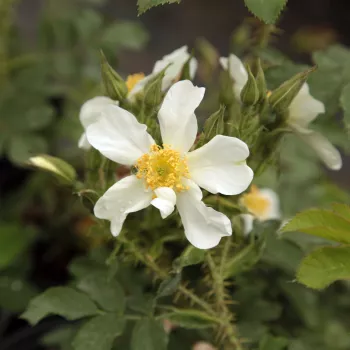
Bushy, spreading habit 70–130 cm high and 210–390 cm wide, forming dense, thorny, moderately leafy mounds with matte, mid-green foliage and good natural self-cleaning after flowering. |
| Flower morphology |
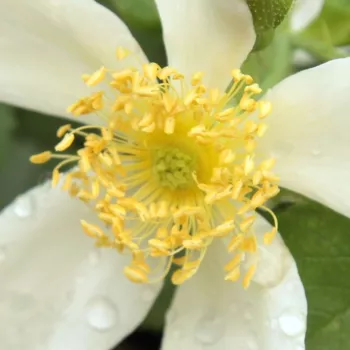
Single, flat, cluster-flowered blooms with 5–12 petals; small flowers (about 0.5–1.5 inch) appear once per season in profuse clusters, then shed their petals cleanly without manual deadheading. |
| Colour data and phenology |
Flowers open ivory with a creamy blush, quickly becoming pure snow-white (RHS NN155C–NN155D), then fade to translucent white with a light beige edge; colour retention modest in strong sun and rain. |
| Fragrance and aroma |
Displays a mild, pleasantly spicy scent that is noticeable at close range without overwhelming nearby seating areas; fragrance best appreciated in calm, warm weather during peak flowering. |
| Hip characteristics |
After flowering it typically sets small, spherical hips 18–26 mm in diameter, bright red (RHS 43A), punctuating the bush with simple autumn interest among the mid-green foliage. |
| Resistance and winter hardiness |
Exceptionally hardy to approximately −29 to −26 °C (RHS H7, USDA 5a), showing high resistance to powdery mildew, black spot and rust, plus good tolerance of heat and moderate summer drought. |
| Horticultural recommendations |
Suited to low-maintenance hedges, groundcover and specimen use at 180–330 cm spacings; tolerates partial shade, coastal exposure and urban sites when planted in reasonably well-drained soil. |
Rosa paulii offers an easy-care white summer spectacle, reliable ground-covering structure and long-lived own-root resilience; a thoughtful choice if you prefer lasting beauty with very little effort.