POMPADOUR RED™ – red bedding floribunda rose – Ruiter
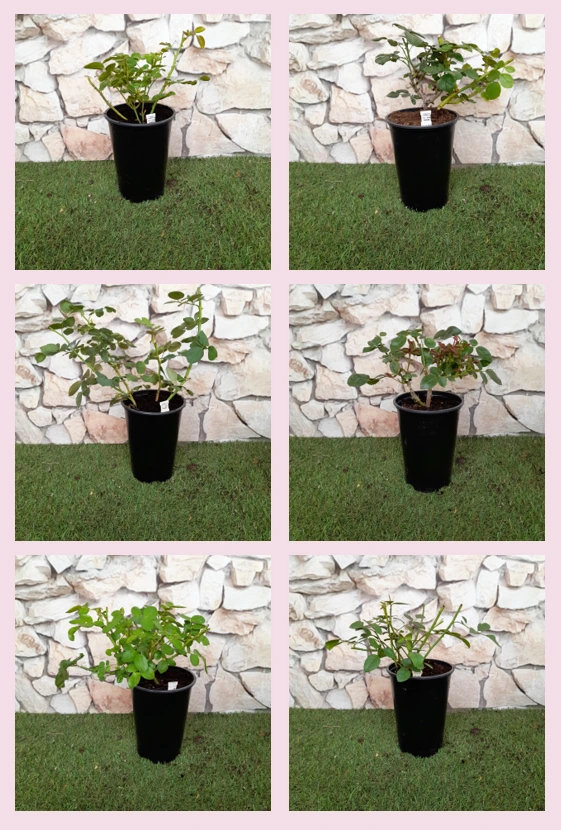
Imagine returning from a breezy coastal walk, seashells in hand, to a veranda sheltered by a low hedge of Pompadour roses, their scarlet blooms glowing even in cool, windy weather. This compact floribunda builds a dense, bushy structure that naturally helps with anchoring in exposed family gardens while its glossy foliage and reliable health keep borders looking fresh with very little effort. Own-root plants establish steadily – think year-by-year progress from rooting to branching to full flower show – so you gain a long-lived, regenerating rose for low, colour-rich planting in coastal-style beds, shingle strips and generous 40–50 litre pots on sunny verandas.
Usage options
| Target area | Reasoning |
|---|
| Small coastal front garden border |
The dense, bushy habit and moderate height create a neat, wind-resilient front border that does not swamp a small plot, while the uniform scarlet-red clusters give clear structure from the pavement. Plant in free-draining soil and allow a little space around each plant for air movement, particularly in exposed Cornish or Devon drives, ideal for the busy beginner |
| Mass bedding along a shingle path |
As a classic bedding floribunda, it responds well to mass planting at the recommended spacing, quickly forming a continuous ribbon of colour that reads strongly even in bright coastal light. Use in shingle or gravel with improved subsoil drainage so roots can establish securely and cope better during wet, blustery spells by the sea, perfect for the coastal stylist |
| Low flowering hedge around a family seating area |
Its upright, hedging-friendly structure and repeat-flowering clusters lend themselves to a low rose hedge that defines a seating nook without blocking light. The modest prickliness discourages shortcut trampling while remaining manageable for routine deadheading and shaping, making a robust yet attractive divider for the family gardener |
| Large container on a sunny veranda (40–50 L+) |
Own-root plants in generous 40–50 litre containers on a sheltered veranda settle into a stable framework of shoots that can be lightly renewed over time, giving season-long colour close to the house. Adequate volume buffers watering intervals, so you enjoy reliable flowering without constant fuss, particularly valued by the time-poor homeowner |
| Season-long colour focus near the front door |
The remontant flowering and notably abundant second flush mean you get a long, reliable display rather than a single peak, helping the entrance stay welcoming through the core garden season. Position by a path or porch where the rich scarlet tones contrast with lighter planting and hard landscaping, reassuring for the impact-seeking owner |
| Easy-care, low-intervention rose bed |
With generally good resistance to key rose diseases, this cultivar suits gardeners who prefer not to spray or micromanage foliage. Combine with low-maintenance companions and a simple mulch regime, and routine care is largely reduced to an annual feed, some deadheading and occasional shaping, very convenient for the casual gardener |
| Long-term, stable planting in a family garden |
As an own-root rose, it does not depend on a graft union, so it ages steadily, can regenerate from its own base wood after hard pruning and maintains its true variety if damaged. This makes it well suited to long-lived borders where you want consistency year after year with minimal replanting, reassuring for the long-range planner |
| Coastal-style mixed planting with grasses and perennials |
Its strong, even colour reads clearly amongst silvery foliage and fine grasses, while the bushy framework weathers breezy days and supports clusters of blooms above sea-kale, Festuca and low Lavandula, helping balance salty, windy, sunny spots beside patios and paths in exposed gardens, especially attractive to the coastal enthusiast |
Styling ideas
- Shellwalk Border – edge a shingle path with repeating groups, underplant with sea kale and low blue fescues for a beach-walk feel – ideal for coastal veranda owners seeking a relaxed, seaside mood
- Crimson Courtyard – plant three in a triangle in a 50 L container, then add trailing thyme and soft grasses around the rim – suited to small urban courtyards needing long-season structure
- Windbreak Ribbon – use as a low hedge on the windy side of a patio, backed by taller shrubs to create a sheltered tea spot – perfect for families wanting gentle enclosure without heavy fencing
- Harbour Entrance – flank your front door with matching pots, combining this rose with lavender and silver foliage for a maritime welcome – appealing to homeowners who like a strong, tidy first impression
- Sunset Mixed Bed – weave groups between smokebush and variegated dogwood so the scarlet flowers punch through contrasting foliage – for gardeners who enjoy rich, dramatic planting with minimal extra care
Technical cultivar profile
| Parameter | Data |
|---|
| Name and registration |
Floribunda bedding rose marketed as POMPADOUR RED™; registered cultivar name Pompadour Red, florists and exhibition floribunda type, verified cultivar authenticity for vivianaROSE® ORIGINAL 2-litre own-root supply. |
| Origin and breeding |
Bred by Gerrit de Ruiter, De Ruiter Innovations BV, Hazerswoude, Netherlands, from Orange Triumph × Anne Mette Poulsen; introduced 1951 via Jackson & Perkins Co. in the USA, unregistered in formal registers. |
| Awards and recognition |
RNRS Trial Ground Certificate awarded in 1951, indicating proven garden performance and ornamental impact under trial conditions, with particular value as a bedding floribunda in traditional rose displays. |
| Growth and structural characteristics |
Bushy, upright shrubs reaching about 100–140 cm in height and 70–110 cm spread, with moderately dense, glossy dark green foliage and moderate thorniness; suited to hedging, bedding and specimen planting layouts. |
| Flower morphology |
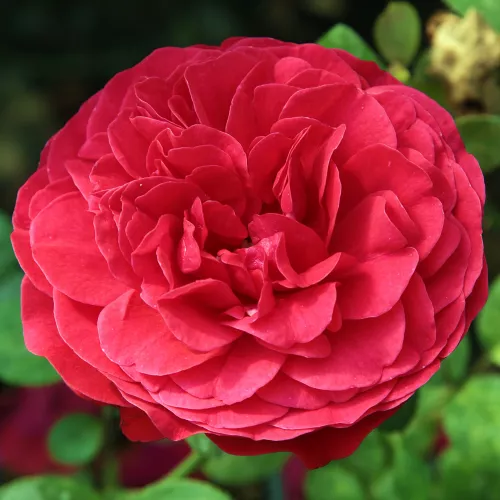
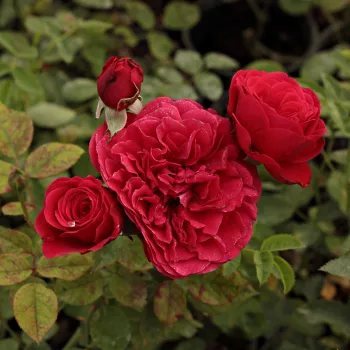
Large, double, cupped blooms with approximately 26–39 petals, borne in clusters on floribunda-type inflorescences; remontant with especially abundant second flush and good presence for both bedding and cutting. |
| Colour data and phenology |
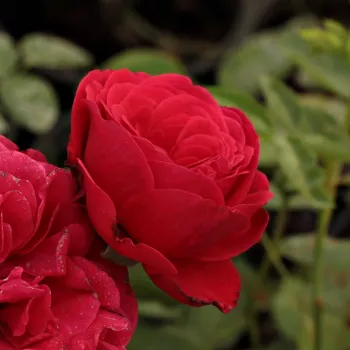
Uniform, intense scarlet red: RHS 46B outer, 53A inner; buds deep glossy scarlet, colour hardly fades, remaining even and only slightly matt with age, giving consistently strong colour impact across the flowering season. |
| Fragrance and aroma |
Fragrance is mild and restrained, not a dominant feature; suits gardeners prioritising colour, health and bedding effect over strong scent, and avoids overwhelming nearby seating or small enclosed terraces. |
| Hip characteristics |
Hip set is naturally limited by the full double flowers; occasional small, globular red hips around 6–10 mm may form, offering modest seasonal interest without significantly detracting from repeat flowering. |
| Resistance and winter hardiness |
Good overall disease resistance, noted as resistant to powdery mildew, black spot and rust; hardy to approximately −21 to −18 °C (RHS H7, Swedish zone 3, USDA 6b), suitable for most UK climates with standard care. |
| Horticultural recommendations |
Plant at about 55–65 cm for hedges or bedding, wider for specimens; allow 2.4–2.7 plants/m² in mass schemes. Low maintenance with minimal intervention; choose well-drained soil and regular watering for containers. |
POMPADOUR RED™ offers season-long scarlet bedding colour, reliable disease resistance and a stable, regenerating own-root framework for enduring coastal-style borders and containers, making it a thoughtful choice to anchor your family garden.