ROSA VIRIDIFLORA – green historic China rose - Smith
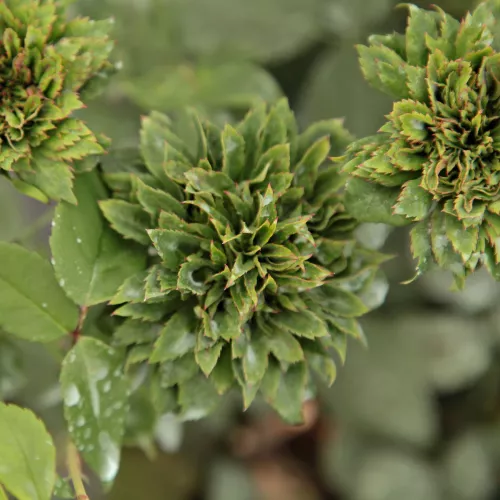
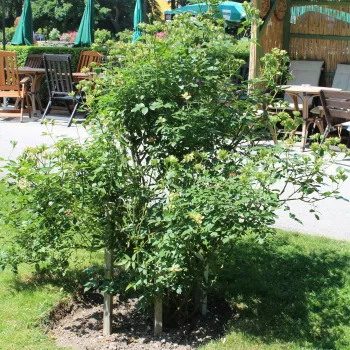
Rosa viridiflora is a historic China rose with truly unique green blooms that bring a quietly modern twist to coastal and family gardens. Its compact, bushy habit stays orderly in small spaces, while remontant flowering gives a surprisingly long season of interest. On breezier plots it copes well with exposure, offering reassuring stability and structure even where you manage heavy soils with careful drainage and watering. The unusual pompon flowers retain their deep green colour with only slight bronzing, adding character to shingle beds, gravel corners and veranda pots from summer well into autumn. As an own-root plant it settles in steadily, with roots in the first year, stronger shoots in the second, and full ornamental value by the third for a satisfyingly lasting feature that suits time-poor but design-conscious gardeners.
Usage options
| Target area | Reasoning |
|---|
| Small coastal veranda container (40–50 litre) |
The compact, upright framework of Rosa viridiflora suits a single, substantial container where space is tight but you still want a focal plant with an intriguing, architectural bloom. A 40–50 litre pot gives enough rooting volume for long-term stability and easier watering rhythm for relaxed coastal-style living, ideal for the beginner. |
| Feature plant in shingle or gravel bed |
The green pompon flowers read beautifully against pale shingle, echoing sea-glass tones while the bushy habit offers a neat, textural anchor among drought-tolerant perennials. With thoughtful watering it tolerates exposed, breezy positions and copes reassuringly where drainage and water management are both important in a family garden for the homeowner. |
| Compact flowering hedge near seating |
Planted at 55–60 cm spacings, Rosa viridiflora knits into a low, semi-formal hedge that frames a terrace or seating nook without overwhelming the space. The unusual flowers encourage you to look closely while the moderately dense, glossy foliage provides a soft screen and a sense of enclosure, rewarding the patient hobby-gardener. |
| Specimen rose in mixed border |
Used singly at about 1 m from neighbours, this historic rose becomes a talking point, its mid-green flowers contrasting calmly with silvers, blues and soft pinks. Repeat flowering gives recurring highlights through the season, and own-root growth supports a long-lived presence that matures steadily for the design-minded collector. |
| Historic or “curiosity” corner in family garden |
Rosa viridiflora’s 19th-century heritage and entirely green blooms make it ideal for a small area devoted to unusual or story-rich plants. Children and guests alike tend to be fascinated by its unexpected colour, and the medium maintenance requirement stays manageable with simple deadheading for the curious family. |
| Part-shade side path or courtyard |
This variety tolerates partial shade, so it can illuminate a side return, north-east veranda edge or light courtyard where sun is limited. The glossy mid-green foliage remains presentable, and repeat flushes ensure continued interest without demanding complex care routines for the busy urbanite. |
| Low-maintenance own-root planting for longevity |
As an own-root shrub, Rosa viridiflora does not rely on graft unions, so it ages steadily, regenerating from the base if cut back by weather or pruning. Over time this underpins a stable outline and dependable ornamental value with fewer replacement plants needed for the practical planner. |
| Wind-sheltered coastal-style planting with grasses |
In a lightly sheltered coastal-style bed, this rose partners well with fine grasses and salt-tolerant companions, offering structure while swaying in the breeze. It remains reasonably composed in showery, blustery spells, complementing a planting scheme designed for salty, windy and sunny days by the sea for the coastal enthusiast. |
Styling ideas
- Shingle Chic – Set Rosa viridiflora among sea kale, Festuca and pale gravel for a muted coastal palette – for those who favour understated, textural front gardens.
- Veranda Focus – Place one rose in a 50 litre clay pot with trailing Campanula at the base – for balcony or veranda owners wanting character from a single container.
- Heritage Corner – Combine this historic China rose with old brick, zinc watering cans and vintage pots – for gardeners who enjoy storytelling plants with a period feel.
- Green Drama – Underplant with dark Heuchera and upright blue grasses to highlight the unusual green blooms – for design-aware gardeners seeking a bold yet easy-care contrast.
- Soft Screen – Use a short row by a seating area with airy Lavandula and Stipa for movement and scent – for families wanting a gentle sense of enclosure without solid fencing.
Technical cultivar profile
| Parameter | Data |
|---|
| Name and registration |
Rosa viridiflora, also known as Green Rose, is a historic China shrub rose; heritage collection type with verified cultivar authenticity under the product name ROSA VIRIDIFLORA – green historic China rose - Smith. |
| Origin and breeding |
A spontaneous sport of ‘Slater’s Crimson China’ (Rosa chinensis), bred by John Smith in the United States around 1827 and introduced into European horticulture in 1855 as a distinctive green-flowered curiosity. |
| Growth and structural characteristics |
Bushy, upright shrub reaching about 80–130 cm in height and 60–100 cm spread, with moderately dense, glossy mid-green foliage, slightly thorny stems and a framework suited to beds, low hedging or container culture. |
| Flower morphology |
Small, double pompon blooms (about 0.5–1.5 inches) carried in clusters, with 26–39 highly modified petals and strong remontant behaviour, giving an initial flush followed by abundant repeat flowering in suitable conditions. |
| Colour data and phenology |
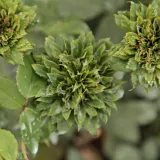
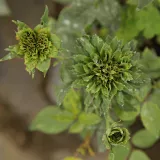
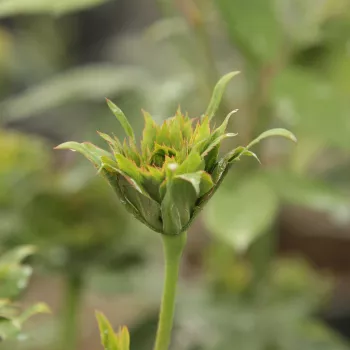
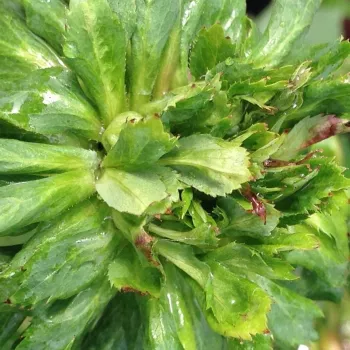
Entirely green flowers: buds oil-green and matt, opening vivid mid-green, then pale yellow-green with bronzed edges, maturing to deep willow green while largely retaining colour even in strong sunlight with minimal bronzing. |
| Fragrance and aroma |
Fragrance is very weak and only barely perceptible, with a subtle spicy character rather than a classic rose scent; flowers are primarily ornamental and of modest value for scented gardens or cut-flower use. |
| Hip characteristics |
Occasional small, spherical hips about 6–10 mm across, green to brownish in colour, may form where flowers are not removed; hips are generally unobtrusive and of limited ornamental impact compared with the unusual blooms. |
| Resistance and winter hardiness |
Hardy to around −21 to −18 °C (RHS H7; USDA Zone 6b; Swedish Zone 3), with good resistance to powdery mildew and black spot, moderate rust susceptibility, and medium tolerance of summer heat and short dry spells. |
| Horticultural recommendations |
Suited to beds, specimen and container planting, at 55–60 cm spacing or around 1 m as a solitary; prefers well-drained soil, regular moisture, occasional protection and deadheading to offset poor natural self-cleaning. |
Rosa viridiflora offers uniquely green, repeat-flowering blooms, compact structure for smaller spaces and long-lived own-root reliability; consider it when you want a quietly distinctive, enduring rose for your garden.