ROSIGE LANDDROSTEI® – red bedding floribunda rose – Kordes
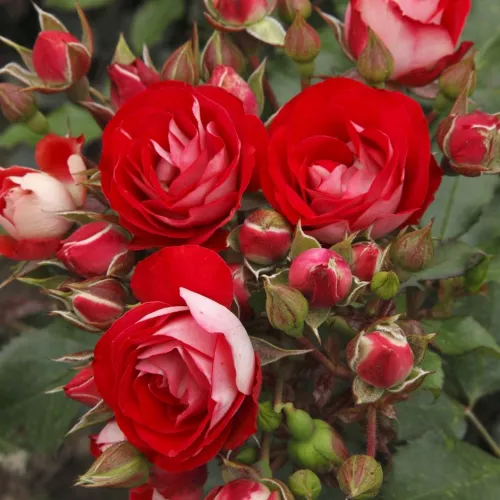
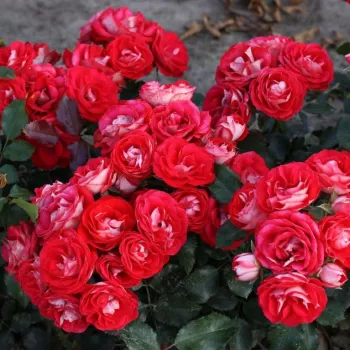
Imagine coming home from the beach to a sheltered, sunny corner where a compact rose brings a sense of coastal refreshment to your garden every time it flowers. Rosige Landdrostei® stays pleasantly manageable in size, making it easy to fit into smaller beds, front gardens or a roomy container on a veranda. Its clusters of small, double blooms give a lively, two-toned red-and-cream effect that pairs beautifully with sea kale, Festuca and lavender, suiting shingle or salt-tolerant planting schemes. As an own-root plant, it builds stability below ground, supporting long-term health and ornamental value in breezy conditions with good drainage and winter resilience. The glossy dark foliage adds lasting structure, so borders still look composed between flushes of flowers. With light, regular care and sensible watering, you can enjoy a dependable display from late spring onwards. Over its first seasons it quietly invests in roots, then stronger shoots, then by year three offers its full presence as an established feature in your family garden.
Usage options
| Target area |
Reasoning |
| Small coastal front garden bed |
The compact, bushy habit fits neatly into narrow beds along paths or driveways, giving colour without overwhelming the space. Its steady performance in breezy, well‑drained sites suits exposed Cornish or Devon front gardens where you want reliable structure and flowers for beginners. |
| Feature rose for shingle or gravel strip |
In a shingle strip with good drainage, Rosige Landdrostei® settles in securely, rooting into the stony surface and coping well with breezy, changeable weather common near the coast, helping you enjoy a bright focal point with modest watering needs as a homeowner. |
| Large container on a coastal veranda |
Its moderate height and width suit a 40–50 litre container, where roots have enough space to anchor and support stable, long-term growth. Placed against a sunny, sheltered wall, it adds welcoming colour you can enjoy close up, ideal for a low-fuss urban-gardener. |
| Low flowering hedge along a seating area |
Planted at hedge spacing, the slightly spreading, bushy growth knits together into a low, colourful edge around a terrace or seating corner. The consistent height makes it easy to look over while still giving a sense of enclosure, suiting relaxed outdoor teas for a family. |
| Mixed border with sea kale and ornamental grasses |
The vivid medium-red, two-tone flowers contrast beautifully with silvery foliage and blue-grey grasses, creating a fresh, coastal feel. Dense, dark green leaves provide a calm backdrop that ties the planting together from spring into autumn for a style‑conscious coastal-lover. |
| Edging rose for a clay-based family garden |
Once established in improved, free‑draining soil on heavier ground, its own-root system supports long life and dependable regrowth, even after a tough winter. Along the front of a border it gives tidy colour and structure with simple seasonal care, reassuring any beginner. |
| Urban courtyard bed with partial shade |
In brighter courtyards where the soil may dry quickly, this moderate-height floribunda is happy with average watering and light pruning, offering repeated flushes of small double blooms. Its tolerance of partial shade helps it flower reliably for a busy city-dweller. |
| Single specimen near a veranda table |
Grown as a solitary plant with generous spacing, its rounded form and clusters of delicately scented, double red blooms become a charming focal point by the seating area. The own-root habit supports steady renewal of shoots, keeping it attractive for many seasons for a relaxed tea-drinker. |
Styling ideas
- Coastal-Veranda Pot – place Rosige Landdrostei® in a 40–50 litre clay pot with seaside touches such as pebbles and blue-glazed containers – ideal for veranda owners wanting easy coastal charm.
- Shell-Edged Border – line a narrow bed with crushed shell or light gravel and underplant with Festuca and lavender to echo the seashore – perfect for those creating a relaxed, beach-inspired front garden.
- Girly-Raspberry Strip – combine its raspberry-red tones with pale pink cranesbill and soft grasses for a light, feminine feel – suited to small family gardens that need gentle colour without overcrowding.
- Shingle-Ribbon Hedge – repeat plants in a loose line through shingle, weaving around sea kale and low perennials – good for homeowners wanting an informal, low hedge with minimal clipping.
- Tea-Corner Feature – position one plant near a bistro table on a sunny patio, framed by lavender-filled pots – made for those who enjoy quiet afternoon tea sheltered from the wind.
Technical cultivar profile
| Parameter |
Data |
| Name and registration |
Rosige Landdrostei® is a floribunda bed rose, registered as KORteidros. It belongs to the bedding rose collection and is sold as a shrub‑type flower bed floribunda for garden and landscape use. |
| Origin and breeding |
Bred by Wilhelm‑Alexander Kordes at W. Kordes’ Söhne, Germany, from (unknown seedling × ‘KORpeligo’) × ‘KORfloci08’. Introduced and registered in 2017 in Europe, reflecting modern breeding standards. |
| Growth and structural characteristics |
Bushy, compact, slightly spreading habit, 80–120 cm high and 40–60 cm wide. Dense, dark green, glossy foliage and moderate prickliness give a robust framework suitable for beds, edging and container planting. |
| Flower morphology |
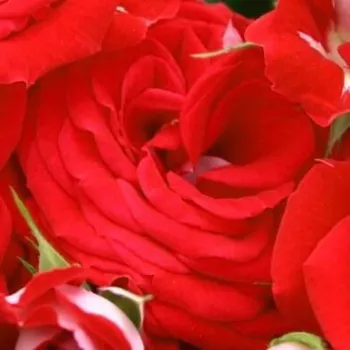
Small, ball to pompon-shaped double blooms with 26–39 petals, borne in clusters of three to ten per stem. Repeats well with a generous second flush, creating long-season ornamental impact in beds and borders. |
| Colour data and phenology |
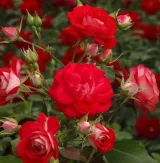
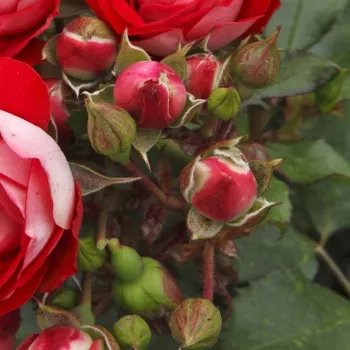
Vivid medium-red petals with creamy-white reverse and silvery sheen. Colour is long-lasting, fading slowly to raspberry shades in strong sun, giving a fresh, two-tone effect from bud through full bloom. |
| Fragrance and aroma |
Delicately rose-scented with very faint intensity, best appreciated at close range. Fragrance is subtle rather than overpowering, suiting seating areas where a light, classic rose note is preferred. |
| Hip characteristics |
Hip set is sparse due to its double flowers; occasional small spherical hips 6–10 mm may form, coloured orange-red (RHS N30A). Hips are incidental rather than a key ornamental feature of the cultivar. |
| Resistance and winter hardiness |
Rated hardy to around −26 to −23 °C (RHS H7, USDA 5b, Swedish zone 4). Disease resistance is medium to common foliar issues, performing best in airy locations with standard, preventive care. |
| Horticultural recommendations |
Suited to beds, edging, parks, containers and urban planting. Plant in well-drained soil at 30–55 cm spacing, with moderate maintenance and protection in enclosed, humid courtyards; tolerates partial shade effectively. |
Rosige Landdrostei® offers compact growth, vivid two-tone flowers and reliable repeat flowering on a long-lived own-root framework, making it a thoughtful choice for relaxed coastal-style gardens and verandas.