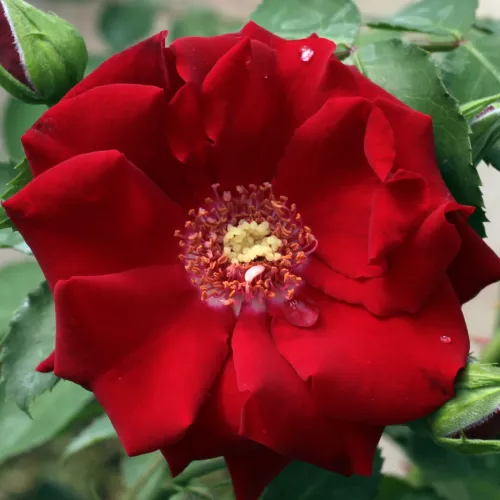
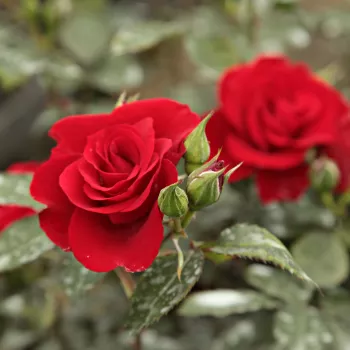
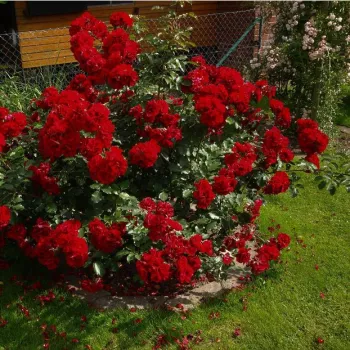
ROTER KORSAR ® – deep red park rose – Kordes
Imagine returning from the beach to sip tea behind a living windbreak of glowing dark red blooms: ROTER KORSAR ® is a robust park shrub rose that copes calmly with brisk coastal breezes and exposed, weathered plots, provided the soil offers basic drainage. This ADR‑certified, award‑winning variety builds a dense, healthy hedge of glossy foliage and self‑cleaning flowers, so spent blooms fall away with little effort from you. As an own‑root plant it settles in steadily and endures for years, suiting compact family gardens and relaxed Cornish or Devon verandas in large 40–50 litre containers. Plant once and enjoy a reassuring, low‑maintenance rhythm: in the first year the roots establish, by the second year the framework fills out, and from the third year you can expect full, rich coverage and a long season of ruby red colour.
Usage options
| Target area | Reasoning |
|---|
| Coastal, wind‑exposed family garden boundary |
The sturdy, bushy habit forms a reliable living barrier that filters salt‑tinged breezes and frames a seating area without demanding fussy care, ideal for a relaxed, sheltered spot after days on the shore for beginners. |
| Low‑maintenance flowering hedge along a drive |
Good disease resistance and self‑cleaning blooms mean less dead‑heading and spraying, so your hedge keeps its dark red display with minimal intervention, suiting those who prefer simple routines for busy homeowners. |
| Feature rose in a small shingle or gravel bed |
The compact spread and upright, arching canes give structure without overwhelming smaller plots, offering a dramatic focal point among pale shingle and driftwood accents for coastal‑style lovers. |
| Large container on a sunny veranda or balcony |
Own‑root vigour and a strong framework adapt well to a 40–50 litre container, where regular watering keeps flowering steady, making an impressive yet straightforward statement for urban veranda owners. |
| Mixed border with ornamental grasses and perennials |
Clustered, deep red flowers sit beautifully with sea kale, Festuca and lavender, adding long‑season colour and movement that remains visually stable over many years for design‑conscious gardeners. |
| Pollinator‑friendly corner near a seating area |
Semi‑double blooms with accessible stamens provide nectar interest while still looking neat and garden‑worthy, so you can watch visiting bees without sacrificing a refined look for wildlife appreciators. |
| Urban front garden with limited maintenance time |
Strong resistance to common rose diseases and good heat tolerance support tidy growth even in paved, heat‑reflective spaces, where simple watering during dry spells is usually enough for time‑poor residents. |
| Informal park‑style planting strip in clay soil |
The robust root system anchors well and copes with breezy sites when basic drainage is improved, echoing gently managed park plantings in an everyday family garden for casual hobby gardeners. |
Styling ideas
- Harbour-Hedge – run a loose line of ROTER KORSAR ® along a shingle path, underplanting with sea kale and blue fescues for a windswept coastal feel – ideal for seaside family gardens.
- Ruby-Veranda – plant one shrub in a 50 litre tub with trailing silver thyme and gravel mulch to create an easy, elegant focal point – perfect for low‑maintenance balconies and verandas.
- Driftwood-Border – combine with pale grasses, lavender and sun‑bleached timber edging to contrast the dark red blooms with soft textures – suited to design‑minded coastal‑style enthusiasts.
- Cornish-Corner – group three shrubs in a triangle near a seating nook, interplanted with blue globe thistle for bold colour and pollinator interest – made for relaxed tea‑and‑view spots.
- Scarlet-Screen – stagger plants at hedge spacing along a boundary fence, letting arching canes form a semi‑transparent screen with glowing hips in autumn – good for privacy‑seeking homeowners.
Technical cultivar profile
| Parameter | Data |
|---|
| Name and registration |
Shrub rose, park type; registered as KORromalu, marketed as ROTER KORSAR ®, a dark red landscaping variety suitable for gardens, hedging, beds and informal small climbing use. |
| Origin and breeding |
Bred by W. Kordes & Sons in Germany (2003) with unknown parentage; registered 2006 and introduced after 2006 through W. Kordes’ Söhne® as a robust landscape shrub rose. |
| Awards and recognition |
Holds ADR certification and UK Gold Standard; multiple trial medals including Dublin Gold, Belfast Gold, Kortrijk Silver and Golden Rose of Hradec Králové, confirming garden reliability. |
| Growth and structural characteristics |
Bushy shrub with arching canes, 120–180 cm high and 60–100 cm wide; dense, glossy dark green foliage and moderate thorns, forming substantial structure in beds or hedging lines. |
| Flower morphology |
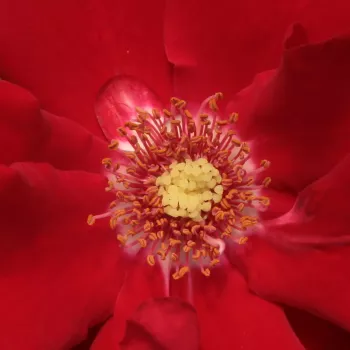
Semi‑double, flat, medium‑sized blooms in clusters, with 13–25 petals; strongly repeat‑flowering, providing abundant first flush and similarly rich later flushes through the main season. |
| Colour data and phenology |
Uniform vivid dark red colour from bud to fall; ruby red on opening, deepening towards petal reverse; colour holds well with minimal fading and no bluing, even as flowers age. |
| Fragrance and aroma |
Fragrance is very weak and barely noticeable, making it suitable where scent is not required or might conflict with other aromatic plants such as lavender, thyme or nearby herb plantings. |
| Hip characteristics |
Produces moderate numbers of small spherical hips, 8–12 mm across, coloured orange‑red; these extend seasonal interest into autumn and can provide light wildlife value in mixed plantings. |
| Resistance and winter hardiness |
Rated resistant to powdery mildew, black spot and rust; hardy to around −21 to −18 °C (RHS H7, USDA 6b, Swedish Zone 3), with good heat tolerance when watered during long dry spells. |
| Horticultural recommendations |
Low maintenance shrub suited to beds, hedges, specimens and urban plantings; plant 50–55 cm apart for hedges or massing, 90 cm for specimens; tolerates partial shade and city conditions. |
ROTER KORSAR ® offers self‑cleaning dark red flowers, strong disease resistance and long‑lived own‑root reliability, making it a practical choice for easy yet characterful planting that you can adopt with confidence.