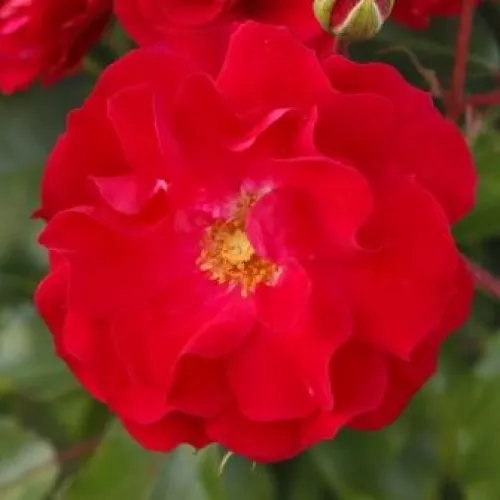
ROTILIA® – carmine-red bedding floribunda rose – Kordes
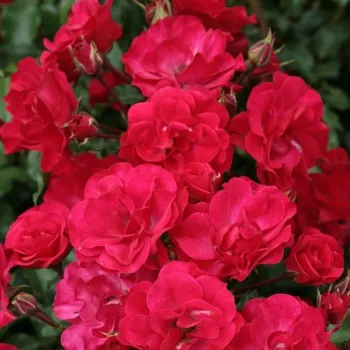
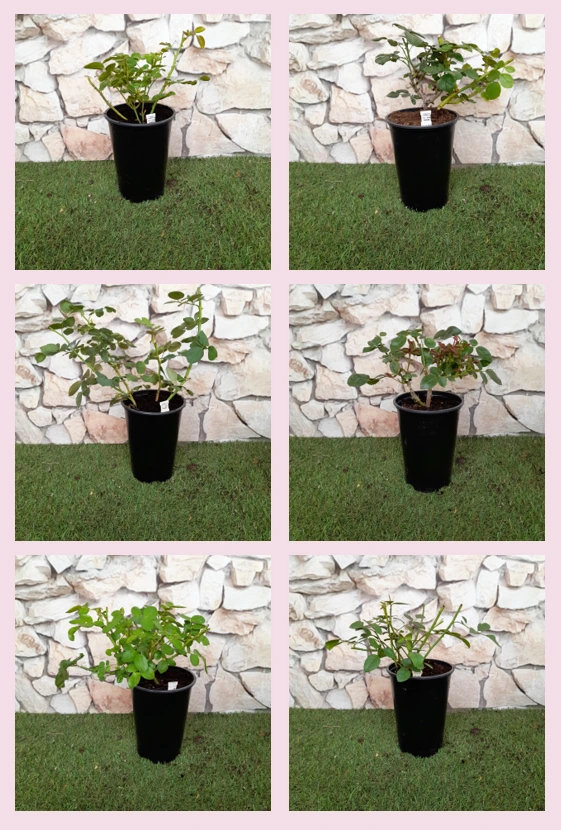
Imagine a low, glowing hedge of carmine-red blooms giving your coastal or town garden a feeling of easy refreshment after a long day, while the dense foliage helps to steady the planting in breezy conditions and quietly manages your garden’s balance of rain and wind. Rotilia® from the RigoRosen® collection is a compact, upright floribunda that covers itself in clusters of semi‑double flowers from early summer, then repeats reliably, so your beds and shingle borders stay full of colour with minimal deadheading thanks to its good self‑cleaning habit. Bred by Kordes for strong disease resistance and ADR‑certified, it shrugs off common rose problems, keeping its dark, glossy foliage attractive without regular spraying, ideal when you just want to enjoy the flowers rather than fuss over them. As an own‑root vivianaROSE® ORIGINAL 2‑litre plant, it establishes steadily, with roots in the first year, more shoots in the second, and full ornamental value by the third, giving a long‑lived, easily maintained structure in a family garden. Rotilia® is equally at home edging a path, filling a sunny bed, or brightening a large pot of at least 40–50 litres on a veranda, where its vibrant colour and partial‑shade tolerance provide practical, good‑looking coastal planting choices for busy, style‑conscious gardeners.
Usage options
| Target area | Reasoning |
|---|
| Coastal front garden bed |
The compact, bushy habit and dense foliage make a low, colourful buffer that copes well with typical seaside breezes and showery spells, supporting that subtle balance of wind, rain and drainage in exposed plots, well suited to beginners. |
| Family flower border |
Continuous clusters of carmine‑red blooms from early summer, followed by an abundant second flush, give long seasonal interest in a modest space, so one or two plants can anchor a mixed border and keep it cheerful for busy homeowners. |
| Low hedge along a path |
The upright, uniform growth and recommended spacing allow you to form a neat, low hedge that guides the eye and gently shelters a walkway without becoming overbearing, ideal for those wanting structure with little shaping work. |
| Large container on veranda |
Planted in a 40–50 litre or larger container, Rotilia® gives a strong, long‑lived display where soil is shallow or paved, and the own‑root form helps it recover well if pots dry or are moved, reassuring for coastal‑style veranda owners. |
| Small urban garden |
The compact footprint, moderate height and naturally tidy habit make it easy to fit into narrow beds or courtyard corners, providing reliable colour without casting too much shade or demanding complex care from time‑pressed residents. |
| Low‑maintenance mass planting |
Good resistance to black spot, mildew and rust, combined with low maintenance needs, means groups of plants stay attractive with minimal intervention, so you can enjoy a high‑impact sweep of colour suited to quality‑conscious gardeners. |
| Pollinator‑friendly mixed border |
The semi‑double, open flowers offer partially accessible stamens that attract bees and other insects, adding gentle wildlife interest to family gardens without sacrificing neatness or ease of upkeep, appreciated by nature‑minded beginners. |
| Long‑term garden investment |
As an own‑root shrub, Rotilia® builds a durable framework that regrows well after hard weather or pruning and maintains its ornamental value over many years, suiting those who prefer planting once and enjoying for the long term. |
Styling ideas
- Harbour-hedge – Line a front path with Rotilia® at hedge spacing for a low, red ribbon of colour, mixed with blue Festuca or sea kale for a seaside feel – ideal for coastal-front homeowners.
- Sunset-bed – Combine Rotilia® with warm-toned Hemerocallis and ornamental grasses to create a glowing, easy-care summer border – perfect for busy family gardeners.
- Veranda-pot – Plant a single rose in a 50‑litre tub, underplant with trailing thyme and small Lavandula for scent and texture – suited to compact coastal verandas.
- Urban-rug – Use several plants at mass-planting density to form a dense, colourful groundcover in a small city front garden – good for low-maintenance urban plots.
- Pollinator-path – Alternate Rotilia® with Agastache 'Blue Fortune' along a path to blend bold colour with bee-friendly nectar sources – appealing to wildlife-conscious beginners.
Technical cultivar profile
| Property | Data |
|---|
| Name and registration |
Floribunda bed rose from the RigoRosen collection, registered as KORvillade, marketed as Rotilia and Rotilia RigoRosen; ARS exhibition name Rotilia, verified cultivar identity for reliable performance. |
| Origin and breeding |
Bred by Wilhelm Kordes III in Germany in 1992, introduced after 2006 by W. Kordes’ Söhne; floribunda type selected for garden toughness and repeat flowering in landscape and domestic settings. |
| Awards and recognition |
Highly decorated: multiple gold and silver medals in Dublin, Kortrijk, Geneva, Madrid, Monza and Potsdam, plus ADR (2002) and Gold Standard (2008), indicating outstanding garden reliability and health. |
| Growth and structural characteristics |
Compact, upright, bushy shrub 60–85 cm high and 40–60 cm wide, moderately thorny, with dense, dark green, glossy foliage providing strong visual presence and good ground coverage in beds. |
| Flower morphology |
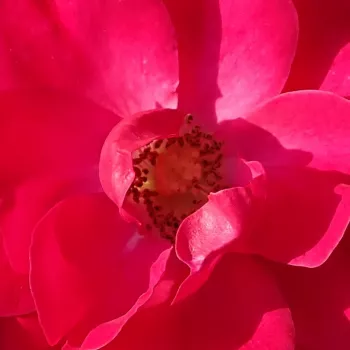
Semi-double, flat blooms with 9–16 petals, medium-sized clusters on branching stems; repeat-flowering with an abundant second flush, and good self-cleaning so most spent flowers drop without deadheading. |
| Colour data and phenology |
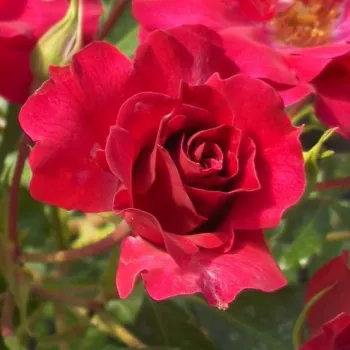
Carmine-red flowers, fiery on opening, then lightening slightly towards raspberry with a delicate silvery edge; colour holds reasonably in sun, giving a vibrant, cool-toned red display across the season. |
| Fragrance and aroma |
Very light scent with a brief, wild-rose character best appreciated at close range; primarily selected for colour and garden performance rather than perfume, making it suitable where fragrance is not essential. |
| Hip characteristics |
Produces moderate numbers of small, spherical hips about 7–10 mm across, in a bright scarlet-red tone, adding a discreet touch of late-season interest without overwhelming the overall display. |
| Resistance and winter hardiness |
Excellent resistance to black spot, powdery mildew and rust; hardy to approximately −21 to −18 °C (RHS H7, USDA 6b, Swedish zone 3), coping well with UK winters and summer heat with some watering. |
| Horticultural recommendations |
Best in well-drained soil with sun or partial shade; ideal for beds, edging and mass planting at 30–55 cm spacing; low maintenance with occasional pruning and watering during prolonged dry spells. |
ROTILIA® offers vibrant long-season colour, dependable disease resistance and a compact habit in a durable own-root form that settles in for years of easy enjoyment, making it a thoughtful choice for relaxed, stylish gardens.