RUBRIFOLIA – pink wild rose - Pourret
Think of a bright coastal afternoon: the breeze lifting your hair, the taste of salt on your lips, and a simple cup of tea behind a natural windbreak of glaucous blue‑green foliage. Rosa rubrifolia brings that atmosphere into an everyday family garden with surprisingly little effort. Its upright, arching habit and naturally bushy shape form a soft screen that copes gracefully with blustery, exposed conditions, while the once‑a‑year flush of small pink flowers hums with pollinators. You plant it once and, as its own‑root system matures, it settles in for the long term with a quiet, reliable presence. Give it a free‑draining spot where it can anchor well in the soil and ride out coastal gales without fuss, and it repays you with a long lifespan, minimal pruning needs and decorative dark red hips that light up autumn. Over the first few seasons – roots establishing, then shoots extending, then full ornamental value – it gradually becomes a cool‑toned backdrop for shingle, sea kale and silvery grasses, an understated structure that frames salty, windy, sunny moments on the veranda for busy, low‑maintenance‑minded gardeners.
Usage options
| Target area | Reasoning |
|---|
| Coastal windbreak hedge along a boundary |
The tall, upright, arching framework knits into a dense, living screen that filters wind without creating damaging turbulence, ideal for shingle or exposed plots where tough, anchoring roots cope well with blustery, salt‑tinged weather – for coastal veranda and salt‑garden owners. |
| Low‑maintenance, naturalistic family garden border |
Once established, this species rose needs only occasional shaping, letting you enjoy its shifting foliage colours, simple pink flowers and autumn hips without regular deadheading or fussy pruning, suiting relaxed borders where time is limited – for busy home gardeners. |
| Wildlife‑friendly corner near seating |
The single blooms with exposed stamens offer easy access to bees and hoverflies, while later hips provide food and shelter interest, creating a lively, gently buzzing backdrop for a cup of tea in a sheltered nook – for nature‑loving garden beginners. |
| Statement shrub in a small to medium lawn |
Planted as a solitary specimen at the recommended spacing, its upright, arching branches and blue‑green foliage read as a sculptural feature that holds shape year‑round, giving structure without crowding an average‑sized family lawn – for design‑conscious home owners. |
| Sunny coastal bank or slope |
The deep root system and robust framework help stabilise sloping ground while coping confidently with sun and drying winds, so a once‑flowering display and hips appear reliably each year with minimal intervention, even in exposed situations – for pragmatic coastal plot owners. |
| Large container on a veranda or terrace |
In a generously sized container of at least 40–50 litres with good drainage, it develops a sturdy, woody base and attractive foliage screen, giving height and privacy on a balcony or veranda while remaining manageable with just periodic pruning – for space‑conscious terrace gardeners. |
| Planting in hotter, drier garden areas |
Its very good heat and drought tolerance means that, once rooted in, it keeps its composure through warm, drying spells, with foliage staying presentable and hips developing reliably even if watering is occasionally delayed – for time‑pressed household gardeners. |
| Long‑term, low‑input structural planting |
As an own‑root species rose, it matures into a long‑lived, stable shrub that regenerates well from the base, supporting reduced chemical use and only periodic renewal pruning, fitting sustainable, low‑input planting schemes over many seasons – for environmentally minded garden owners. |
Styling ideas
- Coastal‑shingle screen – Thread Rosa rubrifolia through gravel and sea‑washed pebbles with sea kale and Festuca to echo a Cornish shore, creating a wind‑filtering, low‑care backdrop – ideal for coastal‑style enthusiasts.
- Romantic‑wild hedge – Use as an informal hedge, letting arching stems mingle with Hakonechloa and Cornus ‘Midwinter Fire’ for year‑round texture and winter colour – suitable for relaxed family gardens.
- Veranda‑privacy pot – Grow one plant in a 50‑litre container with free‑draining compost, underplant with trailing thyme and low lavender to soften the rim – perfect for balcony and veranda owners.
- Blue‑green focal point – Set a solitary shrub in lawn or gravel where its glaucous foliage can stand against a simple backdrop, paired with dark pots or furniture – for design‑aware but time‑poor homeowners.
- Pollinator‑friendly corner – Combine this species rose with herbaceous daisies and airy grasses to form a loose, buzzing patch that needs little more than yearly tidying – great for wildlife‑interested beginners.
Technical cultivar profile
| Characteristic | Data |
|---|
| Name and registration |
Rosa rubrifolia, also known as Rosa glauca, a botanical wild rose marketed as RUBRIFOLIA – pink wild rose - Pourret; unregistered variety used in gardens as a characterful species shrub. |
| Origin and breeding |
Natural species of unknown parentage, historically associated with Pierre André Pourret and introduced to cultivation around 1830; valued for its distinctive foliage and robust growth in varied climates. |
| Awards and recognition |
Royal Horticultural Society Award of Garden Merit (1993) and inclusion in the Great Plant Picks programme (2002), confirming strong garden performance and consistent ornamental value in real landscapes. |
| Growth and structural characteristics |
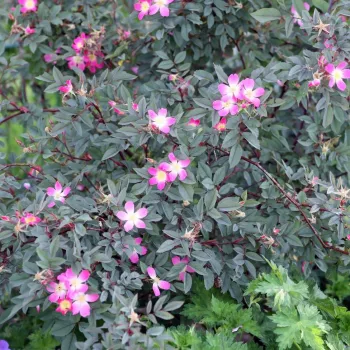
Tall, upright to arching shrub reaching about 200–300 cm high and 120–190 cm wide, with moderately dense, matt, glaucous blue‑green to purplish foliage and a moderately thorny framework forming a bushy outline. |
| Flower morphology |
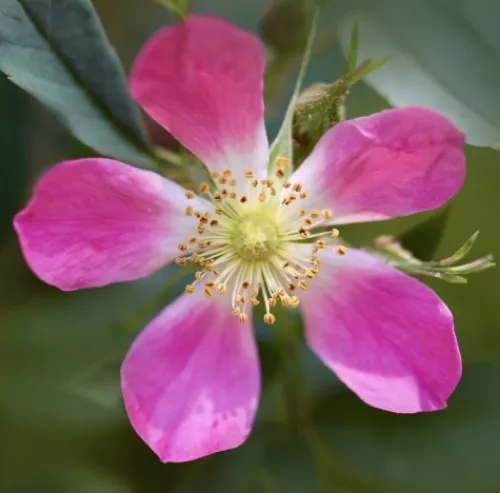
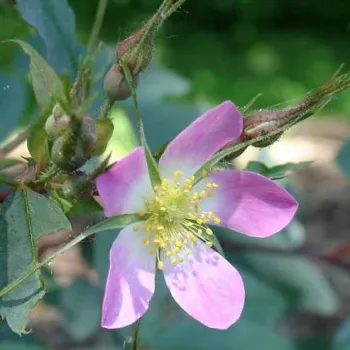
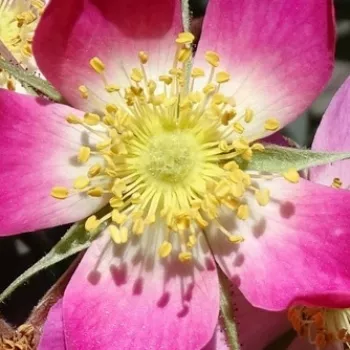
Small, flat, single blooms with 5–12 petals, borne in clusters; non‑remontant, flowering once per season with good self‑cleaning so spent petals fall away cleanly to reveal decorative developing hips later in the year. |
| Colour data and phenology |
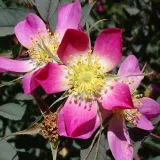
Flowers open deep pink with a paler centre and lilac hint, gradually lightening to pale pink and sometimes near white; ARS colour code DPk, RHS 55C and 65D, offering a soft, naturalistic effect during the main flush. |
| Fragrance and aroma |
Displays a mild, delicately rosy scent that is noticeable at close range without dominating nearby seating areas, complementing its visual character and suiting gardens where strong perfume is not required. |
| Hip characteristics |
Produces moderately abundant, spherical dark red hips, typically 12–18 mm across, extending the season of interest into autumn and providing food and visual structure in more naturalistic or wildlife‑oriented plantings. |
| Resistance and winter hardiness |
Exceptionally hardy, tolerating approximately −46 to −43 °C (RHS H7, Swedish Zon 7, USDA Zone 2a); shows medium resistance to black spot, powdery mildew and rust when grown with reasonable air circulation. |
| Horticultural recommendations |
Suited to parks, hedges, naturalistic gardens and urban greens; prefers full sun but tolerates partial shade, with spacing from 90 to 165 cm depending on use and moderate maintenance, mainly occasional pruning and checks. |
RUBRIFOLIA – pink wild rose - Pourret offers long‑lived structure, coastal‑capable resilience and pollinator interest in a durable own‑root form; an excellent choice if you seek a quietly reliable garden companion.