SOMMERABEND® – deep red groundcover rose – Kordes
Sommerabend® brings a relaxed, seaside atmosphere to family gardens, covering the ground in a low, spreading carpet of deep red blooms that echo summer sunsets over shingle and sea. Its single, open flowers are naturally wildlife-friendly, giving bees an easy landing while you enjoy tea on a breezy veranda. As an own-root shrub it offers reassuring durability, quietly rebuilding from its base after rough coastal weather and living on for many years with stable ornamental value. In the first few seasons it focuses on anchoring roots, then stronger shoots, then a full, glowing carpet of colour as the plant settles into its long-term rhythm. This compact, spreading habit suits modest UK plots, where coverage matters more than height, and it partners beautifully with coastal-style grasses and sea kale. In a large 40–50 litre container on a sheltered terrace it forms a low, wind-tolerant screen, softening paving and gravel while coping well with sun and moderate dryness. Its award-winning garden performance has been recognised across Europe, reassuring you that this is a proven, long-lived choice for laid-back, easy-going outdoor living.
Usage options
| Target area |
Reasoning |
| Low-maintenance seaside front garden |
The compact, spreading habit forms a low carpet that tucks neatly around gravel, boulders and driveways, ideal where you want depth of colour without tall shrubs. Own-root durability keeps it going for years with minimal reshaping for beginners. |
| Coastal veranda in large container |
In a 40–50 litre pot, Sommerabend® creates a wide, low canopy that softens decking and tiles while tolerating sun and moderate dryness, particularly where coastal winds and showers regularly sweep in from the sea for busy-owners. |
| Small family back garden, lawn edge |
Its restrained height and generous spread give a defined, flowered edge to lawns and play spaces without blocking sightlines, making supervision easy while still providing a cheerful backdrop of deep red colour for young-families. |
| Shingle strip with sea kale and grasses |
The even ground-level habit knits between sea kale and low Festuca, echoing a natural dune feel; the single blooms invite bees in, adding movement and life to an otherwise simple planting that suits relaxed, informal coastal-lovers. |
| Urban courtyard with limited planting pockets |
Where soil depth is patchy and space is tight, its ability to root steadily and rebuild from its own base gives long service; you gain a low, colourful shrub that does not outgrow small beds, fitting typical city plots for urban-gardeners. |
| Sloping bed as flowering groundcover |
The spreading, mat-forming habit helps stabilise light slopes while covering bare soil with foliage and flowers, so the area feels finished sooner and needs less weeding once established, supporting those who prefer straightforward, reliable solutions. |
| Mixed pollinator-friendly border |
The open, single flowers with prominent stamens give easy access to visiting bees and hoverflies, adding ecological value without complex maintenance, especially when underplanted with lavender or airy perennials by nature-conscious gardeners. |
| Seasonal highlight bed near seating area |
Mass planting creates a striking deep red “sea” of blooms that reads clearly from a terrace or bench; the plant’s proven garden performance lets you rely on a long display each year with modest input, suiting design-led but time-poor homeowners. |
Styling ideas
- Sunset Shingle Band – run Sommerabend® along a gravel path with sea kale and low Festuca for a shingle-beach feel – ideal for coastal-style enthusiasts seeking simple, wind-hardy structure.
- Veranda Rug – plant three in a 50 litre trough with blue fescue and white thrift to create a low “carpet” of red and silver – good for compact verandas needing colour without height.
- Family Lawn Frame – edge a small lawn with a loose ribbon of plants, backed by feather reed grass, for a soft, watch-through border – suits family gardens where play space and visibility matter.
- Courtyard Glow – cluster roses in wide containers around a bistro set, underplanting with lavender for scent and pollinators – perfect for urban courtyards with limited soil and time.
- Dune-Inspired Mix – scatter plants through a bed of ornamental grasses and sea kale to mimic coastal dunes, the roses adding strong colour at ground level – for relaxed, naturalistic gardeners.
Technical cultivar profile
| Parameter |
Data |
| Name and registration |
Groundcover rose from the Kordes breeding line, registered as KORmarec and marketed as Sommerabend®; a low, spreading shrub suited to groundcover and park planting schemes. |
| Origin and breeding |
Bred by Wilhelm Kordes in Germany from complex shrub and wichuriana parentage; introduced in 1995 after registration in 1992, selected for groundcover habit and ornamental impact. |
| Awards and recognition |
Holds the ADR award (Germany, 1996), plus notable show honours including Grande Rose du Siècle in Lyon, a Certificate of Merit in the UK, and Best shrub rose in Belfast. |
| Growth and structural characteristics |
Very low, spreading shrub reaching around 25–45 cm in height and 55–105 cm wide, with moderately dense, glossy dark green foliage and a ground-hugging, mat-forming habit. |
| Flower morphology |
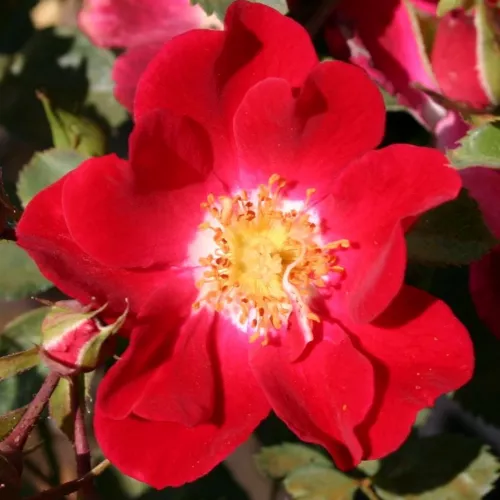
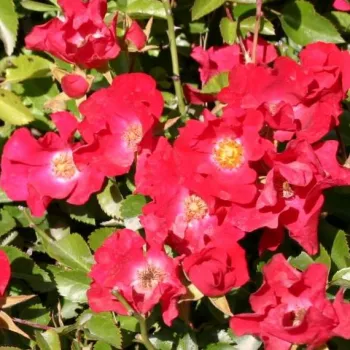
Bears large clusters of single, flat blooms with around 5–12 petals; flowers are medium-sized, repeat freely through the season, and self-clean moderately with light deadheading. |
| Colour data and phenology |
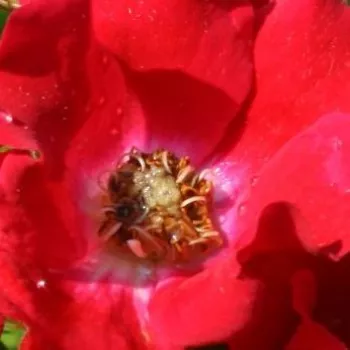
Deep, vivid red blooms with a narrow whitish eye and visible yellow stamens; colour softens slightly in strong sun, moving towards carmine-crimson as the flowers age on the plant. |
| Fragrance and aroma |
Fragrance is very light and unobtrusive, with a delicate, soft character that does not dominate seating areas; chosen more for colour and form than for strong scent in the garden. |
| Hip characteristics |
Occasionally sets small, spherical orange-red hips about 6–10 mm across; hips are generally scattered and decorative rather than forming a heavy crop, adding subtle late-season interest. |
| Resistance and winter hardiness |
Hardy to around −21 to −18 °C (RHS H7; USDA 6b), tolerates heat and moderate drought, but foliage is disease-prone, needing regular monitoring and timely fungicide protection. |
| Horticultural recommendations |
Best in full sun with good air movement and well-drained soil; space plants around 70–150 cm apart depending on use, and apply consistent preventive care to manage foliar diseases. |
Sommerabend® Ground cover KORmarec offers compact ground-hugging coverage, pollinator-friendly single blooms and long-lived own-root resilience; consider it if you want enduring colour in a modest, easy-going space.