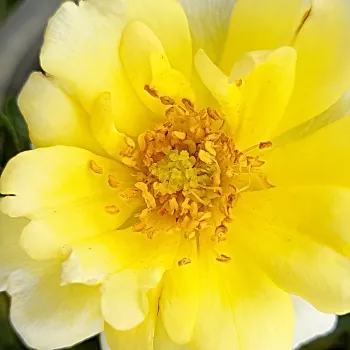
SUNSHINE HAPPY TRAILS® – yellow groundcover rose – Bédard
For a coastal-style family garden that feels both playful and practical, SUNSHINE HAPPY TRAILS® spills cheerful yellow colour along paths and over shingle, creating low, bright mounds that cope well with exposed, breezy sites and thoughtful water management in changeable British weather. Its semi-double, easily accessible blooms are a magnet for bees, while the dense, glossy foliage knits together quickly to smother bare soil and soften hard edges. As an own-root plant it offers reassuring longevity, steady recovery after winter, dependable flowering from early summer, compact groundcover for smaller gardens, excellent container performance in a 40–50 litre pot, relaxed maintenance thanks to good self-cleaning, reliable anchoring once established, and a gentle development from roots in the first year, to structure in the second, and full ornamental value by the third season.
Usage options
| Target area | Reasoning |
|---|
| Low, spreading groundcover in a small family garden |
Its naturally spreading habit and modest height quickly create a low green-and-gold carpet, covering bare soil and smoothing awkward level changes without dominating the space, ideal for relaxed family plots and beginners. |
| Coastal-style shingle or gravel strip by the veranda |
The dense root system and glossy foliage settle well into free-draining shingle, helping stabilise light substrates while the sunny flowers echo seaside hues, suiting breezy patios and coastal-style lovers. |
| Large container or trough on a sheltered balcony |
In a 40–50 litre container it forms a cascading mound of foliage and flowers, with own-root resilience giving long service life and easy renewal, ideal for compact courtyards and busy urban garden owners. |
| Edging for paths and informal garden “trails” |
The low, arching stems gently spill towards the path, defining informal routes with sunny colour while staying low enough for easy access, perfect for child-friendly walkways and family gardeners. |
| Pollinator-friendly strip with grasses and sea-inspired perennials |
Semi-double blooms with exposed stamens provide accessible pollen and nectar, working beautifully among Festuca, sea kale or low lavender for wildlife interest and movement, attractive to nature-minded hobby gardeners. |
| Slope planting where stability and cover are needed |
The spreading growth and root system help knit the soil surface, supporting stability and visual softening of small banks in typical domestic gardens, suited to gently sloping plots and homeowners. |
| Wind-prone, partially sheltered coastal corners |
Its low profile and flexible, spreading habit make it less vulnerable to wind rock, providing reliable colour where taller shrubs struggle, supporting gardens that must balance breeze and moisture for coastal veranda owners. |
| Low-maintenance mixed bed with shrubs and perennials |
Good self-cleaning flowers and own-root staying power minimise deadheading, while it weaves between shrubs like Cornus or compact lavenders, rewarding a few years of patient establishment with durable impact for time-poor beginners. |
Styling ideas
- Seaside-Ribbon – run a loose line of plants along a gravel path, interplanting with blue Festuca to echo sea and sand – ideal for coastal-style lovers seeking an easy, unified look
- Veranda-Bowl – plant one specimen in a 40–50 litre terracotta pot with trailing thyme at the rim – perfect for balcony owners wanting colour without complex care
- Buttercup-Drift – mass three to five plants on a gentle slope, fronted with low lavender, to create a soft yellow and purple wave – suited to hobby gardeners shaping small banks
- Trail-Edge – alternate with sea kale along a family garden path for a playful, beach-walk feel – great for families who want resilient edging near everyday foot traffic
- Cornish-Corner – tuck it at the feet of a colourful Cornus shrub in a sheltered coastal border, letting the rose carpet the base – for homeowners after easy, layered structure
Technical cultivar profile
| Parameter | Data |
|---|
| Name and registration |
Groundcover shrub rose, registered as Weksusacofloc, marketed as Sunshine Happy Trails® / Sunshine Happy Trails™ in the Happy Trails™ collection; ARS exhibition name Sunshine Happy Trails™. |
| Origin and breeding |
Bred by Christian Bédard (USA) from ‘Sun Runner’ × [‘City of San Francisco’ × (‘Neon Cowboy’ × ‘Flower Carpet Pink’)], introduced 2015 by Weeks Wholesale Rose Grower, Inc. |
| Growth and structural characteristics |
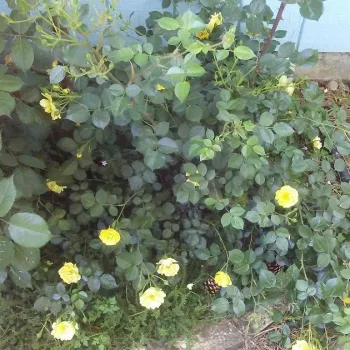
Low, spreading groundcover habit, around 25–45 cm high and 70–120 cm wide, with dense, dark green glossy foliage and moderate prickles; naturally forms a continuous, mounding cover. |
| Flower morphology |
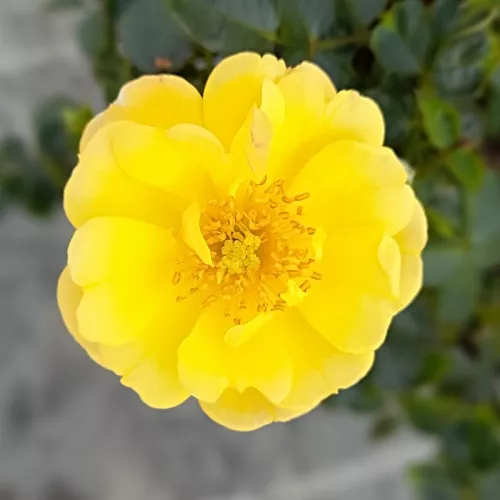
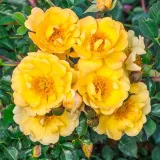
Semi-double, flat, medium-sized clusters with around 13–25 petals, produced in repeated flushes through the season; good self-cleaning, with most spent blooms dropping cleanly without deadheading. |
| Colour data and phenology |
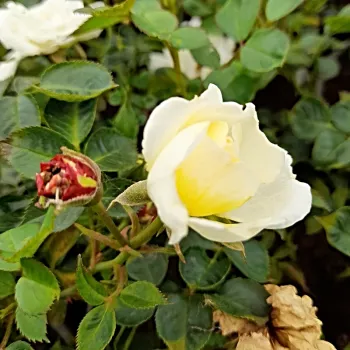
Clear mid-yellow flowers, buds deep yellow, opening to sun-yellow then butter-yellow with pale centre, holding colour well even in heat, with only modest fading as blooms age on the plant. |
| Fragrance and aroma |
Pleasant, clearly noticeable rose fragrance of medium strength, adding sensory interest at close range without overpowering nearby seating areas or neighbouring, more strongly scented planting schemes. |
| Hip characteristics |
Moderate set of small, ellipsoid orange-red hips around 5–8 mm across, adding discrete late-season detail without significantly affecting overall flowering performance during the main season. |
| Resistance and winter hardiness |
Hardy to approximately −32 to −29 °C (RHS H7, USDA 4b), with good heat tolerance; black spot resistant, medium resistance to powdery mildew and rust, needs water in extended dry spells. |
| Horticultural recommendations |
Suited to groundcover, edging, slopes, beds, parks and containers; plant 80–150 cm apart depending on use, 1.2–1.4 plants/m² in mass plantings; prefers well-drained soil and sun to partial shade. |
SUNSHINE HAPPY TRAILS® offers sunny groundcover, pollinator-friendly colour and own-root durability in family gardens, making it a thoughtful choice for easygoing paths, shingle corners or generous containers.