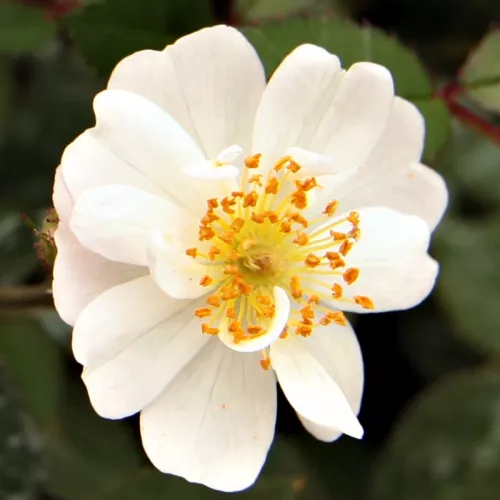
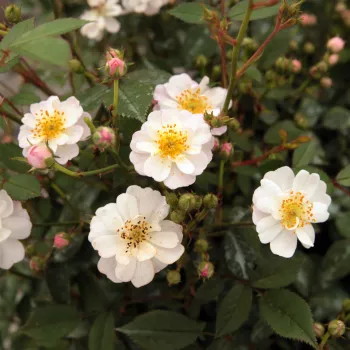
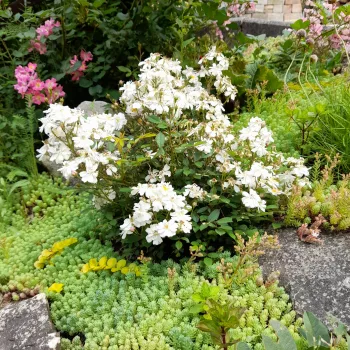
TALAS – white dwarf mini rose - Győry
Along breezy Cornish and Devon verandas, TALAS brings an easy, low‑growing sparkle of white to small gardens where space is precious and weekends are short. Its compact habit fits neatly into front‑of‑border strips, balcony troughs and larger patio containers, settling in reliably even where strong coastal breezes meet well‑managed drainage and firm anchoring in the soil. As an own‑root rose it offers reassuring long‑term stability, regenerating from the base if ever cut back hard and maintaining an even look year after year. Clusters of snowy blooms with golden stamens give a fresh, light effect from early summer onwards, repeating through the season with minimal intervention. In the first year it concentrates on building roots, in the second it gains more flowering volume, and by the third it reaches its full ornamental rhythm and dependable presence in your family garden.
Usage options
| Target area |
Reasoning |
| Balcony or veranda containers (40–50 litre) |
The naturally dwarf, compact habit allows TALAS to thrive in substantial 40–50 litre pots without becoming leggy or overwhelming the space, giving a tidy, long‑lived framework of foliage and flowers on own roots for relaxed coastal veranda layouts for the busy balcony‑owner |
| Front of mixed borders in small family gardens |
With a height of only 20–30 cm, TALAS creates a low white edging in front of perennials and grasses without blocking views, while its medium disease resistance and own‑root resilience keep maintenance simple for the time‑conscious home‑gardener |
| Low edging along paths or driveways |
Planted at 25–35 cm spacing, the even, compact growth habit forms a neat edging line that is easy to trim around and keep in shape, supporting a long lifespan and stable ornamental value for the practical pathway‑planner |
| Coastal, wind‑exposed family plots |
The small stature and moderately dense canopy cope well with blustery conditions, while good winter hardiness to around -21 °C provides reassurance in exposed, salty, windy, sunny gardens near the sea for the weather‑aware coast‑dweller |
| Clay or heavier soils with improved drainage |
The shallow, compact root system anchors firmly when the top layer is improved with grit or compost, complementing thoughtful water management and supporting reliable flowering in ordinary family garden soils for the pragmatic clay‑gardener |
| Minimal‑effort white and green schemes |
Pure white, semi‑double blooms with golden stamens pair effortlessly with low evergreens and groundcovers, giving a clean, calming look that still feels cheerful without needing constant deadheading for the style‑conscious minimalist |
| Long‑season interest in compact spaces |
Remontant flowering with an abundant second flush keeps colour returning through the season, so even a single plant in a small bed or pot earns its place over many months for the space‑limited courtyard‑owner |
| Family gardens with a long‑term view |
As an own‑root rose, TALAS can be cut back and refreshed without fear of reversion, supporting a long lifespan and dependable form that matures gradually rather than needing frequent replacement for the forward‑thinking planner |
Styling ideas
- Coastal‑calm border – Combine TALAS with blue Festuca and sea kale in a shingle strip for a low, breezy, white‑and‑blue ribbon – ideal for coastal‑style enthusiasts.
- Veranda tea corner – Plant TALAS in a 50‑litre tub with lavender and a dwarf Euonymus for year‑round structure and summer bloom – perfect for morning‑coffee balcony users.
- White‑on‑white edging – Run a line of TALAS along a path, backed with white geraniums for a soft, layered snowdrift effect – suited to lovers of restrained palettes.
- Play‑safe family bed – Use TALAS at the front of a mixed bed, where its compact size and own‑root durability tolerate the odd football – good for child‑friendly gardens.
- Evergreen micro‑hedge – Alternate TALAS with low Japanese spindle to build a textural, knee‑high frame around a small lawn – appealing to neat, low‑maintenance gardeners.
Technical cultivar profile
| Parameter |
Data |
| Name and registration |
Miniature, dwarf rose marketed as TALAS – white dwarf mini rose - Győry; part of the Mini - dwarf rose collection; commercial garden type for edging, beds and container use. |
| Origin and breeding |
Bred by Győry Szilveszter with parentage not recorded; introduced by PharmaRosa® Ltd. from Hungary after 2010; developed for compact habit and reliable garden performance. |
| Growth and structural characteristics |
Very compact dwarf shrub 20–30 cm high and 30–40 cm wide with moderately dense, slightly glossy mid‑green foliage and moderate prickliness; ideal where tight spacing is required. |
| Flower morphology |
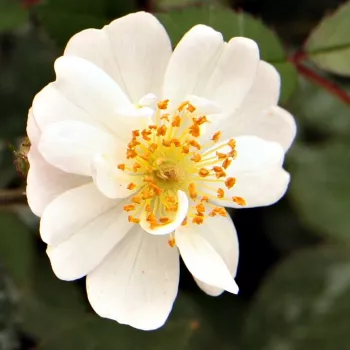
Semi‑double, cupped, small flowers (around 0.5–1.5 inches) produced in clusters; petal count roughly 13–25; remontant with an especially abundant second flush later in the season. |
| Colour data and phenology |
Snow‑white buds open to pure white blooms with soft creamy sheen and golden stamens; colour fades only slightly, edges becoming delicately beige as flowers age in full sun. |
| Fragrance and aroma |
No noticeable fragrance; chosen primarily for clean white colour and compact form rather than scent; semi‑double form with visible stamens gives moderate decorative lightness. |
| Hip characteristics |
Hip production is generally scant; where formed, hips are small, spherical, bright red and about 6–8 mm in diameter, adding occasional discrete late‑season interest. |
| Resistance and winter hardiness |
Medium disease resistance to powdery mildew, black spot and rust; hardy approximately to -21 to -18 °C (RHS H7, USDA 6b, Swedish zone 3), suitable for typical UK winter conditions. |
| Horticultural recommendations |
Best in beds, low edging and containers; plant 25–35 cm apart for edging, 60 cm as solitary; prefers improved drainage on heavier soils and benefits from routine, moderate plant protection. |
TALAS – white dwarf mini rose - Győry offers compact, long‑season white flowering with good hardiness, and its own‑root form supports lasting, low‑stress enjoyment in pots or borders, making it a thoughtful choice for understated family gardens.