TOM TOM™ – deep pink bedding floribunda rose - Lindquist
Imagine returning from the seaside, brushing sand from your shoes and settling with a cup of tea behind a living windbreak of TOM TOM™, its clusters of deep pink blooms bright against dark green foliage. This compact floribunda is made for small coastal gardens and sheltered verandas, coping well with blustery weather while remaining reliably floriferous in a typical UK season. In a roomy 40–50 litre container or a narrow border it establishes steadily, first building roots, then stronger shoots, and by the third year giving you its full ornamental display with minimal fuss. Own-root planting supports long-term stability and easy regrowth after pruning, so you can enjoy low-effort structure, colour and gentle refreshment in your family garden.
Usage options
| Target area | Reasoning |
|---|
| Small coastal front garden bed |
The bushy, upright habit and deep pink clusters create an immediate focal point in limited frontage space, while its moderate disease resistance keeps care simple in salty, breezy streets for beginners. |
| Shingle strip or driveway edging |
Compact height and good flowering in summer make it ideal along shingle or gravel, where drainage is sharp and planting depth is restricted, offering neat, colourful structure for busy owners. |
| 40–50 litre container on a veranda |
Its modest size and upright form suit large pots, where regular watering is straightforward; in a 40–50 litre container roots anchor well and flowering remains generous for urbanites. |
| Mixed border with coastal-style perennials |
Deep pink clusters combine effectively with silvery or blue foliage and grasses, while its remontant flowering keeps colour running through the season in family borders for stylish gardeners. |
| Low, informal flowering hedge |
Planted at hedge spacing, TOM TOM™ forms a low ribbon of colour and foliage that subtly marks boundaries without heavy pruning demands, suiting relaxed plots for homeowners. |
| Pollinator-friendly family corner |
Semi-double flowers offer some access to visiting insects and modest hip production adds seasonal interest, contributing to wildlife-aware designs without complicating maintenance for families. |
| Wind-exposed but sheltered-by-fence spot |
Performs well where buildings or fencing break the force of coastal gusts, helping your planting cope with blustery weather and changeable rain while remaining visually tidy for coastal gardeners. |
| Urban green space or shared courtyard |
Steady growth, moderate maintenance needs and reliable repeat bloom make it suitable for communal beds, where simple deadheading and occasional checks keep displays presentable for caretakers. |
Styling ideas
- Harbour-Edge Classic – mass-plant TOM TOM™ in a shallow sweep along shingle paths, backed with low Ilex crenata domes for structure – ideal for coastal homeowners wanting calm order.
- Veranda Retreat – one TOM TOM™ in a 50 litre clay pot, underplanted with trailing Delosperma for a spill of colour and texture – suited to balcony and veranda users seeking easy charm.
- Cornish Drift – mingle TOM TOM™ with blue Festuca and sea kale for a windswept, beach-inspired border – perfect for design-conscious gardeners craving a soft, naturalistic look.
- Family Colour Strip – create a low hedge of TOM TOM™ along lawns, interspersed with Coreopsis clumps for yellow-pink contrast – great for families wanting cheerful flowers with simple care.
- Urban Courtyard Mix – pair TOM TOM™ with lavender and container grasses around a seating area for long-season colour and scent – fitting for busy urbanites who like structured relaxation.
Technical cultivar profile
| Property | Data |
|---|
| Name and registration |
Floribunda bed rose; registered cultivar name ‘Tom Tom’, trade name TOM TOM™ Bedding rose Tom Tom; American Rose Society exhibition name Tom Tom; bred as an own-root suitable garden variety. |
| Origin and breeding |
Bred by E. J. Lindquist in the United States in 1957, from cross ‘Improved Lafayette’ × ‘Floradora’; introduced via Hemet Wholesale and Howard Rose Co. for bedding and landscape use. |
| Growth and structural characteristics |
Bushy, upright floribunda, around 60–90 cm tall and 45–65 cm wide, with moderately dense, dark green, slightly glossy foliage and moderate prickliness; suitable for groups, borders and containers. |
| Flower morphology |
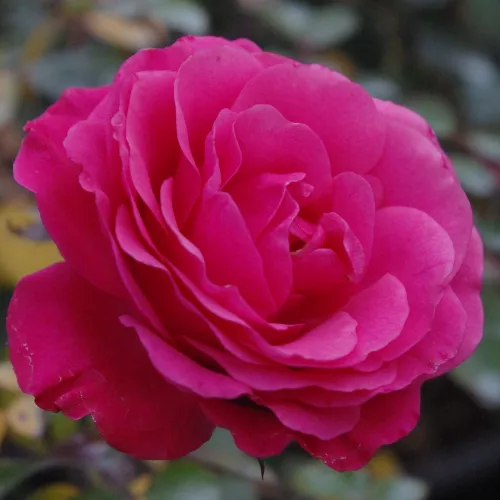
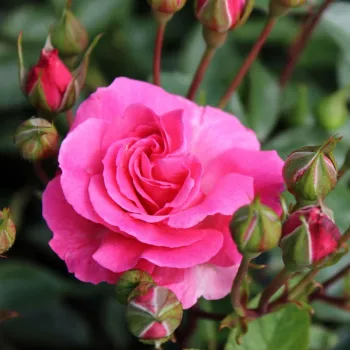
Semi-double, cup-shaped clusters with about 17–25 petals per bloom; large flower size around 7–10 cm; remontant, with a generous second flush under normal garden conditions. |
| Colour data and phenology |
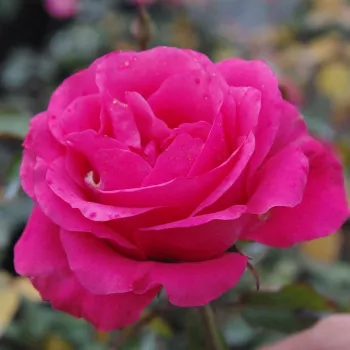
Uniform, saturated deep pink; outer petals near RHS 58B, inner 58C; buds dark and velvety, flowers slightly paler in heat and deeper in cool weather, with medium colour retention through bloom. |
| Fragrance and aroma |
Light, discreet fragrance with mild intensity; best appreciated at close range rather than as a garden-wide scent; suitable where colour impact is preferred over strong perfume. |
| Hip characteristics |
Produces moderate quantities of small, spherical red hips, roughly 7–11 mm across, in RHS 44A tones; offers modest autumn and winter interest without becoming visually dominant. |
| Resistance and winter hardiness |
Hardy to about −21 to −18 °C (RHS H7, USDA 6b), with moderate heat and drought tolerance; generally resistant to black spot, with moderate susceptibility to powdery mildew and rust. |
| Horticultural recommendations |
Suited to borders, edging, containers and group plantings; plant 35–70 cm apart, around 4.9–5.7 plants/m² in mass schemes; prefers well-drained soil and regular watering in dry spells. |
TOM TOM™ combines compact bedding habit, long-season pink flowering and adaptable container use with the quiet durability of an own-root rose; consider it if you want reliable colour without complex care.