TOROCKÓ – lilac-pink climbing rose - Márk
TOROCKÓ wraps your veranda or garden wall in a silvery lilac-pink haze, creating a sheltered corner where you can pause with tea after a breezy walk back from the shore. This own-root climber is bred for resilience and long-term stability, so it settles in steadily rather than demanding constant attention. Its strong, upright growth makes it ideal for pergolas and arbours, while the very double blooms deliver generous colour and a surprisingly long-lasting, strong fragrance even in exposed gardens. Once established, the good drought tolerance helps it cope when summer watering slips your mind, providing reassuring performance in blustery, coastal conditions with sensible drainage that prevents heavy clay from becoming waterlogged. In smaller family plots it works hard as a vertical screen, bringing privacy without using up precious ground space, and its gradual own-root development – first consolidating roots, then building shoots, then full ornamental presence by year three – means you can look forward confidently to many seasons of salty, sunny, wind-kissed colour.
Usage options
| Target area | Reasoning |
|---|
| Pergola over a seating area |
Its tall climbing habit and moderately dense foliage create a soft overhead canopy, while very double, lilac-pink flowers and strong scent lend a calm, romantic atmosphere without overwhelming the space, ideal for relaxed coastal-style beginners. |
| Wind-buffer beside a veranda |
Trained along wires or a trellis, it forms a vertical screen that filters gusts rather than blocking them abruptly, and its own-root stability and good drought tolerance give reassuring reliability in breezy sites for time-pressed coastal garden owners. |
| Clothing a sunny house wall |
With a height of 3–4,5 m and medium maintenance needs, this climber steadily clothes brick or render, softening hard lines; its strong fragrance and colour-shifting blooms reward simple tying-in and occasional pruning for busy home gardeners. |
| Fence or boundary softening |
Planted at recommended spacings, it creates a decorative, flower-covered barrier that feels welcoming rather than stark; own-root planting supports long life and easy regeneration if stems are damaged, reassuring for long-term plot holders. |
| Small family garden focal point |
Used as a specimen on an obelisk or single post, it lifts colour and scent upwards, saving ground space for play or seating while still giving a generous seasonal display that improves year on year for compact-garden rose enthusiasts. |
| Coastal-style shingle planting |
Once established, its good drought tolerance and reliable structure combine well with free-draining shingle beds and thoughtful watering, offering dependable vertical interest among low perennials for informal seaside-evoking scheme lovers. |
| Large container on a sheltered balcony |
In a minimum 40–50 litre container with a sturdy support, its medium maintenance needs and climbing habit give height and privacy without the commitment of digging, especially appreciated by urban veranda and balcony residents. |
| Mixed planting with grasses and shrubs |
Its glossy, medium-green foliage and lilac-pink flowers sit comfortably alongside catmint, low Miscanthus or box, adding scented height that anchors planting while coping with windy periods and sensible drainage management for design-minded garden planners. |
Styling ideas
- Harbour-Pergola – Train TOROCKÓ over a timber pergola with sea kale and blue Festuca beneath to echo a Cornish harbour, perfect for those wanting a salty, wind-softened retreat – coastal veranda owners.
- Pastel-Privacy – Use it along a fence with lavender and Nepeta to create a fragrant, lilac-pink privacy screen that flowers for months – family gardens seeking gentle, low-fuss seclusion.
- Shingle-Romantic – Plant through shingle with low Miscanthus and silvery foliage perennials so its tall, scented blooms rise out of a beach-like tapestry – coastal-style lovers with limited planting depth.
- Balcony-Arbour – In a 50-litre trough with a slim arch, let it frame a compact seating area, giving height and scent without taking up floor space – beginners greening small urban balconies.
- Cottage-Column – Grow it on a single post or obelisk near a doorway, underplanted with catmint and box to form a vertical cottage-garden accent – homeowners wanting impact from one easy-care feature.
Technical cultivar profile
| Parameter | Data |
|---|
| Name and registration |
TOROCKÓ – lilac-pink climbing rose - Márk; large-flowered climbing rose from the Climbing rose collection, commercial climber type used mainly for vertical coverage in family and decorative gardens. |
| Origin and breeding |
Climbing rose bred by Márk Gergely in Hungary before 1991; parentage unknown, introduced by PharmaRosa® Ltd., with registration year 1991 and suited to temperate European garden conditions. |
| Growth and structural characteristics |
Strong climbing habit reaching about 3–4,5 m high with a spread of 1,2–2 m; moderately dense, glossy medium-green foliage and moderate prickliness, forming a flexible yet substantial framework on supports. |
| Flower morphology |
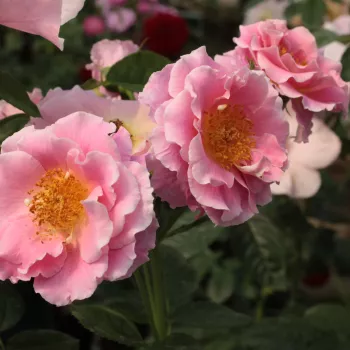
Very double, cup-shaped blooms with over 40 petals, typically borne singly; large flower size around 7–10 cm, remontant with notably abundant second flush following the main early summer flowering period. |
| Colour data and phenology |
Deep magenta-pink buds open purplish-pink, then fade to silvery lilac-pink with pastel edges; colour retention is moderate to weak, giving a multi-toned effect across the bush during the flowering season. |
| Fragrance and aroma |
Described as strongly and persistently scented, with long-lasting perfume on the blooms; detailed fragrance notes are not documented, but it is classed as a strongly fragrant ornamental climbing garden rose. |
| Hip characteristics |
Occasionally forms small round hips after flowering, generally 0–8 mm in diameter; hips are not a dominant ornamental feature and may be sparse, as the plant is primarily valued for repeat-flowering display. |
| Resistance and winter hardiness |
Hardy to approximately −26 to −23 °C (RHS H7, USDA 5b, Sweden Zone 4); disease resistance moderate to main foliar diseases, with some susceptibility possible, and noted drought tolerance once well established. |
| Horticultural recommendations |
Best on supports such as pergolas, arbours, fences or walls at 1,4–2,5 m spacing; medium maintenance with occasional plant protection and pruning; suitable for mass planting or specimen use in parks and gardens. |
TOROCKÓ – lilac-pink climbing rose - Márk offers fragrant, space-saving vertical colour, reliable drought-tolerant performance and the long-lived, easily renewed benefits of an own-root climber; consider it when planning a lasting coastal-style feature.