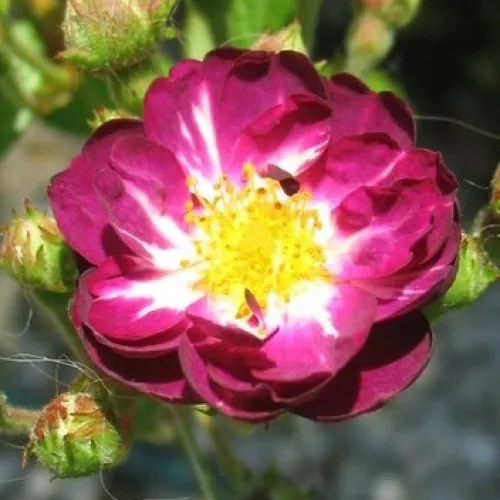
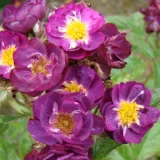
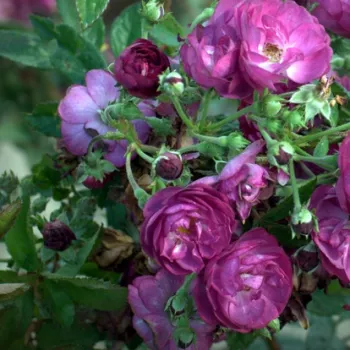
VIOLET HOOD – violet-purple park rose – Lens
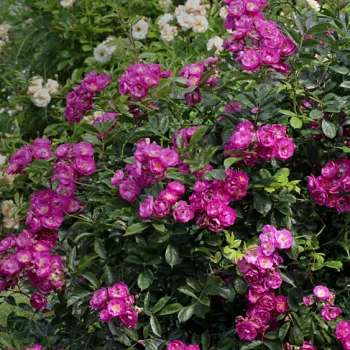
VIOLET HOOD brings a quietly dramatic sweep of purple colour to small and medium gardens, forming a compact, reliable shrub that suits family spaces and coastal verandas alike. Its semi-double blooms appear in generous waves from early summer into autumn, fading from velvety lavender to soft mauve without looking untidy, while neat red hips add seasonal interest. Planted in well-prepared soil it copes reassuringly with breezy, exposed conditions, providing calm structure and floral screening even where gardens face brisk, salt‑tinged sea winds. As an own-root shrub, it offers stability, regrowth after harsher winters, and a naturally long lifespan with no worry about suckers changing the flower colour. In a larger pot of at least 40–50 litres on a sunny terrace, it grows into a dense, sheltering hedge-like presence, especially effective alongside pale gravel, weathered timber and silvery foliage. Over time, it anchors itself strongly, settling into a low‑maintenance structure that suits both careful planners and relaxed, time-poor beginners. With moderate health and manageable care needs, it fits those who enjoy simple, seasonal tasks rather than constant spraying, giving you space to sit back and enjoy the salty, sunny mood.
Usage options
| Target area |
Reasoning |
| Coastal veranda container (40–50 L) |
The compact, upright habit stays in proportion to a substantial 40–50 litre container, creating a wind-filtering presence beside seating without overwhelming small terraces; it fits those who want structure and colour with limited fuss for coastal beginners. |
| Small family garden focal shrub |
Its medium height and rounded frame make a straightforward focal point in average-sized gardens, giving months of changing purple tones and autumn hips without demanding complex pruning, ideal for people seeking a single feature plant for busy homeowners. |
| Informal flowering hedge |
Planted at hedge spacing, VIOLET HOOD knits into a softly billowing line that marks boundaries while still letting light through, offering repeated flowering and seasonal berries with only light trimming, appealing to those favouring relaxed edges for family gardeners. |
| Mixed border with ornamental grasses |
Its muted, velvety mauve flowers and dark foliage sit comfortably among fountain grass and other airy perennials, providing a solid backbone that looks good even between flushes, suiting gardeners who want dependable structure around changing companions for design-conscious users. |
| Low-maintenance park or landscape strip |
In groups, the shrub’s steady growth and remontant flowering give a durable, medium-care solution for public or shared spaces, needing only periodic checks for common rose diseases, practical for those managing planting with limited time for occasional maintenance. |
| Coastal-style shingle bed |
Set into well-drained, improved pockets in shingle, it partners naturally with sea kale and low grasses, its strong root system helping it settle and provide colour and shelter even in breezy, exposed conditions, fitting gardeners recreating a shore mood for seaside lovers. |
| Wildlife-friendly family corner |
The semi-double blooms offer modest pollinator interest, then give way to small red hips that provide discreet autumn food for birds, making sense in gardens where ornamental value is balanced with gentle wildlife support for nature-friendly households. |
| Long-term own-root planting scheme |
Planted once and allowed to establish undisturbed, this own-root shrub gradually builds a resilient framework of roots in the first year and stronger top growth later, giving stable character with modest inputs, well suited to long-view planting for patient planners. |
Styling ideas
- Seaside Screen – line a veranda edge with VIOLET HOOD in large containers, underplant with trailing sea thrift to echo the coast – for coastal-style beginners seeking easy shelter and colour.
- Mauve Ribbon – create a loose hedge along a path, weaving in lavender and Festuca for contrast in texture and scent – for family gardeners wanting a soft, walk-through boundary.
- Twilight Accent – position a single shrub against pale gravel and driftwood features to make its dark purple blooms glow – for design-conscious owners of small town gardens.
- Grassland Drift – mix groups of VIOLET HOOD with fountain grass and calamint to form a breezy, low-care border – for those preferring movement, subtle colour and minimal upkeep.
- Hip Season – allow autumn hips to develop among New Zealand flax and other structural evergreens for winter interest – for nature-minded households who enjoy seasonal change.
Technical cultivar profile
| Property |
Data |
| Name and registration |
VIOLET HOOD – shrub rose, Hybrid Musk park type used in landscape and garden settings; ARS exhibition name Violet Hood, within the Park – shrub rose commercial grouping. |
| Origin and breeding |
Bred by Louis Lens, Belgium, from cross ‘Robin Hood’ × ‘Baby Faurax’; introduced and registered in 1975 by Lens Roses N.V. and Pépinières Louis Lens SA. |
| Awards and recognition |
Kortrijk International Rose Exhibition Silver Medal 1978, reflecting reliable garden performance and ornamental impact in formal assessment under Belgian conditions. |
| Growth and structural characteristics |
Compact shrub 90–140 cm tall, 50–80 cm wide, moderately thorny, with fairly dense, slightly glossy dark green foliage; forms a tidy, upright to bushy framework over several seasons. |
| Flower morphology |
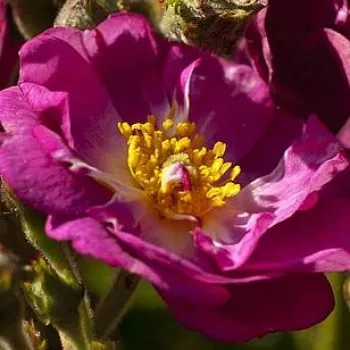
Semi-double, small flat blooms, typically 13–25 petals in well-formed clusters; remontant with a generous second flush, giving repeated flowering from early summer into autumn. |
| Colour data and phenology |
Deep purple buds open velvety lavender-purple (RHS 79A/B), then fade evenly to matte mauve with lighter edges and a brownish-mauve tone before petal fall; colour retention rated good. |
| Fragrance and aroma |
No noticeable scent; focus is on colour display and shrub effect rather than perfume, with partially pollinator-friendly semi-double flowers offering moderate stamen accessibility. |
| Hip characteristics |
After flowering, may set numerous small, spherical red hips 6–10 mm across, adding fine-textured autumn and early winter interest without overpowering the shrub’s outline. |
| Resistance and winter hardiness |
Medium overall disease resistance; powdery mildew and black spot medium, rust resistant; hardy to about −21 to −18 °C (RHS H7, USDA 6b), reliable in most UK regions. |
| Horticultural recommendations |
Best in a sunny position with well-drained soil; suitable for borders, hedging, specimens, containers and cutting; moderate maintenance with occasional health checks and formative pruning. |
VIOLET HOOD offers long-season purple blooms, compact structural form and dependable own-root longevity, making it a thoughtful choice if you want low-fuss colour that matures gracefully over the years.