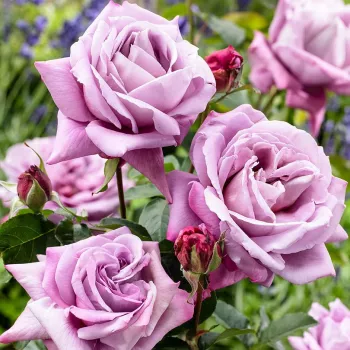
WALTZ TIME™ – mauve hybrid tea rose – Delbard-Chabert
Along a breezy veranda or small Cornish garden, WALTZ TIME™ settles in as a compact, bushy centrepiece that is surprisingly simple to live with in everyday family life. Its mauve blooms open one by one on neat stems, ideal for relaxed cutting for the table without stripping the plant bare. In a well-drained bed that copes calmly with strong coastal weather and steady windspray, this own-root rose builds a discreetly robust framework that suits low-fuss gardening. The first seasons are all about steady rooting and branching, then an increasingly generous wave of flowers appears as it gains confidence. With just occasional basic care, you can rely on a long, graceful lifespan and a consistently tidy look. In large 40–50 litre containers or narrow borders it anchors the planting with quietly romantic colour while asking little in return.
Usage options
| Target area | Reasoning |
|---|
| Small coastal front garden bed |
Its compact, bushy habit and moderate height make it easy to place near house fronts or driveways where space is tight, giving a long-lived focal point that does not overpower low walls or shingle. Ideal for beginners |
| Large container on a seaside veranda |
Performs well in a 40–50 litre pot where its upright stems carry elegant blooms at eye level, while the dense foliage helps it cope with exposed positions typical of upper-storey balconies. Suited to busy-owners |
| Relaxed “girly” seating corner |
The pastel mauve-pink flowers with a silvery sheen create a soft, feminine backdrop for a bistro set or bench, complemented beautifully by pale cushions and light fabrics for afternoon tea. Perfect for style-lovers |
| Cutting row or mixed cutting bed |
Long, straight, solitary blooms and good flower size make it a dependable choice for informal home bouquets, giving you repeat flushes for the vase without needing specialist techniques. A good match for home-florists |
| Feature rose in a small family lawn border |
Its own-root form builds stamina over the years, gradually forming a resilient framework that recovers well from knocks, ball games and the occasional pruning mistake typical of busy family gardens. Reassuring for families |
| Coastal-style shingle planting with grasses |
Works well in freely draining shingle mixed with clumps of Festuca and sea kale, where its upright shape reads clearly among fine textures and handles typical coastal breezes and light salt air. Attractive for coast-gardeners |
| Sunny terrace with restrained maintenance |
Needs only medium-level care and basic plant protection, so it fits a lifestyle where you can water and deadhead at weekends but prefer a rose that accepts small lapses without losing ornamental value. Suited to time-poor |
| Long-term specimen in a mixed perennial border |
As an own-root rose it establishes roots strongly in year one, builds shoots and structure in year two, then by year three offers its full flower and foliage effect with reliable repeat flushes. Ideal for planners |
Styling ideas
- Shingle Chic – Set WALTZ TIME™ in pale coastal gravel with sea kale and dwarf artemisia for a breezy, seaside feel – ideal for coastal-style enthusiasts
- Tea Corner – Place it beside a small table and pastel cushions so you can cut a few stems for a vase during relaxed afternoon breaks – perfect for veranda users
- Mauve Ribbon – Plant a low row along a lawn edge at 60 cm spacing to create a soft mauve border that stays neat yet romantic – suited to compact family gardens
- Balcony Jewel – Grow one plant in a 50 litre pot with trailing thyme at the rim to frame its blooms at eye level – appealing to flat and townhouse dwellers
- Pastel Partners – Combine with blue globe thistle and soft grasses for a muted, feminine palette that still looks structured in wind – attractive for low-maintenance planters
Technical cultivar profile
| Property | Data |
|---|
| Name and registration |
Hybrid tea rose; registered cultivar name DELtos, marketed as Waltz Time™ hybrid tea rose DELtos; American Rose Society exhibition name Saint-Exupéry. |
| Origin and breeding |
Bred by André Delbard-Chabert, France, 1961, for Georges Delbard SA; parentage (Christopher Stone × Marcelle Gret) × (Holstein × Bayadère [1951]). |
| Growth and structural characteristics |
Bushy habit, 85–120 cm high, 50–70 cm spread; moderately thorny with dense, dark green, slightly glossy foliage, forming a well-filled, upright small bush. |
| Flower morphology |
Large, double, solitary hybrid tea blooms, 26–39 petals, cupped form with medium height; remontant, giving a generous main flush followed by a strong second flowering. |
| Colour data and phenology |
Mauve-pink flowers with silvery-lilac sheen; ARS mau, RHS 75C outer and 75D inner; colour lightens to powdery lavender-pink and can fade slightly in strong sun. |
| Fragrance and aroma |
Mild, delicate rose fragrance with a subtle classic character; pleasant at close range but not overpowering, adding refinement without dominating nearby seating areas. |
| Hip characteristics |
Forms a small number of ovoid, egg-shaped hips, 10–14 mm diameter, coloured orange-red, adding discreet late-season interest if spent flowers are not removed. |
| Resistance and winter hardiness |
Hardy to about −21 to −18 °C (RHS H7, Swedish Zon 3, USDA 6b); moderate disease resistance and moderate heat and drought tolerance with watering in long dry spells. |
| Horticultural recommendations |
Best in sunny, well-drained soil; spacing 50–90 cm depending on use, 2.8–3.2 plants/m² in groups; maintenance medium, requiring occasional deadheading and plant protection. |
WALTZ TIME™ offers compact, elegant blooms for cutting, long-lived own-root reliability and a gentle maintenance level that suits relaxed coastal or family gardens, making it a thoughtful choice when refining your planting plans.