WILLIAM LOBB – deep purple historic moss rose - Laffay
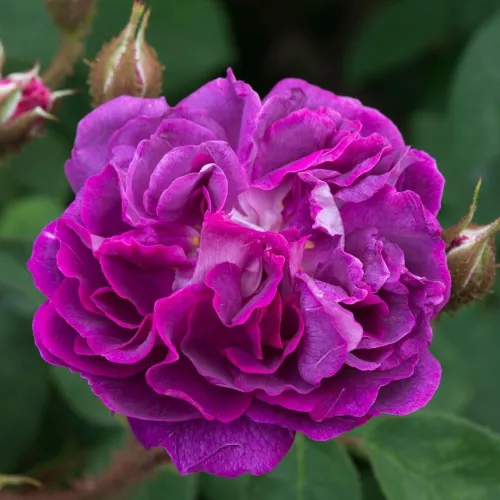
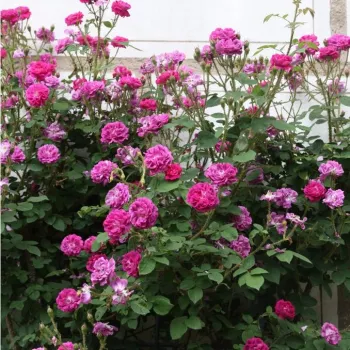
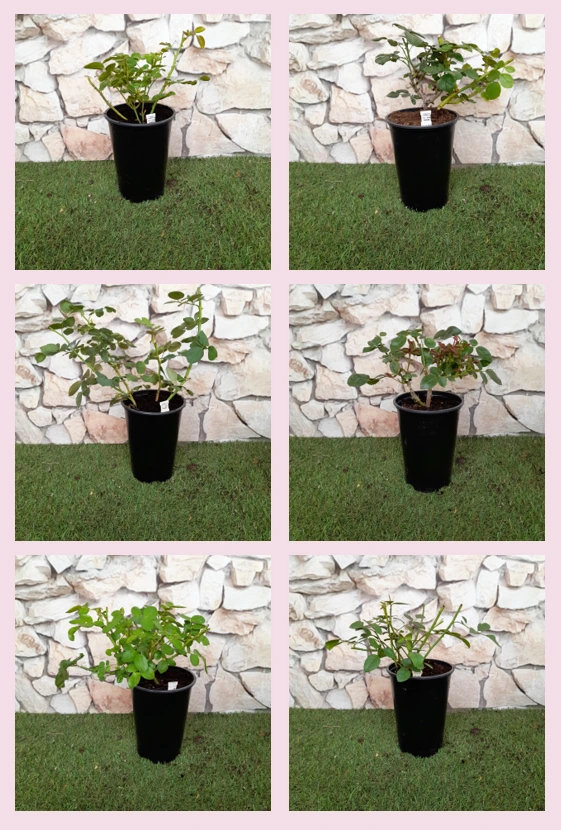
Imagine stepping onto your veranda after a breezy walk on the beach, sheltered by a screen of historic character and shimmering, deep purple blooms: William Lobb brings a mood of salty, windy, sunny refreshment to modest coastal gardens. This once-flowering moss rose forms an upright, slightly arching shrub that anchors itself securely, coping reliably with exposed sites where strong breezes and wet spells meet careful drainage and thoughtful watering. Over the seasons, its dark green foliage frames large rosette flowers that open from violet buds to smoky, silvery-mauve tones, backed by a rich, long-lasting fragrance ideal for evening tea outdoors. Delivered as a pharmaROSA® ORIGINAL own-root plant, it develops steadily — roots in the first year, stronger shoots in the second, then full ornamental value by the third — creating a long-lived, structurally dependable screen for shingle beds and coastal-inspired spaces. In containers of at least 40–50 litres or in the ground, this moss rose rewards simple, regular care with a uniquely atmospheric flowering moment that lingers in the garden’s memory.
Usage options
| Target area |
Reasoning |
| Small coastal veranda container (40–50 litres minimum) |
A large, deep container gives William Lobb the root room it needs to build a stable shrub while remaining manageable on a veranda. Once established, it forms a tall, upright presence with one impressive flush of strongly scented flowers for relaxed summer tea on a breezy deck, suiting beginners. |
| Shingle or gravel bed near the house |
Planted into well-prepared ground under shingle or gravel, this moss rose forms a structurally strong, upright shrub that copes well with blustery conditions when combined with good drainage, water management and firm anchoring. Its historic character and smoky colour palette flatter coastal-style planting for homeowners. |
| Feature rose in a small mixed border |
William Lobb’s once-a-year flowering creates a memorable seasonal highlight in a compact border, then its moderately dense, dark foliage continues to give structure for the rest of the year. Underplant with low grasses and perennials to soften the base and suit urbanites. |
| Informal flowering screen along a seating area |
Its 150–230 cm height and slightly arching habit allow you to form a loose, textural screen, softening fences or windward edges around a patio. The strong fragrance in full bloom adds sensory interest even in smaller gardens, rewarding patient families. |
| Historic-style rose bed for enthusiasts |
As a classic 1855 moss rose with RHS Award of Garden Merit, William Lobb suits gardeners who value authentic heritage forms and traditional shrub outlines. It works well as a focal point among other old roses, appealing to thoughtful collectors. |
| Partially shaded coastal side garden |
This variety tolerates partial shade, so it can be used where buildings or fences limit direct sun, provided the soil is improved and not waterlogged. The tall, upright framework still delivers a good display in these conditions for practical planners. |
| Low-input structural planting with seasonal impact |
Once established on its own roots, this shrub gives long-term structure with minimal replanting, even though it needs periodic deadheading and disease monitoring. In return, it offers many years of evocative midsummer bloom for time-pressed owners. |
| Rose and perennial combination bed |
Pair William Lobb with drought-aware companions such as sea kale, Festuca and lavender in free-draining soil so each plant copes better with wind and summer dry spells. Their contrasting textures and colours extend interest for design-conscious beginners. |
Styling ideas
- Veranda Screen – position in a 50–60 litre container beside a balustrade, combining with sea kale and silvery grasses for a sheltered, sea-breeze tea spot – ideal for coastal veranda owners
- Shingle Drift – plant into a gravel bed with Festuca and low lavender, letting the smoky purple blooms rise from a pale, beach-like surface – suited to coastal-style lovers
- Heritage Corner – use as a single specimen framed by old bricks, weathered pots and historic perennials to emphasise its 19th-century French origin – for romantic traditionalists
- Evening Nook – place near seating where the strong fragrance drifts through open windows on summer evenings, paired with pale anemones for contrast – perfect for scent-focused gardeners
- Mixed Border Spine – slot into a small mixed border as a tall, structural backbone, underplanted with coneflowers and airy annuals to prolong colour after flowering – great for busy beginners
Technical cultivar profile
| Parameter |
Data |
| Name and registration |
William Lobb is a historic moss rose from the Heritage rose collection, sold under the current trade name William Lobb – Laffay; unregistered as a modern cultivar but recognised in exhibitions. |
| Origin and breeding |
Bred by Jean Laffay in France and introduced in 1855, this moss rose descends from ‘Gloire des Mousseux’; precise parentage records are incomplete, as is typical for many historical shrub roses. |
| Awards and recognition |
Holder of the Royal Horticultural Society Award of Garden Merit since 1993, recognising reliable performance, ornamental value and garden usefulness under UK conditions when grown with appropriate care. |
| Growth and structural characteristics |
Forms an upright to slightly arching shrub 150–230 cm tall and 100–160 cm wide, with moderately dense, dark green foliage and heavy prickling, creating a strong, visually textured structural presence. |
| Flower morphology |
Large, double rosette blooms with 26–39 petals, borne mainly in clusters; once-flowering with a single, generous summer flush, weakly self-cleaning so spent flowers generally need manual deadheading for neatness. |
| Colour data and phenology |
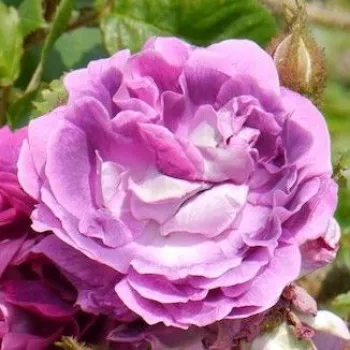
Closed buds are dark violet-purple; newly opened flowers deep crimson-purple, later maturing to smoky greyish-lilac with silvery centres, especially in sun; ARS code m, RHS 61B outer and 60B inner petals. |
| Fragrance and aroma |
Noted for a strong, full-bodied and lingering old-rose fragrance that intensifies in still evening air; scent is one of the main ornamental qualities, best appreciated near paths, doors or seating areas. |
| Hip characteristics |
Occasionally forms ovoid, red–orange hips 14–22 mm across; hips add modest late-season interest but are not produced in heavy quantities, varying with season, pruning approach and flowering success. |
| Resistance and winter hardiness |
Hardy to approximately −32 to −29 °C (RHS H7, USDA 4b, Swedish zone 5) but only medium resistance to mildew and black spot and very susceptible to rust, requiring regular monitoring and timely treatments. |
| Horticultural recommendations |
Best as a specimen or park shrub at 110–180 cm spacing; prefers fertile, well-drained soil, regular deadheading and proactive disease control; tolerates partial shade and moderate heat once well established. |
William Lobb offers richly fragrant, once-a-year purple flowering, strong structural height and long-lived own-root resilience; consider it if you wish to add a distinctive historic presence to your garden.